
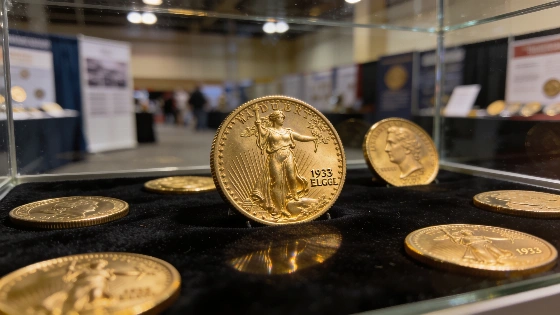
The 2026 ANA World's Fair of Money brought all 11 government-owned 1933 Double Eagles together for the first time, showcased shipwreck gold, and saw over $70 million in rare coin auctions, setting a new benchmark for numismatic events.
For the first time, all 11 government-owned 1933 Saint-Gaudens Double Eagles were displayed together, making the 2026 ANA World's Fair of Money in Pittsburgh a landmark event for collectors and historians. The United States Mint's decision to exhibit these coins side by side for one day on August 28 drew intense interest. The Double Eagle's history-marked by survival, government seizure, and decades of legal battles-has long captivated the numismatic world. According to a detailed review by NGC, this was the first occasion the U.S. Mint presented all 11 coins in a single session, confirming the event's unprecedented status in monetary history NGC Market Insights. The E-Sylum industry report also confirmed the Mint's unveiling of these ultra-rare and controversial coins, highlighting the event's significance for the numismatic community.
The Double Eagles were only part of a convention that expanded the scale and ambition of American numismatic gatherings. More than 6,300 attendees filled the David L. Lawrence Convention Center from August 25 to 29. The sold-out bourse featured 489 booths and over 1,430 rare coin and paper money dealers. The American Numismatic Association (ANA) organized a full schedule of educational seminars, competitive exhibits, and major auctions, while museum-quality displays brought together more than $100 million in coins, currency, and artifacts.
Historic coins and shipwreck treasures
The convention's centerpiece was the historic assembly of the 1933 Double Eagles, coins struck but never released for circulation after the U.S. government changed its gold policy during the Great Depression. Nearly the entire mintage of 445,500 coins was melted, leaving only a handful of survivors. The 11 coins on display remain federal property, with just one privately owned example authorized for private ownership-a specimen that previously sold for over $18 million, reflecting its unique legal status and the extraordinary demand for such rarities NGC Market Insights. Their appearance in Pittsburgh offered collectors a rare chance to see a complete set never before assembled, and the U.S. Mint's booth became the convention's focal point, as confirmed by NGC's event analysis.
Beyond the Double Eagles, the convention floor featured treasures from the S.S. Central America, the "Ship of Gold" that sank in 1857 with California Gold Rush bullion aboard. The exhibit included gold bars, coins, and personal artifacts recovered from the Atlantic seabed, along with scientific insights into the recovery process. The ANA described the Central America's loss as the greatest lost treasure in U.S. history, and the display provided a rare look at both the material and human stories behind the shipwreck.
Other museum exhibits ranged from ancient coins of the Achaemenid Persian Empire to the ANA's renowned Bebee Specimen 1913 Liberty Head Nickel. The Tyrants of the Golden Horn exhibition spanned 1,700 years of imperial coinage, while the Short Snorter Project connected numismatics with World War II aviation and Hollywood history, featuring a banknote signed by actor and combat aviator James "Jimmy" Stewart.
Auctions and market impact
Three major auctions anchored the financial side of the convention, with Stack's Bowers Galleries, Heritage Auctions, and Early Cents Auctions collectively reporting more than $70 million in sales. Stack's Bowers' September 1 Rarities Night session alone realized $26,305,945, while Heritage's ANA U.S. Coins Signature Auction reached $39,918,268, including the sale of the finest privately held Quintuple Stella from the Bob R. Simpson Collection. Early Cents Auctions contributed nearly $4 million with the Hall of Fame Collection of 1793-1814 Cents, highlighted by a 1793 S-1 R4 Chain AMERI. Cent graded PCGS AU55, considered the best of its die state outside the American Numismatic Society.
These results reflect the event's scale: five U.S. coins surpassed the seven-figure mark during Heritage's sales, and the combined auction total set a new record for the ANA's annual convention. The bourse was fully booked, showing strong demand for both classic rarities and modern collectibles. The surge in auction results comes as the Federal Reserve continues to monitor inflation and interest rate policy, with recent FOMC statements emphasizing price stability and the resilience of the U.S. dollar in global markets. The relationship between tangible assets like rare coins and broader monetary policy is increasingly relevant, as investors seek diversification amid fluctuating yields on U.S. Treasuries and ongoing currency volatility.
For context, the 2026 World's Fair of Money's auction results far exceeded typical annual coin show volumes, with over $70 million realized from just three headline sales. Attendance of more than 6,300 collectors and professionals also marked a significant turnout for a U.S. numismatic convention, reinforcing the market's resilience and the enduring appeal of physical currency as both collectible and historical artifact. The European Central Bank has also noted in its statistical bulletins that physical cash remains a vital part of the euro area's payment landscape, even as digital transactions expand ECB monthly statistical bulletin.
Education and community
Education remained central to the ANA's mission, with technical seminars on counterfeit detection and coin grading held before the show opened. Attendees could join Money Talks presentations and the Maynard Sundman/Littleton Coin Company Lecture Series, which this year explored 250 years of American numismatics. The ANA reported 116 participants for the Sundman lectures, reflecting steady interest in the historical and technical aspects of collecting.
Younger collectors were actively engaged. Ernie's Treasure Treehouse and Treasure Trivia drew nearly 200 children into hands-on activities, while the Young Collectors Corner offered introductory sessions on coin collecting. U.S. Mint Director Paul Hollis made a surprise appearance, and historic reenactors portraying Abraham Lincoln and George Washington mingled with attendees, blending American history with numismatic education.
Recognition for contributions to the field came through a series of awards, including the ANA Presidential Award, the Goodfellow Award, and the Louis S. Werner Host Club Award. The 135th Anniversary Banquet honored individuals such as Anthony Terranova, Bill Fivaz, Beth Deisher, Laura Sperber, and Jeff Garrett for their achievements in numismatics, while Jim Halperin and Andrew Shiva received the Philanthropy Award for expanding ANA membership and supporting educational outreach.
Special issues and international highlights
Convention-goers lined up for limited-edition collectibles, including 250 free copper commemorative coins distributed daily by Minted Assets. The 2026 issue, designed by the late Joel Iskowitz, became one of his final numismatic works. China's ANA Show Pandas returned with a one-year design tied to Pittsburgh landmarks, available exclusively through GOVMINT.
World Coin News presented the 2026 Coin of the Year awards during the event, with China's silver 10 yuan Chinese Dragon winning both the overall honor and Best Crown Coin category. This was the first time China captured the top award, with the Shenzhen Guobao Mint producing the coin for the People's Bank of China. The People's Bank of China, as the nation's central bank, continues to manage the renminbi's exchange rate and support the internationalization of the Chinese currency, as highlighted in recent IMF country reports.
The Edward C. Rochette Money Museum used the convention to launch its Worth Its Weight podcast, debuting with a live recording featuring leading figures in the field. The ANA now releases new episodes twice weekly, expanding its educational reach beyond the convention floor.
For those following the changing landscape of coin collecting, the intersection of tradition and technology is a recurring theme. As reported earlier, the numismatic world is adapting to digital grading and evolving patterns of cash use, raising questions about how physical coins will retain their relevance in a rapidly digitizing economy.
Looking ahead
With the 2026 World's Fair of Money concluded, the ANA is already preparing for its next national events: the 2027 National Money Show in Virginia Beach and the World's Fair of Money's return to Rosemont, Illinois. For many, however, the Pittsburgh convention set a new standard. In just five days, attendees could view the full set of government-owned 1933 Double Eagles, examine shipwreck gold, study centuries of coinage, and witness record-breaking auctions-all under one roof.
The 2026 ANA World's Fair of Money showed that, even as digital payments and virtual assets reshape the financial landscape, the tangible history and artistry of coins continue to attract attention and investment. The event's mix of education, market activity, and historical spectacle reinforced the enduring value of physical currency as both a collectible and a record of economic history. The Federal Reserve, European Central Bank, and People's Bank of China all continue to monitor the evolving role of cash and collectibles in the context of monetary policy, inflation, and exchange rate management.
The 1933 Double Eagle is a $20 gold coin designed by Augustus Saint-Gaudens and struck at the Philadelphia Mint. Although 445,500 pieces were produced in 1933, nearly all were melted after the U.S. government ended the gold standard for domestic currency. Only a small number survived, and legal disputes over their ownership have made them among the world's most famous and valuable coins. Today, only one example is privately owned with government authorization, while the rest remain federal property. The Double Eagle's story illustrates how changes in monetary policy can transform everyday objects into rare historical artifacts.