Two experimental 1912 Buffalo nickel electrotypes, created by James Earle Fraser to convince U.S. Treasury officials of his design, have resurfaced and will be offered at auction in 2026, providing a unique glimpse into American coin history
Before the Buffalo nickel became a fixture of American coinage, its creator, James Earle Fraser, faced the challenge of persuading U.S. Treasury officials to approve his unconventional design. Rather than waiting for the United States Mint to produce traditional pattern coins, Fraser commissioned the Medallic Art Company to create coin-sized electrotypes-thin metal shells based on his early models. These experimental pieces allowed officials to physically examine the proposed nickel, accelerating the design process and bypassing the delays of Mint production. Over a century later, two of these rare 1912 electrotrials have reemerged and are set to be auctioned as a pair in 2026.
Electrotypes as a Creative Shortcut
The two electrotrials, produced in 1912, were never intended for circulation. Instead, they served as tangible prototypes, demonstrating how Fraser's larger sculptural models would translate to actual coin size. According to numismatic research, the Medallic Art Company reduced Fraser's sketches and formed thin shells, which were then reinforced and plated to mimic the appearance of nickel. This approach allowed Fraser to present a convincing vision of his design to Treasury Secretary Franklin MacVeagh and Mint Director George E. Roberts, keeping the project moving while the final models were refined. The electrotypes effectively replaced the need for struck Mint patterns at this early stage, capturing the Buffalo nickel's evolution as a work in progress.
The obverse electrotrial, catalogued as Judd-1912-1, weighs 4.0 grams and features a Native American portrait that closely resembles the final 1913 coin, though with smaller date numerals and the absence of Fraser's designer initial. The reverse, Judd-1912-2, weighs 4.096 grams and depicts an American bison, but with notable differences: smaller lettering for "FIVE CENTS," hyphens instead of periods in "UNITED STATES OF AMERICA," and unusually small "E PLURIBUS UNUM." These details highlight the experimental nature of the pieces and provide insight into Fraser's design decisions before the coin's official release.
From Studio to Auction Block
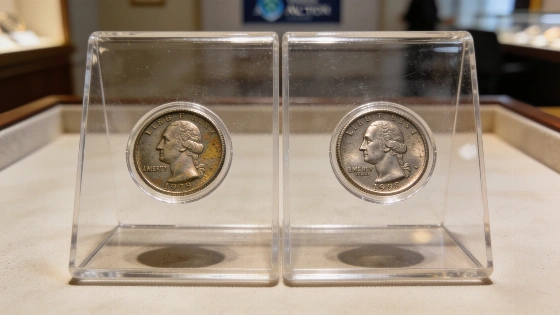
The provenance of these electrotrials is unusually strong. Both pieces trace directly to the estates of James Earle Fraser and his wife, sculptor Laura Gardin Fraser, before being sold in the 1981 William R. Sieck Collection auction and again in 1988. Now certified MS-64 by PCGS and housed together in a double-size holder, the electrotrials retain their deep pewter-gray surfaces, a finish intended to resemble the nickel alloy of circulating coins. Their journey from Fraser's studio to the auction room underscores their role as both artistic prototypes and historical artifacts.
Stack's Bowers Galleries will offer the pair as Lot 2048 during its Summer 2026 Global Showcase Auction Rarities Night session on September 1. For advanced collectors, the direct link to Fraser's estate and the pieces' role in the Buffalo nickel's development make them especially significant. The Buffalo nickel itself entered production in 1913, featuring a Native American on the obverse and a bison on the reverse, and remained in circulation until 1938. The original Type I reverse, with the bison standing on a raised mound, was modified within the first year to protect the denomination, resulting in the Type II design.
Historical Context and Collector Impact
Electrotypes like these are more than mere patterns; they document the creative and political process behind one of America's most recognizable coins. They show Fraser experimenting with portrait details, lettering, and layout at a time when the Liberty Head nickel had dominated U.S. five-cent pieces since 1883. The Buffalo nickel's introduction marked a dramatic departure, and Fraser's electrotrials played a key role in convincing officials to embrace this new direction. The pieces also reflect the broader context of early 20th-century American coinage, when artists and officials debated the balance between artistry and practicality.
For collectors and historians, the 1912 Buffalo nickel electrotrials offer a rare window into the design's evolution. Their survival, direct provenance, and upcoming auction highlight the intersection of numismatic artistry and institutional decision-making. The story of these electrotypes echoes other moments in U.S. coin history, such as the unique circumstances surrounding the 1887 Liberty Head Half Eagle, which was struck only in Proof format and remains a subject of collector fascination-see the detailed exploration in this analysis of the 1887 Half Eagle's origins and rarity.
When the Buffalo nickel was released in 1913, it weighed 5.0 grams, measured about 21.2 mm in diameter, and was composed of 75% copper and 25% nickel. Production began at the Philadelphia Mint on February 17, 1913. The design faced resistance from the Hobbs Manufacturing Company, which produced anti-counterfeiting devices for vending machines, leading to months of negotiation before the coin's public debut. Despite these challenges, the Buffalo nickel became a defining symbol of American coinage, with its design enduring for a quarter-century.
Electrotypes, or electrotrials, are a form of early coin prototype created by electroforming-a process that deposits metal onto a mold to produce a thin shell. Unlike struck coins, which are made by impressing designs into metal blanks with dies, electrotypes are assembled from shells and reinforced with additional metal. This method allowed artists like Fraser to present near-final designs without the need for Mint equipment or formal approval. Electrotypes played a crucial role in the development of several U.S. coins, offering a practical way to test and refine designs before committing to full-scale production. Their survival provides valuable evidence of the creative and institutional processes that shape national currency.