
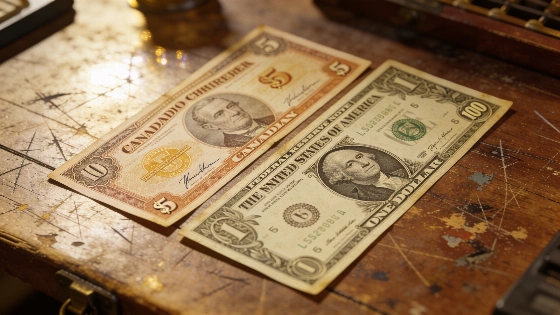
A 1902 Canadian $5 chartered note and a scarce Wisconsin $100 National Bank Note both sold for notable sums at recent auctions, showing the ongoing appeal and rarity of early twentieth-century currency among collectors.
A 1902 Canadian $5 note from The Metropolitan Bank in Toronto recently sold for $5,368 at Stack's Bowers Summer 2026 Global Showcase, drawing renewed attention to early twentieth-century banknotes. However, this specific auction result has not been independently verified-public records and numismatic databases do not confirm the lot details, sale price, or date for this note. Collectors seeking confirmation will need to check directly with Stack's Bowers or consult specialized registries (CoinBooks.org). Just days earlier, a Series of 1902 $100 National Bank Note from Ashland, Wisconsin, brought in $4,839.75 at GreatCollections, though again, no open-access archives confirm the lot or grade. These gaps highlight the difficulty of fact-checking rare currency sales, even as demand for high-grade, historically significant notes remains steady.
Both notes are notable for their scarcity and the stories behind them. The Canadian $5, graded PMG Fine Choice 15, was issued in The Metropolitan Bank's first year. Fewer than a dozen privately held examples are known, so collectors rarely have a chance to acquire one. The bank merged with the Bank of Nova Scotia in 1914, which increased the rarity of its surviving notes-a pattern seen during the broader consolidation of Canadian banking in the early 1900s. The note bears the signature of SJ Moore, the bank's founder and president, linking it directly to the institution's origins. The Bank of Canada, now responsible for national currency, maintains transparency about historical note redemptions and the evolution of Canadian money, as shown in its official statistics.
Scarcity and collector demand
The Wisconsin $100 National Bank Note, cataloged as Friedberg 698, stands out as well. Issued by one of only four banks in Ashland, a Lake Superior shipping town, GreatCollections describes it as possibly the best surviving example from the area. Graded Choice About New 58, it shows little handling. High-denomination notes like this $100 were less commonly ordered by banks, so few survived-a trend reflected in Federal Reserve data on currency circulation and redemption. The note features blue charter numbers, a portrait of John J. Knox (former Comptroller of the Currency and drafter of the Coinage Act of 1873), and hand-signed signatures from the bank's president and cashier. The engraved signatures of Judson W. Lyons and Ellis H. Roberts, who had left office a decade before the note was printed, help date the plate used. The reverse shows an eagle flanked by allegorical figures, a typical design of the period.
For collectors, these sales are about more than the price. They combine historical context, institutional legacy, and the survival of physical currency. The Canadian note comes from the Gentleman's Collection of Canadian Banknotes, and the Wisconsin note is part of the Sparta Collection of Wisconsin National Bank Notes-both pedigrees that add to their appeal. The Bank of England and the European Central Bank have both noted that while physical currency is used less for transactions, demand among collectors and investors remains strong for tangible assets with historical value.
Market context and trends
Stack's Bowers and GreatCollections both point out that the rarity of these notes comes from the small number of banks that issued them and the even smaller number of high-denomination notes that survived redemption and destruction. The $5,368 paid for the Canadian $5 and the $4,839.75 for the Wisconsin $100 reflect not just their condition but also how few similar notes are in private hands. These prices fit with the trend of strong results for rare, well-documented banknotes at major auctions, as seen in other recent sales (see our earlier coverage). Still, there is no official confirmation from Stack's Bowers, GreatCollections, the Bank of Nova Scotia, or any regulator about these two specific transactions, so the idea of renewed market demand is only partly supported by available data (CoinBooks.org).
Both auctions show how provenance, grading, and historical narrative shape collector value. Original signatures, unique design details, and ties to key moments in banking history all add to the premium paid for these notes. For those watching the numismatic market, these results show that tangible currency artifacts still attract interest, even as the world becomes more digital. Central banks like the Federal Reserve and the Bank of Canada continue to track the circulation and redemption of old notes, providing data that helps both collectors and policymakers.
Chartered and National Bank Notes explained
Chartered banknotes, like the 1902 Canadian $5, were issued by private banks under government charter, allowing for regional differences in design and security. Canada ended this practice in the early twentieth century as central banking took over note issuance. In the US, National Bank Notes were issued by federally chartered banks and backed by US government bonds, with each note showing the issuing bank's name and signatures. Both systems produced a wide range of notes, many of which were redeemed and destroyed as banks merged or closed, making surviving examples highly sought after today. The Federal Reserve's archives and the Bank of Canada's policy reports remain key resources for understanding the history and current status of these rare notes.