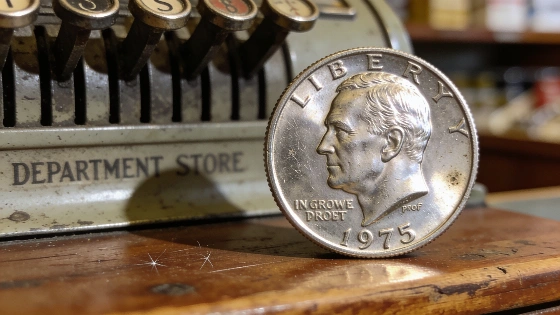
A 1976 Eisenhower Dollar with no mintmark and a silver proof finish surfaced in a Washington department store cash register. Its unexplained origin and unique features have pushed its value close to $1 million
One Eisenhower Dollar, found not in a vault or a collector's safe but in the till of a Washington, D.C. department store, now stands as the most enigmatic and valuable modern US coin. This 1976 No S silver proof dollar, with a face value of just one dollar, has been valued by specialists at nearly $1 million. Its existence defies official Mint records and numismatic logic, making it a singular outlier in American currency history.
Unlike the mass-produced Bicentennial coins that flooded the US in the 1970s, this coin should not exist. It combines a proof strike, a 40% silver composition, and the refined Type 2 Bicentennial reverse-yet it lacks the "S" mintmark that should identify it as a San Francisco proof. Only one such coin has ever been authenticated, and its journey from the US Mint to a department store cash register remains unsolved nearly fifty years later.
The Coin That Should Not Exist
To understand why this Eisenhower Dollar is so extraordinary, it helps to know what was supposed to happen. In 1976, the US Mint celebrated the nation's 200th birthday by issuing special Bicentennial designs for the quarter, half dollar, and dollar. The Eisenhower Dollar's reverse, designed by Dennis R. Williams, paired the Liberty Bell with the Moon-a nod to both the nation's founding and its space-age ambitions. Proof coins with 40% silver content were struck for collectors, always at the San Francisco Mint and always with an "S" mintmark. Circulating coins from Philadelphia had no mintmark but were made of base metal, not silver, and were not struck as proofs.
The unique coin in question breaks every rule. It is a proof, it is silver, it has the Type 2 reverse with thin, serifed lettering, and it has no mintmark. According to PCGS, the leading coin grading service, no official documentation explains how such a coin could have been produced. The Mint's own records show that early Philadelphia trial strikes lacked the "S" but used the Type 1 reverse, not the Type 2. The only plausible explanations are either an undocumented trial strike by Chief Engraver Frank Gasparro or a special presentation piece ordered by Mint Director Mary Brooks-yet neither theory is supported by surviving Mint paperwork.
Discovery in Everyday Commerce
The coin's path into the public eye is as improbable as its creation. In 1977, an employee at Woodward & Lothrop, a well-known Washington department store, reportedly found the coin in a cash register. The location-just blocks from the federal government-has fueled speculation that the coin may have been spent by a government official or someone with privileged access to Mint products. After its discovery, the coin was tested and authenticated as a genuine 40% silver proof dollar, not a post-Mint alteration or counterfeit.
Most Eisenhower Dollars without a mintmark are common Philadelphia issues, worth little more than face value. The difference here is in the details: proof finish, silver content, and the Type 2 reverse. A standard Philadelphia Bicentennial dollar weighs about 22.68 grams, while the 40% silver version comes in at roughly 24.59 grams. The unique coin matches the latter, confirming its silver composition. This combination of features is not found in any other known Eisenhower Dollar.
Market Value and Collector Impact
The coin's commercial history is as remarkable as its physical characteristics. First sold in 1982 for $5,000, it changed hands among prominent dealers before being certified by both NGC and PCGS, eventually achieving a PR66CAM grade. Its last major public auction appearance was in 2002, when it sold for $41,400. Since then, estimates of its value have climbed steadily, with PCGS listing it at nearly $1 million and some market observers suggesting it could fetch even more if offered today. The coin remains in private hands, its whereabouts known only to a select few in the numismatic world.
For context, the US Mint produced over 117 million Bicentennial Eisenhower Dollars at Philadelphia during 1975-76, all without a mintmark. Yet none share the proof strike, silver content, and Type 2 reverse of the unique No S coin. This is not a case of a missing mintmark error on a common coin; it is a one-off anomaly with no documented precedent.
Unanswered Questions and Enduring Mystery
How did a coin with no official production record, combining features never meant to coexist, escape the Mint and enter everyday commerce? Theories abound, but none are conclusive. Some believe it was a trial piece struck to test the new reverse design on silver planchets. Others suspect it was created for a high-level presentation and accidentally spent. The lack of documentation leaves the coin's true origin open to debate, adding to its allure among collectors and historians.
Numismatic rarities often emerge from estate collections, bank vaults, or old hoards. This Eisenhower Dollar's journey-from a possible government handoff to a department store till-defies that pattern. Its story echoes the unpredictable fate of other US coins, such as the earlier breakdown of the US Trade Dollar, which also saw a coin designed for one purpose end up in unexpected places.
As the United States approaches its 250th anniversary, the 1976 No S Eisenhower Dollar stands as a reminder that even in an era of mass production, true monetary anomalies can still surface in the most ordinary settings. The coin's unique status, unexplained origin, and improbable discovery have made it a benchmark for modern US coin collecting-one that blurs the line between classic and contemporary rarity.
While the Eisenhower Dollar was intended as a democratic symbol-millions of Americans could hold a piece of the Bicentennial-this single coin has become the ultimate outlier. Its value is not just monetary but historical, representing a collision of Mint policy, production error, and sheer chance. Until new evidence emerges, the 1976 No S silver proof Eisenhower Dollar remains a singular enigma, its story as compelling as any in the annals of American currency.
The distinction between proof and business-strike coins is central to understanding modern US coinage. Proof coins are struck with specially prepared dies and planchets, resulting in a mirror-like finish and sharp details, and are intended for collectors rather than circulation. Business strikes, by contrast, are produced for everyday use and lack the same level of finish. The presence or absence of a mintmark, the coin's composition, and the reverse design all serve as identifiers for collectors and researchers. In rare cases, as with the 1976 No S Eisenhower Dollar, these identifiers can combine in ways that defy official records, creating a unique object whose value is determined as much by its mystery as by its metal content.