
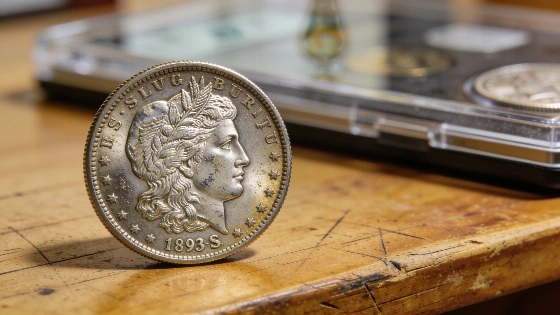
A legendary 1893-S Morgan Silver Dollar with a storied pedigree has set a new MS65 auction record, selling for $1,181,250-over 50% above its price guide value. The sale highlights the fierce demand for top-condition U.S. coin rarities.
The market for elite U.S. coins has a new benchmark: the Clapp-Eliasberg 1893-S Morgan Silver Dollar, graded MS65 by PCGS and approved by CAC, has sold for $1,181,250 at a GreatCollections auction. This result not only shatters the previous MS65 record for this key date but also lands more than 50% above the $775,000 PCGS Price Guide value for the grade. For collectors, this is not just a headline-it's a signal that the appetite for condition rarities with historic pedigrees is intensifying.
Competition for the coin was fierce. GreatCollections reported over 14,000 page views and 433 registered trackers for the lot, with 101 bids placed before the hammer fell. The winning bidder, based in the Midwest, took possession of the coin at the American Numismatic Association's 2026 World's Fair of Money in Pittsburgh, where GreatCollections served as the official auctioneer. The coin was offered without reserve, underscoring the confidence in its market appeal.
The Making of a Trophy Coin
What sets the 1893-S Morgan Dollar apart is a combination of scarcity, condition, and provenance. The San Francisco Mint struck just 100,000 business-strike examples in January 1893-the lowest mintage of any Morgan dollar. The timing was disastrous for silver coinage: the Panic of 1893 triggered a wave of bank failures and economic contraction, sharply curtailing silver dollar production. Most 1893-S dollars entered circulation, and many were later melted under the Pittman Act of 1918. Surviving records do not specify how many 1893-S coins were destroyed, but estimates suggest tens of thousands may have vanished in the melting pots.
Today, PCGS estimates that fewer than 10,000 1893-S Morgan dollars survive in all grades, but Mint State coins are a different story. Only 123 are believed to exist in MS60 or better, and the MS65 population may be as low as six or seven coins. This extreme rarity in high grade is why the 1893-S is often called the "King of the Morgan Dollars."
Pedigree and Provenance: A Coin's Journey
The Clapp-Eliasberg specimen's pedigree is as storied as its condition. Its documented history begins with Philadelphia dealer J. Colvin Randall in 1893, followed by acquisition by John M. Clapp in 1894. The coin remained with the Clapp family for nearly 50 years before legendary collector Louis E. Eliasberg Sr. purchased the entire Clapp Collection in 1942. Eliasberg's collection is still recognized as the only complete set of U.S. coins by date and mintmark ever assembled. After decades in Eliasberg's hands, the 1893-S passed through the Stellar, Sunnywood, Simpson, and Wizard of Oz collections, before returning to the U.S. market in 2026. Its selection as the plate coin for the 1893-S in '100 Greatest U.S. Coins' further cements its status among the elite.
For context, another PCGS MS65 1893-S with CAC approval sold for $600,000 in November 2020. The new $1.18 million result nearly doubles that figure. Only the Vermeule-Jack Lee-Coronet 1893-S, graded MS67, has fetched more-$2,086,875 at auction in 2021, making it the first Morgan dollar to cross the $2 million threshold.
Demand for Condition Rarities Intensifies
Why do collectors chase these coins so aggressively? The Morgan dollar series is one of the most widely collected in the United States, and the 1893-S is its undisputed key date. Circulated examples can be found with patience and resources, but Mint State coins-especially those with Gem certification and a blue-chip pedigree-are almost never available. The Clapp-Eliasberg coin's originality and luster have been singled out by specialists as among the finest known, adding another layer of desirability.
GreatCollections, founded by Ian Russell in 2010, has auctioned more than 1.8 million certified coins with a combined value exceeding $1.5 billion. The firm continues to seek major rarities for future sales and invites collectors to submit want lists or consignments. The company's role as the ANA's official auctioneer further cements its influence in the high-end U.S. coin market.
Facts and Figures: The 1893-S Morgan Dollar
The 1893-S Morgan Dollar was struck at the San Francisco Mint with a mintage of 100,000 coins. Composed of 90% silver and 10% copper, each coin weighs 26.73 grams and contains 0.77344 troy ounces of silver. PCGS estimates only 123 Mint State examples survive, with as few as 6-7 in MS65 or better. The $1,181,250 auction price is 52% above the PCGS Price Guide value for MS65 and nearly double the previous MS65 auction record set in 2020.
Pedigree is not just a matter of pride for collectors-it's a tangible link to numismatic history. The Clapp-Eliasberg coin's journey through the hands of legendary collectors mirrors the way other rare coins, such as those from Zaire's Katanga region, have become symbols of both monetary policy and personal ambition, as explored in our earlier breakdown.
Understanding Condition Rarity in U.S. Coins
Condition rarity refers to the scarcity of coins in high grades, regardless of their original mintage. For the 1893-S Morgan Dollar, the combination of low production, heavy circulation, and subsequent melting means that Gem Mint State coins are almost never encountered. This is distinct from absolute rarity, which counts total surviving examples. In the world of U.S. numismatics, condition rarities like the 1893-S in MS65 or better command extraordinary premiums because they represent the pinnacle of what is possible for a given issue. Collectors and investors alike are willing to pay far above price guide levels for coins that combine technical quality with historic provenance.