
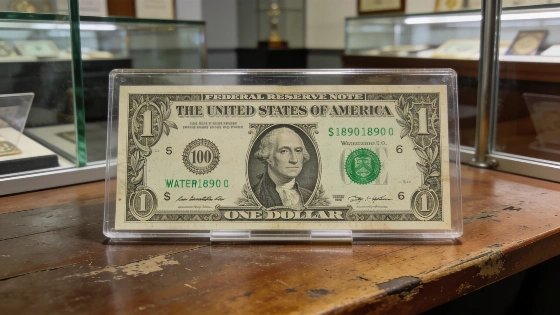
The 1890 $100 Watermelon Treasury Note, famed for its distinctive design and Civil War connection, will be auctioned on October 4, 2026. With only about 35 known survivors, this note remains a highlight of American currency collecting.
One of the most sought-after pieces in American currency history, the 1890 $100 Watermelon Treasury Note, is set to return to the auction spotlight this October. Known for its striking design and extreme rarity, the note will be offered by GreatCollections on October 4, 2026, at 7:11:50 p.m. Pacific Time. The example up for sale, graded PMG Very Fine 20 with a Restoration notation, comes from the Schwenk Family Collection, which is dedicated to the 100 Greatest American Currency Notes.
Design, Rarity, and Historical Context
The Watermelon Note stands out for more than its scarcity. Its face features a portrait of Admiral David Glasgow Farragut, a celebrated Civil War naval leader, alongside ornate floral engravings and a prominent brown Treasury Seal. The note's nickname comes from the reverse, where two large green zeros in the "100" denomination resemble watermelons-a feature that has made the note instantly recognizable among collectors.
Issued under the Sherman Silver Purchase Act of July 14, 1890, the $100 Treasury Note was part of a monetary experiment during a period of intense debate over silver and gold standards in the United States. Unlike Silver Certificates, Treasury Notes could be redeemed in either gold or silver coin at the discretion of the Treasury secretary, and they carried full legal-tender status. This flexibility reflected the political and economic uncertainty of the era, as the U.S. government sought to balance competing interests in its monetary system.
Survival Rates and Auction Records
Of the 120,000 Series 1890 $100 Treasury Notes originally printed, only about 35 are known to survive today, according to census data from Heritage and Track & Price. Seven or eight of these are held in institutional collections, leaving fewer than 30 potentially available to private collectors. This translates to a survival rate of roughly 0.03%, making even circulated examples highly desirable.
Recent auction results highlight the note's appeal and the impact of condition on value. In September 2024, a PMG Very Fine 20 Watermelon Note with restoration sold for $114,000. Higher-grade examples have commanded even stronger prices: a PMG Very Fine 30 brought $228,000 in May 2024, and a Choice Uncirculated 63 EPQ-the finest graded-realized $372,000 in March 2020. Each note's price reflects a combination of grade, originality, restoration, margins, color, and provenance, making direct comparisons challenging.
Legacy and Collector Interest
The Watermelon Note's reputation is further enhanced by its association with the even rarer $1,000 Grand Watermelon Treasury Note, which has achieved multi-million-dollar prices at auction. While the $100 Watermelon is more accessible, it remains a trophy for advanced collectors. The note's unique blend of artistry, historical significance, and scarcity ensures its continued status as an icon of American paper money.
For collectors and historians, the Watermelon Note is more than a curiosity. It encapsulates a pivotal moment in U.S. monetary history, linking the legacy of Admiral Farragut and the Civil War to the nation's evolving approach to currency and precious metals. The note's short-lived design-abandoned after just one series in favor of a more open reverse-adds to its mystique and desirability.
Specifications and Notable Details
The 1890 $100 Watermelon Treasury Note (Friedberg 377) was printed by the Bureau of Engraving and Printing and authorized by the Act of July 14, 1890. It measures approximately 7.8 × 18.8 cm (about 3 1/16 × 7 13/32 inches). The note features the signatures of William Starke Rosecrans (Register of the Treasury) and James Nelson Huston (Treasurer of the United States). The Schwenk Family example, certified as PMG Very Fine 20 with Restoration (certification number 1998552-001), will be the centerpiece of the upcoming auction.
The Watermelon Note's enduring appeal is matched by other legendary U.S. rarities. For example, the 1879 Liberty Head Quintuple Stella gold coin, with only five known examples, is another highlight of American numismatics and will also be offered at auction in 2026. Details on that coin's unique status can be found in this feature on the 1879 Quintuple Stella.
The Watermelon Note's story illustrates how design, policy, and history converge in the world of currency collecting. Its survival against the odds, combined with its instantly recognizable reverse, ensures that each appearance at auction draws international attention from collectors and historians alike.
While the Watermelon Note is celebrated for its visual impact, its deeper significance lies in its role as a product of the Sherman Silver Purchase Act and the monetary debates of the late 19th century. Treasury Notes like this one were issued to support silver purchases and could be redeemed in either gold or silver, reflecting the uncertainty and compromise of the era's currency policy. The rapid withdrawal of the Watermelon design after just one series underscores how quickly monetary priorities and banknote aesthetics can shift in response to changing economic and political pressures.