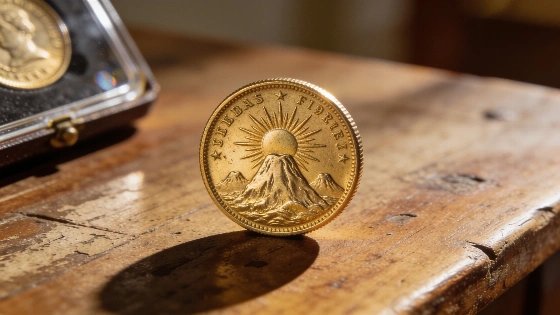
A gold 8 Escudos coin from Costa Rica's brief federal era will be auctioned in 2026, with experts estimating its value at up to $300,000. The coin's design reflects a pivotal moment in Central American monetary history.
One of the finest surviving examples of the 1828 Costa Rica 8 Escudos gold coin is set to be auctioned in August 2026, drawing attention from collectors and historians alike. The coin, minted during a short-lived period of Central American unity, is expected to fetch between $200,000 and $300,000 according to Stack's Bowers Galleries, which will offer the piece as Lot 40168 in its Summer 2026 Global Showcase Auction in Costa Mesa, California.
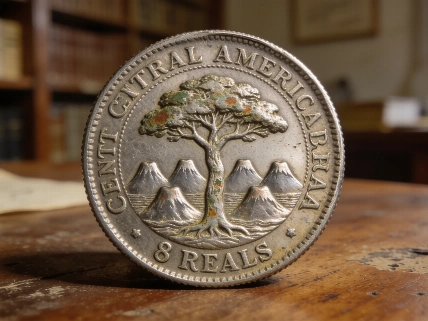
The coin's obverse features a golden sun with a human face above five volcanoes, while the reverse displays a prominent tree flanked by the denomination. These motifs were chosen to symbolize the new political order that emerged in Central America after independence from Spain, marking a deliberate break from colonial imagery.
Origins in a Revolutionary Era
The 1828 Costa Rica 8 Escudos was issued under the Federal Republic of Central America, a federation formed in 1823 by Costa Rica, Guatemala, El Salvador, Honduras, and Nicaragua. The union sought to establish a republican identity distinct from Spanish rule, and its coinage reflected this ambition. A law passed in March 1824 banned royal symbols, replacing them with republican designs such as the sun, volcanoes, and the motto "LIBRE CRESCA FECUNDO"-commonly translated as "May it grow free and fruitful."
The San José Mint produced only 5,302 examples of the 1828 8 Escudos, making it the first and rarest date in a short series. The coin weighs 27 grams, measures 35 millimeters in diameter, and is struck in .875 fine gold (21 karats). The mintmark "CR" identifies Costa Rica, while the assayer's initial "F" refers to Félix Mora, who oversaw the coin's production.
Condition and Collector Demand
Many surviving 1828 8 Escudos coins show signs of wear, weak strikes, or later damage. The example offered in 2026 stands out for its sharp detail and original mint luster, earning a high grade of NGC MS-63+. This level of preservation is rare for early Costa Rican gold coins, where most pieces entered circulation or suffered from cleaning and mounting.
Market data shows that condition is a key driver of value for this type. In August 2025, Heritage Auctions sold another NGC MS-63+ example for $240,000, setting a record for any Costa Rican coin at auction. Lower-grade or circulated examples have sold for significantly less, with a similar grade realizing $90,000 in January 2021. The combination of low mintage, historical significance, and exceptional preservation positions the 1828 8 Escudos as a trophy piece for advanced collectors.
Specifications and Historical Context
The 1828 Costa Rica 8 Escudos was the largest regular gold coin of the federal monetary system, known as the onza. Its design elements-five volcanoes for the member states, a radiant sun, and a tree of liberty-were intended as a visual manifesto for the new republic. The coin's inscription "21 Qs" confirms its gold fineness, matching published standards for the type.
Key specifications include:
- Issuer: Federal Republic of Central America
- State: Costa Rica
- Denomination: 8 Escudos
- Date: 1828
- Mint: San José Mint
- Mintmark: CR
- Assayer: Félix Mora ("F")
- Composition: Gold, .875 fine (21 karats)
- Weight: 27 grams
- Diameter: 35 mm
- Actual gold weight: approx. 0.7596 troy ounce
- Mintage: 5,302
- Grade: NGC MS-63+
- Auction: Stack's Bowers Summer 2026 Global Showcase Auction, Lot 40168
- Estimate: $200,000-$300,000
The Federal Republic of Central America dissolved between 1838 and 1840 amid civil conflict and political division, but its coinage remains a tangible record of the era's ambitions. The 1828 8 Escudos stands as a rare artifact from a period when Central America sought unity and independence through both political and monetary means.
For collectors, the coin's appeal lies not only in its rarity and condition but also in its role as a symbol of a lost republic. Its design, preservation, and provenance offer a direct connection to a formative chapter in Central American currency history.
The use of republican imagery on the 1828 Costa Rica 8 Escudos illustrates how new states often employ currency design to assert political identity and break with the past. By replacing royal portraits and coats of arms with symbols of unity and liberty, the Federal Republic of Central America used its coinage as a tool of nation-building. Such choices continue to influence how countries present themselves through their money, especially during periods of transition or reform.