
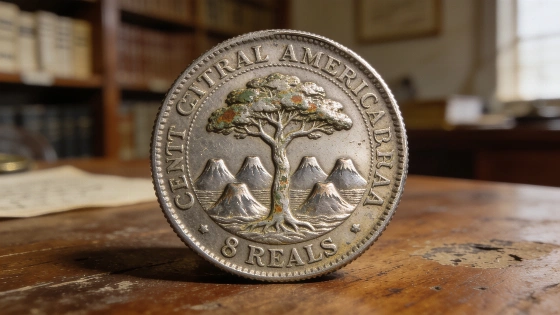
The 1824 Central American Republic 8 Reales silver coin became a symbol of independence and unity, surviving long after the federation that issued it dissolved, and even circulating in the United States as legal tender
In the early 19th century, Central America attempted a bold political experiment: five former Spanish provinces-Guatemala, El Salvador, Honduras, Nicaragua, and Costa Rica-joined forces to form the Federal Republic of Central America. Their ambition was not only political but also monetary. In 1824, the new federation issued a silver coin, the 8 Reales, whose design rejected the symbols of monarchy in favor of a landscape featuring five volcanoes and a Ceiba tree. This coin would ultimately outlast the very republic it was meant to represent.
From Colonial Rule to Republican Symbols
After gaining independence from Spain in 1821, Central America briefly became part of the Mexican Empire before declaring its own independence in 1823. The Federal Republic of Central America was formally established with a constitution in November 1824. One of its first acts was to break with colonial monetary imagery. On March 19, 1824, the National Constituent Assembly passed a law banning royal portraits and coats of arms from new coins. Instead, the law mandated a new visual language: five volcanoes under a rising sun on one side, and a Ceiba tree-an emblem of liberty-on the other. The motto "LIBRE CREZCA FECUNDO" ("Grow free and fruitful") encircled the tree, reinforcing the ideals of independence and prosperity.
The 8 Reales coin, known as the "silver peso," maintained the familiar weight and fineness of its Spanish predecessor: about 27.07 grams, .903 silver purity, and a diameter of roughly 39 mm. This continuity reassured merchants and the public, who were accustomed to the Spanish-American peso as a standard for trade and savings. The Nueva Guatemala Mint in Guatemala City produced the coin, with the assayer's mark "M" for Manuel Eusebio Sánchez, a figure who bridged the colonial and republican eras.
Circulation Beyond Borders
The Central American Republic's 8 Reales was not just a local currency. On June 25, 1834, the United States Congress passed legislation recognizing certain foreign silver coins-including those from Central America-as legal tender at par with the U.S. dollar, provided they met specific standards for weight and purity. This meant that the Central American 8 Reales could circulate in the United States at a value of 100 cents, giving the coin a reach far beyond its original federation. Such cross-border acceptance was rare and underscored the coin's credibility in international commerce.
Despite its symbolic power, the coin could not prevent the political fragmentation of the region. By the late 1830s, internal conflicts and regional rivalries led to the collapse of the federation. By 1840, most member states had left, and the union was effectively dissolved, with El Salvador maintaining a legal successor status until 1841. Yet, the coin's design endured. The Nueva Guatemala Mint continued to strike 8 Reales coins with the original republican imagery through at least 1847, even as the political entity that issued them no longer existed. This phenomenon-where a currency outlives its issuing authority-offers a striking example of how monetary trust can persist independently of political structures.
Design, Data, and Legacy
The 1824 Central American Republic 8 Reales is catalogued as KM-4 in major numismatic references. Collectors value the coin for its artistry: the five volcanoes are widely interpreted as representing the federation's five founding states, while the Ceiba tree stands for liberty and growth. The coin's technical specifications-weight, fineness, and size-matched the established Spanish-American standard, facilitating its acceptance in trade and as a store of value. The continued production of the coin after the federation's collapse highlights the distinction between political legitimacy and monetary continuity.
For comparison, the Nueva Guatemala Mint issued 8 Reales coins with the same design from 1824 through at least 1847. The coin's silver content (approximately 0.7859 troy ounce) and dimensions made it interchangeable with other widely accepted silver dollars of the era. Its legal-tender status in the United States, confirmed by the 1834 Congressional act, placed it alongside Mexican, Peruvian, and Chilean silver dollars in North American commerce. This cross-border recognition is reminiscent of other historical episodes where currency outlasted or transcended its original political context, such as the Katanga coins during the Congo Crisis, discussed in our analysis of currency manipulation in post-colonial Africa.
Enduring Meaning of the 8 Reales
The story of the 1824 Central American Republic 8 Reales illustrates how currency can become a vessel for political ideals, economic continuity, and even nostalgia. While the federation it represented was short-lived, the coin's imagery and silver content allowed it to circulate for decades, trusted by merchants and recognized across borders. Its survival beyond the collapse of its issuing authority demonstrates the resilience of monetary trust and the power of shared symbols in the history of money.
The Central American Republic's 8 Reales coin is a prime example of how monetary systems can persist even as political arrangements change or disappear. The coin's continued acceptance was rooted in its intrinsic value, familiar specifications, and the trust it inspired among users. This distinction between the authority that issues money and the public's willingness to accept it remains relevant today, especially in regions facing political uncertainty or monetary reform. The 8 Reales reminds us that, while governments may rise and fall, the credibility of a currency often depends on deeper foundations of trust, utility, and shared meaning.