
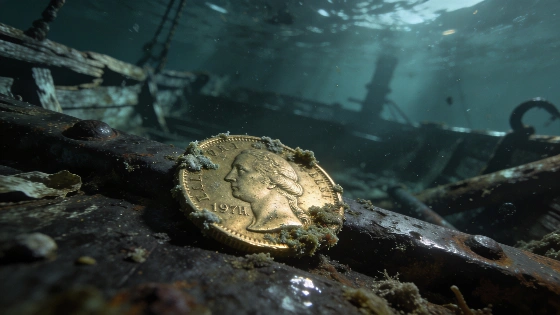
A $5 gold coin minted in 1836 and lost in the 1838 Pulaski disaster has been recovered from the Atlantic, offering a rare glimpse into early US currency and the personal fortunes carried by travelers before the Civil War
Saltwater hid the Pulaski's secrets for almost 180 years. That changed when divers brought up an 1836 Classic Head Half Eagle from the wreck. This $5 gold coin, struck in Philadelphia, vanished just two years after minting when the steamship exploded off North Carolina. The coin is more than a collector's prize. It is a piece of a lost world-one where American money, travel, and disaster collided. In the 1830s, gold and silver values swung wildly. The US still ran on a bimetallic standard. Treasury officials and early central bankers often changed exchange rates to keep up.
On June 14, 1838, the Pulaski's boiler blew up at night. The ship sank in less than an hour. Most of its cargo and the fortunes of wealthy passengers went down with it. Only 59 people survived. Historians put the death toll near 128. For generations, the Pulaski's riches stayed out of reach. No official word has come from US financial regulators or central banks about the legal status of these recovered coins. The Federal Reserve and the Office of the Comptroller of the Currency have not issued new policy updates, according to Reuters coverage.
Personal wealth at the bottom of the sea
The Pulaski's gold and silver coins were not government shipments. They belonged to the passengers. At the time, the total value of lost valuables was pegged at nearly $150,000. That was a huge sum. One survivor lost $20,000 in gold coins. Divers have found US half eagles, silver coins, and money from Spain, Mexico, and Great Britain. This mix shows how many types of coins Americans used before the Civil War. US law even accepted some foreign gold coins as legal tender. The reason was simple. The US Mint could not make enough coins, and there was no single national currency. That changed decades later. The Federal Reserve System, created in 1913, finally stabilized the dollar and took charge of monetary policy.
Modern recovery started in 2017. Endurance Exploration Group and Blue Water Ventures International searched a site about 120 feet deep. In 2018, divers found artifacts stamped with the Pulaski's name. That confirmed the wreck. By September, more than 500 gold and silver coins had come up. The first 502 coins went to collectors in a commercial sale. Numismatic Conservation Services and Numismatic Guaranty Company handled conservation and grading. They made a special Pulaski label. Later, PCGS-certified coins with the shipwreck pedigree also hit the market. Despite the buzz, US financial authorities have not released verified totals or new legal rulings. There are no official updates in top news feeds or central bank bulletins.
The Classic Head Half Eagle and its monetary context
The 1836 Classic Head Half Eagle came out of a time of reform. In the early 1830s, US gold coins often had more gold than their face value. Many were melted or shipped overseas. Congress passed the Act of June 28, 1834. It cut the half eagle's weight and gold content. The goal was to keep coins in the country. Chief Engraver William Kneass designed the Classic Head. Liberty faces left. The reverse drops the motto E PLURIBUS UNUM to mark the lighter coins. This design lasted only until 1839, when Christian Gobrecht's Liberty Head took over. These changes were early fixes for gold outflows and exchange rate problems. Later, the Federal Reserve and the Bank for International Settlements (BIS) would handle such issues with coordinated policy.
Philadelphia made 553,147 half eagles in 1836. Most disappeared through use or melting. The Pulaski disaster froze a few in time. Some coins came up from the wreck in Mint State. One 1836 HM-2 Classic Head Half Eagle, graded NGC MS64 with CAC approval and Pulaski pedigree, sold for $28,800 at Heritage Auctions in January 2025. Collectors pay a premium for coins with both top condition and a story. As seen in the reported earlier find of gold Moroccan coins from a 17th-century wreck, coins can be both evidence and objects of fascination.
Evidence and aftermath
The Pulaski's passenger list read like a who's who of wealthy families. Many were heading north to escape the Southern summer. Built in Baltimore in 1837, the ship was run by the Savannah and Charleston Steam Packet Company. It was seen as a symbol of luxury and new technology. Its loss stunned the country. Newspapers called it one of the worst disasters on the American coast. The story came back into the spotlight when Discovery Channel called the Pulaski "America's Titanic" on Expedition Unknown.
Unlike many wrecks, the Pulaski's coins were not bank shipments. They were the real money people carried-pocket change, savings, fortunes in trunks and purses. The mix of US and foreign coins gives a rare look at the 1830s currency scene. Americans used Spanish, Mexican, British, and other foreign coins alongside US money. Federal law allowed several foreign gold coins as legal tender. This changed as the US Mint grew and the monetary system matured. The move to a single currency sped up with the Federal Reserve's creation. The Fed now sets benchmark rates and manages the dollar's global role, as shown in the Federal Reserve monetary policy overview.
Historical data and market impact
By late 2018, the Pulaski team had reported over 500 gold and silver coins recovered. The first 502 coins went to market in a commercial sale. The Philadelphia Mint made 553,147 half eagles in 1836, but few survived in top grades. Pulaski coins, some in Mint State, have brought high prices at auction. One sold for $28,800 in January 2025. These numbers show how rarity, history, and collector demand meet. Today's gold market moves with central bank reserves and currency interventions. But the value of Pulaski half eagles comes from their story and condition, not from spot gold prices or current policy by the Federal Reserve or the European Central Bank (ECB).
The Pulaski's 1836 half eagle is more than a relic. It is a piece of a lost economy, a survivor of disaster, and a snapshot of American money frozen in time. The coin's path-from the Mint, to a passenger's pocket, to the ocean floor, and finally to auction-shows how money can travel through history.
In the early 1800s, the US had a tangled money system. Foreign coins mixed with US issues. Laws let certain foreign gold and silver coins count as legal tender. This was practical. The US Mint could not keep up with demand. Over time, the Mint made more coins and Congress changed coin specs to stop export and melting. The country moved toward a single currency. Pulaski shipwreck coins, with their mix of types and values, are rare proof of this changing era in American money.