
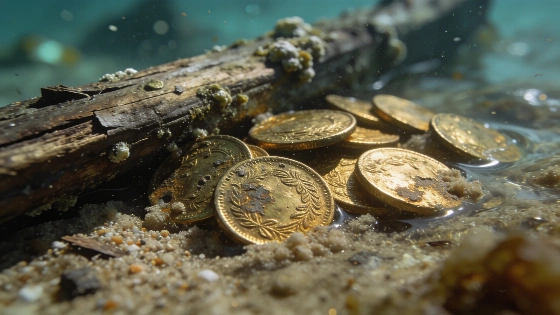
More than 400 gold Moroccan coins have cracked a decades-old mystery, confirming the identity of a 17th-century Dutch shipwreck off England's south coast and revealing new details about early trade routes.
For thirty years, a wreck off Devon's coast kept its secrets. Divers found scattered cargo, but no name. That changed with the discovery of over 400 gold Moroccan coins-Barbary ducats-pulled from the seabed. These coins finally identified the ship as the Dom van Keulen, a Dutch trader lost in 1633. The wreck sits about 18 meters deep in Salcombe Bay. Most of the hull is gone. Only fragments of cargo remain, according to maritime archaeologists at The Past.
The real breakthrough came from dogged research and hard evidence. Historian Ian Friel dug through the National Archives. He found records that matched the ship's fate to the coins found underwater. The Dom van Keulen left Morocco for the Netherlands in autumn 1633. A storm wrecked her near Salcombe. The crew survived. The cargo did not. Archival records listed the goods: 9,000 Barbary ducats, 150 bags of gum arabic, 64 bags of saltpeter, and 320 goat skins. The details fit the find exactly.
Barbary ducats and the trade network
The coins open a window into 17th-century trade. These gold ducats, minted by the Sa'dian Sharifs of Morocco, were prized for their purity. Dutch merchants often melted them down and reissued them as Dutch ducats. Gold moved across borders. The Dom van Keulen's manifest-9,000 Barbary ducats, 150 bags of gum arabic, 64 bags of saltpeter, 320 goat skins-shows the scale of trade between North Africa and Northern Europe. This was part of a global money system. Gold coins crossed borders and were re-coined to fit local standards. Central banks like the European Central Bank (ECB) and Bank of England (BoE) still manage currency flows today, echoing these old practices.
Most of the cargo was salvaged after the wreck. But over 400 gold coins stayed hidden until the South West Maritime Archaeology Group found them in 1995. The British Museum now holds these coins. They are protected under the Protection of Wrecks Act 1973. Local authorities keep watch to stop illegal dives. The British Museum's role shows how provenance and legal rules matter in preserving money artifacts. It's a modern parallel to the oversight of the Bank of England and other regulators.
Historical context and coinage
The Sa'dian Sharifs ruled Morocco at the time. They issued undated gold dinars and fractions, with coins linked to rulers like Abu Faris 'Abdallah al-Wathiq b. Muhammad and Zaydan al-Nasir b. Ahmad. Their rule shaped Morocco's money and its ties to Europe. After the Sa'di dynasty, the 'Alawi sharifs took over in 1654 and kept minting gold coins. These coins later became the basis for Moroccan currency. Their international role is similar to how the euro and US dollar work today. The ECB and Federal Reserve track their value and circulation through policy and inflation targets.
Only a small part of the original 9,000 Barbary ducats escaped salvage. Today, these coins prove how African, Dutch, and British economies were linked centuries ago. The Dom van Keulen's story is told in the book From Morocco to the Coast of England: The Story of the Dom van Keulen and its Remarkable Cargo, edited by Dave Parham of Bournemouth University and Venetia Porter, formerly of the British Museum. The finds are kept at the British Museum. A full research volume will be published in September 2026. The work connects old money flows to today's currency analysis.
Preservation and ongoing research
All Dom van Keulen artifacts are protected by law. The British Museum is now responsible for the Moroccan coins. The site's security falls under Operation Birdie, a national effort to protect historic wrecks. This approach is now common in numismatics and maritime archaeology. The focus is on context and provenance, not just the objects. The rules for these finds mirror strict compliance and anti-money laundering standards set by modern regulators like the Financial Conduct Authority (FCA) in the UK and the European Banking Authority (EBA).
The British Museum's head of research said the African gold found off Devon raised big questions about wealth movement and early trade. The research team pieced together a rare, well-documented case of coins revealing a shipwreck's identity. The Barbary ducats' economic role stands out. They settled international trades, much like central banks today manage cross-border payments and reserves. For current central bank policy and exchange rates, see the ECB policy and exchange rate statistics.
The numbers are clear. The Dom van Keulen carried 9,000 Barbary ducats. Just over 400 were recovered in 1995. The manifest also listed 150 bags of gum arabic, 64 bags of saltpeter, and 320 goat skins. These details show the value and variety of goods traded between Morocco and the Netherlands in the 1600s. The records give a rare, precise look at early trade, much like the International Monetary Fund (IMF) reports trade balances today.
For collectors and historians, the Dom van Keulen stands apart from modern coin finds, such as those reported earlier with tiny mintages. Here, rarity is not the main story. The coins help rebuild a lost chapter of global trade and money history.
The Barbary ducats from the Dom van Keulen show how gold coins worked as both a store of value and a way to pay across continents. Their path-from Moroccan mints to Dutch traders, then to the seabed off England-shows how money really moved. Modern banknotes are dated and standardized. These coins were often undated and re-coined, making them hard to trace. The Dom van Keulen's story proves that in numismatics, context is everything. The value of a coin is tied to its journey and the networks it once linked.