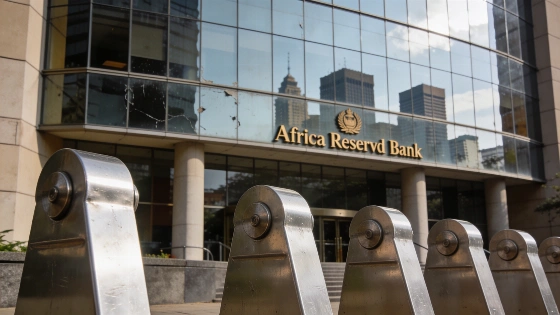
Crédit Agricole expects the South African Reserve Bank to keep its policy rate at 7.25 percent through the fourth quarter. Oil prices remain the main risk, and the Pound to Rand exchange rate holds above 22.00.
Traders who counted on more South African rate hikes are now facing a different picture. The Pound Sterling has kept its ground above 22.00 against the Rand. The GBP/ZAR rate is holding firm as bets on more tightening from the South African Reserve Bank (SARB) lose steam. Crédit Agricole says the market may have gone too far in expecting more hikes this year.
By Friday's close, the Pound to Rand rate stood at 22.0374. That's a tiny drop of 0.03 percent after a sharp 1.19 percent jump the day before. Sterling is still above its September finish at 21.7846. It hasn't reached its level from the start of the year. The latest move shows how sentiment has shifted. The SARB's September rate hike-25 basis points to 7.25 percent-now looks like the likely ceiling for 2026, unless inflation flares up again. Every SARB committee member backed the decision. The new rate took effect on 25 September. The central bank is sticking to its goal of keeping inflation in check as outlined by the SARB. That's the mandate.
Rate hike bets under pressure
Crédit Agricole's latest research, out at the end of September, points to a gap between what markets expect and what the central bank signals. The bank says investors had priced in another 66 basis points of tightening over six months. Crédit Agricole calls that too much. The SARB's own base case is to keep rates at 7.25 percent through year end. The central bank has also cut its 2026 GDP growth forecast from 1.4% to 1.2%. That's a sign of trouble ahead. South Africa's GDP shrank by 0.2% in the second quarter. This is backed up by data from The Asian Banker and the International Monetary Fund (IMF).
The September rate hike was a unanimous call. But the SARB's model now points to steady rates unless outside shocks-like oil prices, global rate moves, or wage jumps-force a change. Inflation sped up between April and June. It slowed in July and August. Then it ticked up again in August to 4.4%, up from 4.3% in July. The SARB warns that rising fuel costs and outside shocks are short-term risks. If oil prices drop in the fourth quarter, the SARB will likely hold steady. No rush to tighten. The Bank for International Settlements (BIS) has made similar points about how emerging markets need to stay flexible.
Economic drag and currency fallout
Weak growth is another reason for caution. South Africa's GDP fell 0.2 percent in the second quarter. Electricity output in July was down 7.9 percent from a year earlier. After the September hike, the prime lending rate in South Africa rose to 10.75%. That means higher costs for mortgages and consumer loans. First-time home buyers and household spending will feel it according to Eyewitness News. Inflation has run hot this year, but short-term real rates have stayed above 2.5 percent. That gives the SARB some space to focus on growth instead of more hikes.
The Rand has lost a key support as hopes for more rate hikes fade. Unless UK rate expectations change or global sentiment swings, the Rand may keep struggling against Sterling. But Crédit Agricole's forecast comes with a warning. If oil prices spike again or the Rand weakens further, the SARB could still act. The central bank has said another hike is possible if global rates rise or the currency comes under new pressure. The next policy meeting is set for 19 November. Traders will watch local inflation and outside signals, including moves from the Federal Reserve and the European Central Bank. Anything can happen.
This careful approach to rate moves is not unique. Other markets face the same uncertainty. Earlier reports on Australia show how inflation and energy costs are shifting central bank thinking there too.
Key numbers and market view
On Friday, GBP/ZAR was at 22.0374. That's a small pullback after a strong 1.19 percent gain the day before. The SARB's policy rate sits at 7.25 percent after the September hike. Markets had priced in another 66 basis points of tightening over six months. South Africa's GDP dropped 0.2 percent in the second quarter. Electricity output fell 7.9 percent year-on-year in July. Inflation sped up in the second quarter, slowed in July and August, then edged up again in August. This supports a pause in more rate hikes unless new shocks hit.
Central banks use policy rates to steer borrowing costs, inflation, and currency values. Raising rates usually aims to slow inflation by making loans more expensive. It can also draw in foreign money and help the currency. But if rates go too high or growth stalls, the trade-off gets tough. In South Africa, the SARB has to keep inflation in check without making the slowdown worse. The push and pull between rates, inflation, and exchange rates is a constant challenge for central banks everywhere. The Federal Reserve and Bank of England have said as much in their latest policy updates.