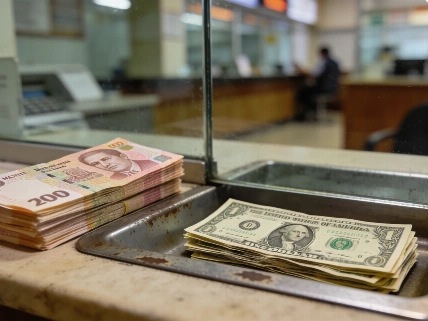

Goldman Sachs has raised its forecasts for the Nigerian Naira, pointing to strong oil receipts, elevated local yields, and persistent undervaluation as the main drivers of further appreciation against the US dollar over the coming year.
Goldman Sachs has taken a more optimistic view on the Nigerian Naira, accelerating its timeline for expected appreciation against the US dollar. The shift comes as robust oil revenues and high local yields reshape the currency's prospects. The bank now expects the USD/NGN exchange rate to reach ₦1,250 within twelve months, with interim targets of ₦1,300 in three months and ₦1,275 in six months-each lower than its previous projections. As of September 17, the pair traded near ₦1,325, making the 12-month forecast about 5.7% stronger than current levels. This outlook is consistent with recent market data, as the official rate on the Nigerian Foreign Exchange Market (NFEM) remained in the ₦1,326-₦1,331 range between September 14 and 18, 2026, according to Central Bank of Nigeria (CBN) data and market reports from BusinessDay.
Unlike many import-dependent currencies that come under pressure when oil prices rise, Nigeria's status as an oil exporter has provided a key buffer. Goldman Sachs expects ongoing disruptions to Middle East shipping to keep oil prices high through 2027, which should reinforce Nigeria's external balance and support the Naira. The bank's valuation models continue to show the Naira as deeply undervalued, indicating further upside potential compared to currencies such as Kazakhstan's Tenge, which has already rallied. The International Monetary Fund (IMF) has also emphasized the role of oil receipts in supporting Nigeria's external accounts, a factor that helps explain the Naira's resilience amid global volatility.
High yields and investor incentives
High yields on local assets are a major factor in the Naira's outlook. Goldman Sachs notes that open-market-operation (OMO) securities with maturities over 14 days are offering average yields around 20%. Recent market reviews confirm OMO and treasury bill yields in the 19.96%-20.02% range for select tenors in September 2026, supporting a strong carry trade for the Naira. After adjusting for expected inflation, real yields are estimated above 5%, approaching the highest levels since 2015. This substantial carry attracts investors and provides a buffer against inflation, making Nigerian assets stand out in a global environment where real returns are scarce. The Bank for International Settlements (BIS) has observed that such high real yields can draw significant foreign portfolio inflows, especially when global rates are less competitive.
For international investors, the combination of high yields and undervaluation presents a rare opportunity. While the Naira has experienced volatility in recent years, the current macroeconomic backdrop-anchored by strong oil receipts and a favorable yield differential-has shifted the risk-reward balance. The CBN's recent intervention, selling $151 million to authorized banks, led to a short-term strengthening of the Naira to around ₦1,326-₦1,328 per US dollar, helping to stabilize the official market.
Central bank policy and the pace of appreciation
Despite these supportive factors, the Central Bank of Nigeria's approach to building foreign reserves has slowed the Naira's gains. Goldman Sachs points out that the central bank's ongoing foreign currency purchases, aimed at boosting reserves, have limited the pace of appreciation. While this policy strengthens Nigeria's external buffers, it also raises the cost of absorbing domestic liquidity when interest rates are high. The bank expects policymakers to favor a gradual strengthening of the Naira rather than a rapid move to the ₦1,250 target, reflecting a cautious stance on currency management. By mid-September 2026, Nigeria's foreign reserves had reached $54.60 billion, a level seen by market participants as providing additional support for the currency during FX stabilization efforts.
These dynamics mirror broader trends in global currency markets, where central banks such as the Federal Reserve and the European Central Bank must weigh the benefits of reserve accumulation against the costs of sterilizing liquidity and the risk of distorting market signals. As reported earlier, shifts in oil prices and interest rates are already influencing currency strategies worldwide.
Facts and figures
Goldman Sachs' updated forecasts for the USD/NGN pair are: ₦1,300 in three months (down from ₦1,325), ₦1,275 in six months (down from ₦1,300), and ₦1,250 in twelve months. The current reference rate as of September 17 is near ₦1,325, with the official NFEM/CBN rate closing at ₦1,329.15 on September 15 and ₦1,329.86 on September 16, marking the longest period of stability since July 2025. The parallel market rate remains weaker, trading in the ₦1,385-₦1,410 range per US dollar in mid-September. Average yields on Nigerian OMO securities with maturities over 14 days are estimated at 20%, with real yields above 5% after accounting for expected inflation. The bank's models continue to indicate that the Naira remains deeply undervalued relative to its fundamentals.
Valuation models and currency dynamics
Currency valuation models estimate the "fair value" of a currency based on economic fundamentals such as trade balances, inflation, interest rates, and external reserves. When a currency is considered undervalued, its market price is lower than what these models suggest is justified by the data. However, actual exchange rates can diverge from model estimates for extended periods due to policy decisions, capital flows, or shifts in market sentiment. For the Nigerian Naira, the central bank's reserve accumulation policy and the high-yield environment are both shaping the currency's path, but neither guarantees a straightforward move to the forecasted levels. Investors and policymakers must remain alert to changes in oil prices, inflation, and global risk appetite, all of which can shift the forces driving the Naira's value. For official policy updates and regulatory guidance, see the Central Bank of Nigeria website.