A 1928 $5,000 Federal Reserve Note from Kansas City, one of just two known examples, is headed to auction at GreatCollections. Its appearance highlights how nearly all high-denomination US currency has disappeared from circulation.
Just two examples of the 1928 $5,000 Kansas City Federal Reserve Note are known to survive. One of them is about to go up for auction, giving collectors a rare shot at a banknote that was never meant for public use and has almost vanished from the American money supply.
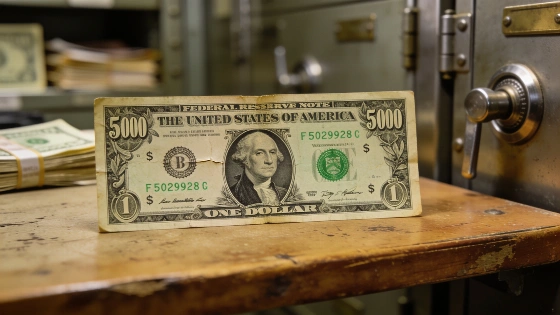
GreatCollections will auction the note, graded PMG Extremely Fine 40 and cataloged as Friedberg 2220-J, on October 18, 2026. It comes from the Schwenk Family Collection of 100 Greatest American Currency Notes. This note is a holdover from an era when banks moved large sums on paper, not by wire or digital transfer. The PMG Extremely Fine 40 grade means the note saw real circulation but still looks sharp, which matters for collectors and is explained in the PMG grading guide.
High-denomination notes made for banks
The $5,000 Federal Reserve Note was never intended for daily spending. Congress approved these large bills in 1918 to make it easier for banks to transfer big sums without piles of paperwork. Along with the $500, $1,000, and $10,000 notes, the $5,000 bill was strictly for institutional use, not for the public. By 1946, the Federal Reserve decided these high-value notes were no longer needed, since checks and smaller bills worked better for large payments. Production stopped, and the notes started disappearing from circulation. The Federal Reserve has confirmed these notes were for banks, and their withdrawal matched the rise of electronic payments and the decline of large cash transactions (Federal Reserve History).
Kansas City received only a small share. Out of 18,244 Series 1928 $5,000 notes printed for all districts, just 720 went to Kansas City. Today, only two are confirmed to exist from this district. The note now at GreatCollections was the first known example, thought to be unique until a second turned up in 2014. Its face shows James Madison, the Kansas City Federal Reserve District seal, and a green Treasury seal. The back features an ornate "5000." Collectors and auction houses use the Friedberg catalog system, which lists this note as Fr. 2220-J, with "J" for Kansas City (Whitman Publishing).
Survival against the odds
Finding any genuine $5,000 bill is rare; finding a Kansas City example is nearly impossible. Census data lists only 20 confirmed survivors from the entire 1928 series, with 27 reported by specialized researchers. Since 1969, the government has destroyed any large-denomination notes that return to banks, so the number can only shrink unless new examples are found. The Board of Governors of the Federal Reserve System has stated that while these notes are still legal tender, they are no longer printed or circulated, and banks must destroy them if they come back (Federal Reserve FAQs).
This Kansas City note's ownership is well documented. It was part of the Taylor Family Collection, then owned by Ronald R. Gustafson, and sold for $228,000 at Heritage Auctions in September 2024. Heritage noted its strong inks, white paper, and professional restoration at the top margin. Now, it's in the Schwenk Family Collection, with its PMG certification number listed in the registry for the 1928 $5,000 slot.
The last gold-backed five thousand
The Series 1928 $5,000 stands out for one reason: its face promises it is "redeemable in gold on demand." This gold clause was dropped after the US changed its gold policy in 1933, making the 1928 series the only small-size $5,000 notes with this promise. Later issues, like the Series 1934, replaced it with legal-tender language and redemption in lawful money. The 1928 note marks the shift from gold-backed currency to the modern system. The move away from gold redemption came during the Great Depression, as the US tried to stabilize its currency and banking system under the Treasury and Federal Reserve.
By the end of 1968, only 634 $5,000 notes of all series were still outstanding, down from 1,405 at the end of 1945. The Federal Reserve's destruction policy means each surviving note is a leftover from a vanished financial world. For collectors, the chance to buy a Kansas City $5,000 note is about more than grade or condition-it's about the rarity of the note appearing for sale at all.
Rarity and collector stakes
Q. David Bowers and David Sundman's 100 Greatest American Currency Notes ranks the Series 1928 $5,000 at No. 92, but the Kansas City issue is even rarer within this group. While collectors might find $5,000 notes from other districts, only two Kansas City examples are known. The note's auction history, registry pedigree, and gold clause make it a highlight for advanced collectors of high-denomination US currency. Auction houses and catalogs focus not just on condition, but also on provenance and authenticity, which are key for value and demand (GreatCollections catalog pages).
The note's details: $5,000 denomination, Series 1928, Friedberg 2220-J, Kansas City District 10, JA block, James Madison portrait, green Treasury seal, and signatures of Walter O. Woods and Andrew W. Mellon. Its last major auction brought $228,000, and its next sale is set for GreatCollections in 2026.
Most Americans will never see a $5,000 bill. The story of this Kansas City note is similar to other rare US currency, like the rare 1945 Jefferson nickel with two major minting errors. Both show how scarcity, history, and official policy can turn ordinary money into something extraordinary.
The Federal Reserve's ongoing destruction of high-denomination notes means the number left will stay fixed unless new finds come to light. For the few collectors able to compete for these pieces, the stakes are set not by face value, but by the note's place in the story of American money. The Kansas City $5,000 bill is a direct link to a financial era that has nearly disappeared.
High-denomination US banknotes like the $5,000 and $10,000 bills were never meant for public use. Their main job was to help banks move large sums before electronic payments took over. As banking modernized, these notes became obsolete, and policy shifted to remove them from circulation. Today, their rarity is due not just to age, but to deliberate destruction and changes in how money moves. Collectors looking for these notes face a market shaped by both history and official policy.