Jersey's coins and banknotes reveal a century of political upheaval, wartime occupation, and monetary reform, from rare royal issues to the transition to decimal currency and the latest commemorative coins
The evolution of Jersey's coinage over the past century offers a window into the island's shifting political landscape, monetary reforms, and the practical challenges of maintaining a local currency. From the brief reign of King Edward VIII to the present, each era has left its mark on the coins and notes circulating in the Bailiwick of Jersey.
Royal Transitions and Rare Issues
King Edward VIII's abdication in 1936, after just 326 days on the throne, meant that no circulating coins bearing his portrait were ever released in Jersey or the wider UK. Only a handful of pattern coins and proofs were produced, making them among the rarest British numismatic items, with most held in institutional collections such as the Royal Mint Museum. The subsequent reign of King George VI saw the minting of several coins for Jersey, including the Coronation Medal, 1/24 shilling, and 1/12 shilling denominations. The 1937 Coronation Medal, featuring crowned portraits of George VI and Queen Elizabeth, was distributed at the discretion of Jersey's authorities and designed for wear, with a pierced top for attachment. Standard coinage during this period included the 1/24 shilling (minted in 1937, 1946, and 1947) and the 1/12 shilling, with a special 1945-dated issue marking the liberation of Jersey from German occupation.
Occupation, Shortages, and Local Banknotes
World War II brought acute currency shortages to Jersey. As British coins and notes disappeared from circulation-hoarded by residents or taken as souvenirs by occupying German troops-the island's authorities responded by issuing their own emergency paper money. In 1942, local artist Edmund Blampied was commissioned to design notes in denominations from 6 pence to 1 pound. These notes, issued between 1942 and 1945, included subtle resistance motifs, such as the oversized "X" in "six" on the 6d note, which folded to form a "V" for victory. The obverse of these notes featured the island's arms and local figures, while the reverse often depicted scenes intended to evoke wartime caution. The German occupation of Jersey lasted from June 1940 until May 1945, making it the only part of the British Isles under Nazi control during the war.
Decimalization and Modern Coinage
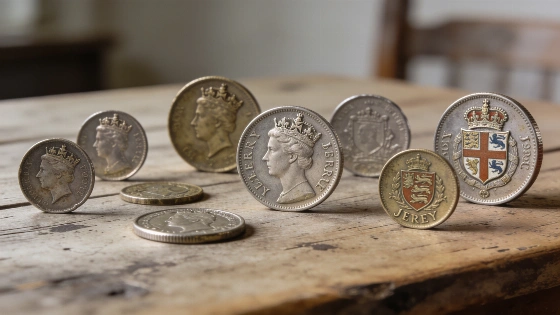
After King George VI's death in 1952, Queen Elizabeth II's portrait first appeared on Jersey's coins in 1954, using the Mary Gillick effigy. The pre-decimal system remained in place until the UK's move to decimal currency in 1971, which Jersey followed. The new decimal coins matched their UK counterparts in size and composition, with denominations ranging from ½ new penny to 1 pound and higher-value commemorative issues. The ½ new penny, introduced in 1971, was withdrawn from circulation in 1984 due to inflation and practical handling issues. Notable commemorative coins include the 1977 25 pence marking the Queen's Silver Jubilee and the 1972 1 pound coin celebrating the royal wedding anniversary. The 1966 5 shilling coin, featuring the Norman Conquest, was another significant issue of the period.
Recent Developments and Commemorative Issues
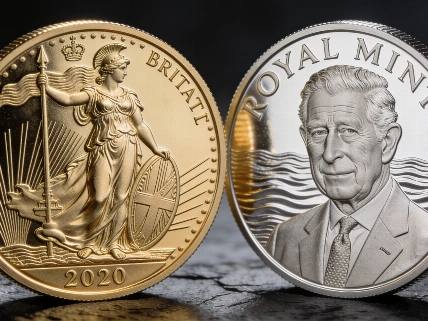
Following Queen Elizabeth II's death in 2022, Jersey's Treasury announced a gradual transition to coins and notes featuring King Charles III. As of late 2025, no standard circulating coins with the new king's portrait have been issued, though several commemorative non-circulating coins have appeared, such as the 2023 gold 1 penny and 5 pounds coronation proofs. These limited-edition coins, struck by the Royal Mint, feature the effigy of King Charles III and are primarily intended for collectors rather than everyday use. Jersey's approach mirrors that of other Crown dependencies, where commemorative coins are often produced in precious metals and in small numbers.
Facts and Figures: Jersey Coinage in Numbers
During the reign of King George VI, Jersey's 1/24 shilling coin had a mintage of 72,000 in 1937, while the 1945-dated 1/12 shilling Liberation issue saw 1 million coins produced. The 1964 1/12 shilling with Queen Elizabeth II's portrait reached a mintage of 1,200,000. The 1977 25 pence commemorative coin had a mintage of 262,000 in copper-nickel and 25,000 in silver proof. The 1972 1 pound coin, commemorating the royal wedding anniversary, was limited to 24,000 pieces. The 2023 gold 1 penny Charles III coronation proof was restricted to just 250 coins, with 50 designated as "first strike" editions.
Jersey's Coinage in Historical Perspective
Jersey's monetary history is shaped by its status as a British Crown dependency and its unique local circumstances. The island's coinage has reflected not only royal transitions and political events but also practical responses to crisis, such as the emergency banknotes issued during World War II. The transition to decimal currency in the 1970s aligned Jersey's system with the UK, but the island has continued to issue its own distinctive coins and commemoratives. For collectors and historians, Jersey's coins and notes offer a tangible record of the island's resilience and adaptation through periods of upheaval and reform.
For those interested in how political power and monetary policy have intersected elsewhere, the story of Katanga's short-lived coins during the Congo Crisis provides another example of currency reflecting turbulent times. See the detailed analysis in this report on Katanga's coins and currency manipulation.
The process of decimalization in Jersey, as in the UK, involved not only the introduction of new coins but also a significant public education effort. Decimalization replaced the centuries-old system of pounds, shillings, and pence (where 1 pound = 20 shillings, 1 shilling = 12 pence) with a simpler structure of 100 pence to the pound. This change required new coin designs, adjustments in pricing, and updates to cash registers and accounting systems. While the transition was carefully managed, it also marked the end of a monetary tradition that had shaped daily life for generations. Today, Jersey's coinage continues to evolve, balancing the demands of modern commerce with the island's distinct historical identity.