
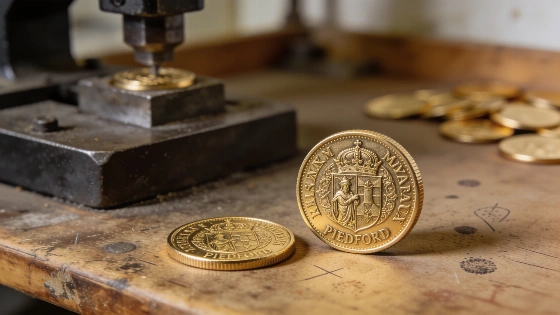
Hungary's 2026 commemorative coin series features gold and base-metal florins inspired by the medieval coins of King Matthias I, offering collectors a modern tribute to a pivotal era in Hungarian monetary history
Hungary's latest commemorative coin series pays tribute to King Matthias I, whose reign from 1458 to 1490 marked a period of significant monetary and political reform. The 2026 "Gold Florins of Hungary" release, produced by the Hungarian Mint, draws direct inspiration from the medieval gold florins issued during Matthias's rule, reflecting both historical design and modern minting standards.
The new series includes two gold coins denominated at 50,000 forints: a standard 1-ducat piece and a quadruple-ducat piedfort, both struck in .986 fine gold and finished to a proof-like quality. A copper-nickel-zinc alloy version with a 5,000-forint face value is also being issued for collectors seeking a more accessible option. All coins in the series share a 20 mm diameter, with the 1-ducat weighing 3.491 grams (limited to 2,000 pieces) and the piedfort at 13.964 grams (limited to 500 pieces). The base-metal coin weighs 2.7 grams and is capped at 5,000 units.
Designs Rooted in Medieval Heritage
The 2026 coins closely replicate the motifs found on florins from Matthias I's era, as catalogued in Friedberg number 22 of the 10th edition of Gold Coins of the World. The obverse features St. Ladislas standing with an orb and battle ax, encircled by the legend "MAGYARORSZÁG" and flanked by the BP mintmark and the year. The denomination is inscribed in a slightly raised band beneath the central motif. On the reverse, Madonna is depicted seated with the infant Christ, surrounded by the legend "I. ÁTYÁSARANYFORINTJA" and the dates "1458" and "1490," marking the span of Matthias's reign. The lower band bears "MATHIAS REX" and the Hunyadi family's coat of arms-a raven holding a ring.
Edge treatments distinguish the versions: the 1-ducat and base-metal coins have plain edges, while the piedfort's edge is inscribed twice with "PATRONA HVNGARIE" in a medieval font, separated by dots. This detail echoes the style of "garas" coins, silver pieces circulated in Hungary during the Middle Ages and early modern period.
Historical Context and Collector Details
The "Gold Florins of Hungary" series began in 2012, initially commemorating the first gold florins minted under King Charles I in 1325. Since then, the series has expanded to include coins with denominations from 2,000 to 50,000 forints, issued annually or biannually, and crafted in various metals. The 2026 release highlights Matthias I's efforts to centralize and strengthen the Hungarian state, with the coin designs serving as a tangible link to the country's numismatic and political heritage.
According to the Coins & Currency Institute, which represents the Hungarian Mint in North America, the 1-ducat gold coin is priced at $675, while the 4-ducat piedfort is offered at $2,685. The base-metal version is available for $23.95. These coins are not intended for circulation but are produced for collectors and those interested in Hungary's monetary history.
For context, Hungary's commemorative coin issues often attract international attention, especially when they revive historical designs or mark significant anniversaries. The country's approach to numismatic releases is comparable to other nations that use coinage to celebrate cultural milestones, as seen in the U.S. with rare proof coins such as the 1939 Walking Liberty Half Dollar, which recently set a grading record at auction (see how rare U.S. coins continue to shape collector markets).
Florins, Ducats, and Piedforts Explained
The florin, originally introduced in Hungary in the 14th century, became a widely recognized gold coin across Europe. The ducat, another gold denomination, was often used for larger transactions and international trade. Piedfort coins, characterized by their extra thickness and weight, were historically produced as presentation pieces or for collectors, rather than for everyday use. In modern commemorative issues, these formats allow mints to showcase historical artistry and technical skill while appealing to a range of collectors.
Understanding the distinctions between circulating, commemorative, and collector coins is essential for anyone interested in numismatics. Circulating coins are produced for everyday transactions and must meet practical standards for durability and recognizability. Commemorative coins, like Hungary's 2026 florins, are typically legal tender but not intended for general circulation; their value often lies in their historical, artistic, or material qualities. Collector coins may be issued in limited quantities, with special finishes or packaging, and are usually sold at a premium above face value. These distinctions help explain why certain coins, despite their official status, are rarely seen in daily commerce but remain highly sought after by enthusiasts and historians.