
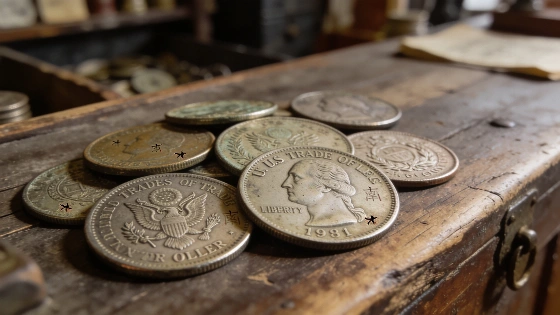
The US Trade Dollar was designed to outcompete Mexico's peso in Asian trade, but its journey from export tool to domestic headache reveals the risks of currency innovation and the limits of monetary policy abroad
Few coins have traveled as far-or caused as much confusion-as the United States Trade Dollar. Minted to break Mexico's grip on Asian silver trade, the coin's legacy is a cautionary tale of ambition, miscalculation, and unintended consequences. Its withdrawal from circulation in 1887 marked not just the end of a coin, but the collapse of a bold American experiment in monetary diplomacy.
For American merchants in the 19th century, the dominance of Mexico's silver peso in China and Japan was more than an inconvenience-it was a barrier to trade. Earlier US silver dollars, lighter and less trusted, failed to gain traction. The solution, authorized by Congress in 1873, was the Trade Dollar: a heavier, .900 fine silver coin, minted specifically for export. The San Francisco Mint's Louis Garnett, having witnessed firsthand the peso's supremacy, pushed for a coin that could finally compete abroad.
Export Ambitions and Domestic Fallout
The Trade Dollar's specifications were calculated to impress: 27.22 grams in weight, 38.10 mm in diameter, and a composition of 90% silver. It was never intended for everyday American wallets. Congress granted it limited legal tender status, but this was revoked in 1876 after the coin began circulating domestically at a discount, frustrating the public and undermining confidence in silver money. By 1887, Congress authorized a six-month redemption window, allowing holders to exchange Trade Dollars for standard silver dollars. Most were melted down, with the silver repurposed for Morgan Dollars and subsidiary coins.
Between 1874 and 1878, the Philadelphia, San Francisco, and Carson City mints struck millions of Trade Dollars. Over $28 million worth were exported to Asia, where the coins were accepted in exchange for tea, silk, and porcelain. Yet the coin's domestic afterlife was far less successful. Silver producers and banks, eager to offload excess coins, pushed them into US circulation, where they quickly became unpopular and traded below face value.
Chopmarks and the Asian Circuit
In China and other Asian markets, authenticity was everything. Merchants routinely stamped imported silver coins with "chopmarks"-small counterstamps verifying the coin's silver content. Each chopmark recorded a stop on the coin's journey through the region's bustling trade networks. For decades, American collectors dismissed these marked coins as damaged. Today, however, chopmarked Trade Dollars are recognized as tangible evidence of the coin's intended purpose and global reach. William Taylor Leverage's 2023 study, By Weight, Not By Coyne, has helped reframe these artifacts as essential records of 19th-century commerce.
Competing nations were not idle. Mexico's peso, struck at a slightly higher silver purity but lower weight, remained the preferred coin in Asia. Japan and France issued their own trade coins, adjusting weights and purities to match shifting market preferences. The US Trade Dollar's attempt to outdo its rivals in heft and design was bold, but ultimately could not dislodge the entrenched trust in the peso.
Design, Rarity, and Redemption
The Trade Dollar's design was a deliberate message. Liberty, seated on a bale of goods and facing west toward the Pacific, extends an olive branch toward Asia-a visual statement of American commercial intent. The reverse features an eagle with outstretched wings, arrows, and olive branch, surrounded by inscriptions detailing the coin's weight and fineness. Mintmarks from Philadelphia, San Francisco, and Carson City distinguish the origin of each piece.
Production for circulation ended in 1878, but the Philadelphia Mint continued to strike Proof-only issues for collectors until 1883. In 1884 and 1885, a handful of Proofs were secretly produced, their existence unknown until 1907. These clandestine coins, all traced to dealer William K. Idler, are now among the rarest US silver issues. The total mintage across all years reached $35,965,924, with 6,564 Proofs. Of these, nearly $1 million were melted before 1887, and $7.6 million were redeemed and recoined.
Numbers Behind the Experiment
Official records show that the highest business-strike mintage occurred in 1877 at the San Francisco Mint, with 9,519,000 coins. The lowest was 97,000 at Carson City in 1878. Proof mintages peaked at 1,987 in 1880, while only five Proofs are known from 1885. The Trade Dollar's alloy was 90% silver and 10% copper, with a reeded edge and a diameter of 38.10 mm. Its legal-tender status was never fully restored after 1876, despite later legal ambiguities.
For context, the Trade Dollar's fate echoes other episodes where currency innovation collided with political and economic realities. As reported earlier, attempts to manipulate or replace dominant coins often run into entrenched trust and practical acceptance-factors that no amount of official policy can easily override.
Legacy and Lessons
The Trade Dollar's brief, turbulent life reveals the limits of monetary engineering. Designed to project American power into Asian markets, it ended up as a domestic liability and a collector's curiosity. Its story is not just about silver content or legal status, but about the unpredictable consequences of trying to reshape global commerce with a single coin. The Trade Dollar remains a physical reminder that currency, trust, and policy are never as easily aligned as lawmakers hope.
Chopmarked Trade Dollars offer a window into the mechanics of 19th-century international trade. In the absence of modern authentication technology, Asian merchants relied on physical marks to verify silver content and deter counterfeiting. Each chopmark reduced the coin's appeal to American collectors but increased its credibility in the markets where it was meant to circulate. This practice highlights a fundamental tension in currency history: the priorities of official issuers often diverge from the practical needs of those who actually use the money.