A vast cache of early US half dollars, discovered in Pennsylvania and linked to the Harmony Society, continues to influence coin collecting and the availability of historic silver coins today
In the early 19th century, the town of Economy, Pennsylvania, became the unlikely setting for one of the most significant coin discoveries in US history. The Harmony Society, a religious community led by German immigrant George Rapp, settled there after fleeing persecution in Europe. While their beliefs set them apart, their approach to wealth was pragmatic: the group accumulated large amounts of silver, particularly in the form of half dollars, which were the largest silver coins in regular circulation at the time.
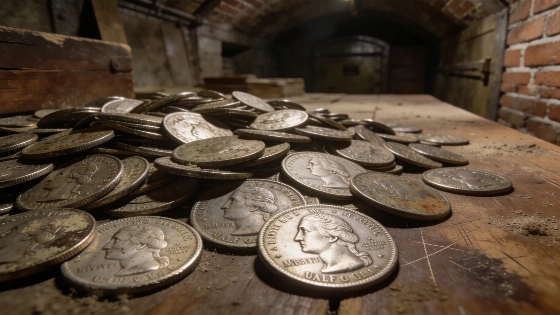
During the first decades of the 1800s, silver dollars were rarely seen in everyday transactions, having been suspended from production after 1804. This left the half dollar as the primary high-value silver coin available to the public. The Harmony Society's preference for these coins was not unique, but the scale of their holdings was extraordinary. In 1878, a hoard attributed to the group was unearthed, revealing a trove of approximately 115,000 coins, most of them half dollars dated before 1836.
The Scale and Composition of the Economy Hoard
The Economy Hoard, as it became known, included a remarkable range of early US coinage. Among the most notable finds were around 150 examples of the 1794 Flowing Hair half dollar and 650 of the 1795 issue-together representing a significant share of all known surviving coins of these types. The hoard also contained a handful of the rare Draped Bust, small eagle half dollars from 1796 and 1797, and several thousand other Draped Bust coins. However, the overwhelming majority-over 111,000 pieces-were Capped Bust half dollars minted between 1808 and 1836. This abundance has made these coins relatively accessible to collectors even today.
Other denominations were present in smaller numbers, including a single 1794 Flowing Hair silver dollar and about 400 quarters dated from 1818 to 1828. The reasons for the hoard's concealment remain uncertain, but the absence of coins dated after 1836 suggests it was hidden for decades before its discovery. The 1805 half dollar, for example, was present in modest quantities, reflecting its original mintage of just 211,722 coins-a small figure by modern standards, but significant at the time, especially since silver dollar production had ceased the previous year.
Rarity, Value, and Collector Impact
Within the hoard, some coins stood out for their rarity and value. The 1805/4 overdate half dollar, a variety created when a die from 1804 was repurposed for 1805, was represented by only about 25 pieces. Today, the price difference between a standard 1805 half dollar and the 1805/4 overdate is substantial, especially in higher grades. For instance, a G-4 grade 1805 half dollar is valued at around $220, while the overdate commands $375. In extremely fine (XF-40) condition, the regular date can reach $4,200, with the overdate at $5,000. At the uncirculated MS-60 level, prices rise to $22,000 and $30,000, respectively. These figures reflect both the scarcity and the historical significance of coins potentially linked to the Harmony Society's cache.
The discovery of the Economy Hoard has had a lasting effect on the availability and pricing of early US half dollars. Collectors today benefit from the relative abundance of Capped Bust half dollars, many of which may trace their provenance to this single find. The hoard's story also highlights the role of religious and communal groups in shaping the early monetary landscape of the United States, as well as the practical realities of coin circulation in a period when large silver denominations were in high demand but limited supply.
Historical Context and Ongoing Legacy
The Economy Hoard is not the only example of a major coin discovery reshaping numismatic history. For instance, the recovery of an 1857-S Liberty Head Double Eagle from the wreck of the S.S. Central America, after more than a century underwater, provided a direct link to a pivotal moment in US financial history and demonstrated how lost or hidden caches can re-enter the market and influence collector interest. The story of that gold coin's survival and rediscovery is detailed in this feature on the 1857-S Double Eagle.
According to available records, the Economy Hoard's composition has shaped the market for early US half dollars for nearly 150 years. The presence of so many Capped Bust coins, in particular, has kept prices for lower-grade examples relatively stable, while rarer varieties and higher grades remain highly sought after. The hoard's discovery also underscores the importance of provenance in numismatics, as coins with a documented link to such finds often command a premium among collectors.
The Harmony Society's approach to wealth-accumulating and safeguarding large quantities of silver-reflects broader patterns in early American monetary history. In an era before widespread banking and paper money, physical coins represented both security and liquidity. The decision to hide such a large hoard may have been driven by concerns over theft, instability, or simply the desire to preserve wealth for future generations. Whatever the motivation, the legacy of the Economy Hoard endures in the collections and markets of today.
Understanding the role of coin hoards in monetary history requires attention to both economic and social factors. Hoards like the one found in Economy, Pennsylvania, often emerge from periods of uncertainty, when individuals or groups seek to protect their assets from loss or devaluation. The coins themselves become historical documents, offering insight into patterns of circulation, saving, and trust in official money. For collectors and historians alike, the story of the Harmony Society's silver remains a vivid reminder of how physical currency can bridge the gap between past and present.