
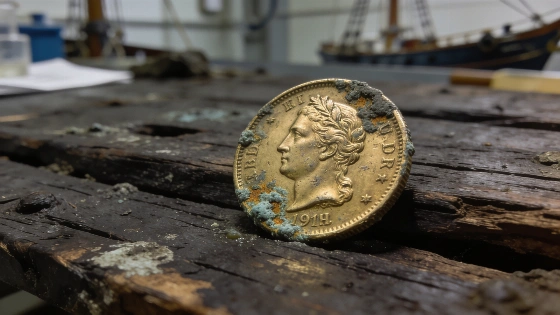
A rare 1857-S Liberty Head Double Eagle, graded MS-65, resurfaced after spending over a century on the Atlantic seabed following the S.S. Central America disaster, linking numismatic history to a pivotal moment in US finance
Few coins encapsulate as much American history as the 1857-S Liberty Head Double Eagle recovered from the wreck of the S.S. Central America. Graded MS-65 by PCGS and featuring the Spiked Shield reverse variety, this $20 gold piece is more than a numismatic rarity-it is a survivor of both a maritime tragedy and a financial crisis that shaped the United States.
Struck at the San Francisco Mint in 1857, just three years after the facility opened to process California Gold Rush bullion, the coin was part of a shipment intended to support the nation's eastward flow of gold. The San Francisco Mint produced 970,500 Liberty Head Double Eagles that year, each weighing 33.40 grams and containing 0.9675 troy ounce of gold. The coins were designed by James Barton Longacre and intended to facilitate large-value transfers in an era before the transcontinental railroad.
The Spiked Shield and Its Significance
What distinguishes this particular double eagle is its Spiked Shield reverse, cataloged as Variety-20A. The variety is identified by two raised projections on the shield, a result of a specific reverse die used at the young San Francisco Mint. This physical marker allows collectors to trace the coin to a particular moment in minting history, and the Spiked Shield is especially prevalent among coins recovered from the S.S. Central America. PCGS recognizes this variety under #70000, making it a sought-after piece for both variety specialists and Gold Rush historians.
The S.S. Central America Disaster
The coin's journey took a dramatic turn in September 1857. After being shipped from San Francisco to Panama, then across the isthmus and onto the S.S. Central America, the gold was bound for New York. The side-wheel steamer, captained by William Lewis Herndon, encountered a devastating hurricane off the US East Coast. Despite desperate efforts by passengers and crew, the ship sank on September 12, 1857, with the loss of approximately 425 lives and a massive cargo of California gold-including thousands of freshly minted double eagles.
The timing of the disaster was critical. The loss of gold intensified the Panic of 1857, a financial crisis that had already begun to destabilize American banks and markets. The disappearance of so much specie further undermined confidence in the financial system, amplifying the effects of the panic.
Recovery and Numismatic Impact
For over 130 years, the S.S. Central America and its treasure rested nearly 8,000 feet below the Atlantic. In 1988, advanced underwater technology enabled treasure hunters to locate and recover the wreck. Among the finds were more than 5,000 1857-S double eagles, many in high Mint State grades. Before this discovery, such coins were rarely seen in pristine condition, as most had entered circulation. The recovery transformed collector understanding of the issue, providing a unique window into mid-19th-century American coinage and commerce.
Not all recovered coins are equal. Large gold coins often show contact marks from storage and handling, even if they never circulated. The MS-65 example offered by AU Capital Management stands out for its exceptionally clean surfaces, rich satin luster, and rose-gold coloration. According to a 2024 Stack's Bowers listing, the coin can be traced to the S.S. Central America, though its current PCGS insert does not display this provenance. As of 2024, PCGS reported 619 Spiked Shield double eagles in MS-65 and 158 finer, but population figures can change as coins are regraded or reholdered.
Historical and Collecting Context
This coin appeals to multiple collecting interests: Liberty Head gold specialists, variety collectors, Gold Rush historians, and shipwreck enthusiasts. Its survival in Gem Mint State after a transcontinental journey, a shipwreck, and 131 years underwater is remarkable. The coin's story is a tangible link to the economic, technological, and human dramas of 19th-century America.
For those interested in the broader context of American coinage milestones, the United States Mint's recent commemorative issues-such as the dual-date Morgan and Peace Silver Dollars marking 250 years of independence-demonstrate how numismatic releases continue to reflect pivotal moments in US history. For more on these modern commemoratives, see the coverage of the 2026 Morgan and Peace Dollar anniversary coins.
Coin specifications for the 1857-S Double Eagle include a denomination of $20, a diameter of 34 mm, a reeded edge, and a composition of 90% gold and 10% copper. The coin is currently offered by AU Capital Management, led by Russell Augustin, who has been active in the numismatic field since 1982.
Understanding Shipwreck Provenance in Numismatics
Shipwreck provenance adds a unique dimension to coin collecting. Coins recovered from famous wrecks like the S.S. Central America are valued not only for their rarity and condition but also for their historical narrative. Provenance can affect both desirability and price, especially when the coin's journey intersects with major events such as financial panics or technological milestones. Collectors should be aware that population reports for such coins can fluctuate as grading services update their records, and that provenance may not always be reflected on certification inserts. Ultimately, shipwreck coins like the 1857-S Double Eagle serve as enduring artifacts of the complex interplay between currency, commerce, and history.