
The 2001-D American Buffalo Silver Commemorative Dollar revived a classic U.S. coin design and sold out its entire mintage in only two weeks, linking collectors to Native American history and supporting a major Smithsonian museum project
In June 2001, the United States Mint launched a commemorative coin that would quickly become a landmark in modern American numismatics. The 2001-D American Buffalo Silver Commemorative Dollar, issued to mark the creation of the Smithsonian Institution's National Museum of the American Indian, combined a celebrated historical design with a civic fundraising mission. The result was an unprecedented surge in demand: the entire authorized mintage of 500,000 coins was sold out in just 15 days.
This commemorative issue did more than honor a museum opening. It reintroduced James Earle Fraser's iconic Buffalo Nickel design to a new generation, connecting collectors to a narrative rooted in the American frontier, Indigenous heritage, and national memory. The coin's rapid sellout demonstrated the enduring appeal of classic American coinage when paired with a meaningful cause.
Design, Purpose, and Public Response
The 2001-D American Buffalo Silver Commemorative Dollar was authorized by Public Law 106-375, which established the American Buffalo Commemorative Coin Program. The law's intent was to celebrate the founding of the National Museum of the American Indian in Washington, D.C., and to help fund its construction, endowment, and educational outreach. Each coin carried a $10 surcharge, with proceeds directed to support the museum's mission of representing Indigenous cultures and histories in the heart of the U.S. capital.
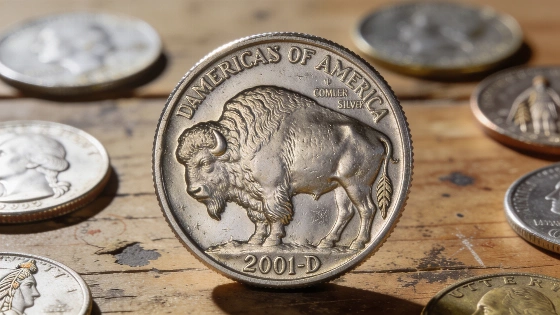
Rather than commission a new design, the Mint revived Fraser's Buffalo Nickel motif, first introduced in 1913. The obverse features a composite portrait of a Native American, inspired by Iron Tail (Sioux), Big Tree (Kiowa), and Two Moons (Cheyenne), symbolizing enduring Native strength. The reverse depicts an American bison standing on a mound, a powerful image of resilience and the American landscape. The commemorative dollar, struck in 90% silver with a 38.1 mm diameter, offered a larger and more detailed canvas than the original five-cent piece.
Collectors responded immediately when sales opened on June 7, 2001. Both the uncirculated Denver ("D" mint mark) and proof Philadelphia ("P" mint mark) versions were available, but the total mintage was capped at 500,000 coins. By June 21, the entire allocation had been purchased, with 227,131 uncirculated and 272,869 proof coins distributed. Calls for additional production were rejected, locking in the coin's scarcity from the outset.
Numismatic Impact and Cultural Significance
The 2001-D American Buffalo Silver Commemorative Dollar stands at the intersection of art, history, and civic engagement. It was the first U.S. commemorative coin to directly support a major museum dedicated to Indigenous peoples, giving it lasting cultural relevance. The decision to revive Fraser's Buffalo Nickel design resonated deeply with collectors, reaffirming its status as one of the most admired motifs in U.S. coinage. The coin's runaway success also paved the way for the U.S. Mint's 24-karat Gold Buffalo bullion program, introduced in 2006, which drew on the same design and benefited from the renewed enthusiasm generated by the 2001 issue.
For context, the rapid sellout of the Buffalo commemorative echoed other moments in coin history when collector demand outpaced supply. For example, the 1780 Courland thaler, issued just before the region's absorption by Russia, remains a sought-after piece for its historical significance and limited availability-a story explored in our article on Courland's last independent coinage.
Many modern commemorative coins struggle to maintain collector interest, but the 2001-D Buffalo dollar remains notable for its modest mintage, instantly recognizable design, and connection to a major national milestone. Its place in the modern commemorative canon is secured by the rare convergence of legislative intent, cultural recognition, and numismatic artistry.
Facts and Figures
The 2001-D American Buffalo Silver Commemorative Dollar program was limited to a maximum of 500,000 coins, split between uncirculated (Denver) and proof (Philadelphia) versions. Sales began on June 7, 2001, and the entire mintage was sold by June 21, 2001. The final distribution was 227,131 uncirculated and 272,869 proof coins. Each coin contained 90% silver and carried a $1 face value, with a $10 surcharge benefiting the National Museum of the American Indian.
The coin's rapid sellout and enduring popularity highlight the power of combining classic design with a clear civic purpose. The Buffalo motif's return in 2001 not only honored a new museum but also demonstrated that historical coinage can still capture the imagination of modern collectors when thoughtfully reissued.
Commemorative coins in the United States are typically authorized by Congress for specific events, anniversaries, or institutions. Unlike circulating coins, these issues are produced in limited quantities and often include surcharges to support designated causes. The 2001-D American Buffalo Silver Commemorative Dollar is a prime example of how such programs can bridge the gap between public history, cultural recognition, and collector demand. Its success also illustrates the importance of mintage limits in shaping long-term numismatic value, as scarcity and historical context often drive sustained interest among collectors.