The 1923 Lincoln Porthole $5 Silver Certificate stands out for its bold design, limited release, and unusual history, making it one of the most sought-after large-size U.S. banknotes among collectors and currency historians
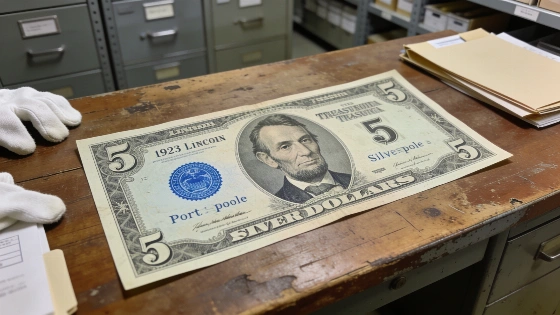
Among the most distinctive American banknotes, the 1923 Lincoln Porthole $5 Silver Certificate is instantly recognizable for its oversized format and striking portrait of Abraham Lincoln framed within a bold circle. Issued during a period of Treasury modernization, this note's story is as much about changing eras in U.S. currency as it is about design. While millions were printed, most were held in government vaults, and only a fraction ever reached the public, contributing to its enduring rarity and mystique.
The Porthole's nickname comes from its unique layout: Lincoln's portrait appears as if viewed through a ship's round window, surrounded by the words THE UNITED STATES OF AMERICA. Blue Treasury seals and serial numbers, along with a large blue numeral 5, add to its visual impact. The reverse features the Great Seal of the United States in green, surrounded by intricate geometric engraving. Measuring about 7.4 by 3.1 inches, these so-called "Horse Blanket" notes are much larger than today's U.S. bills, which measure 6.14 by 2.61 inches.
Origins and Treasury Policy Shifts
The roots of the Silver Certificate trace back to the Bland-Allison Act of 1878, which allowed Americans to deposit silver coins with the Treasury in exchange for paper certificates. Initially available only in higher denominations, $1, $2, and $5 Silver Certificates were introduced in 1886, making it easier for people to carry value without heavy coins. By the early 1920s, however, the U.S. currency system had become complex, with overlapping denominations and outdated designs. Treasury Secretary Andrew Mellon led a push for modernization, aiming for simpler layouts and consistent portraits across denominations. The 1923 $5 Silver Certificate, featuring Lincoln, was part of this effort, with production beginning in 1924 and serial numbering continuing until 1926.
Despite a total print run of 6,316,000 notes (equal to $31,580,000 in face value), the Treasury's evolving policy soon made the $5 Silver Certificate obsolete. Officials decided to focus on $1 Silver Certificates and phase out the $5 denomination, leaving millions of freshly printed Portholes in storage. Only about two million notes were released in 1924 and 1925, with another large batch entering circulation in New York in 1929 due to a local shortage of $5 bills. The remainder never saw regular use, making high-grade examples especially scarce today.
Design, Criticism, and Collector Appeal
Lincoln's central portrait, engraved by Charles Burt from an 1864 Anthony Berger photograph, had already appeared on earlier notes and coins, but the Porthole gave it a dramatic new setting. The note's design was so unusual that some numismatic lore claims people thought Lincoln appeared as if seen through a gun barrel-a story often repeated but not supported by Treasury correspondence. Documented criticism at the time focused instead on the ornate Roman numeral V, which some mistook for a 1. The Smithsonian's National Numismatic Collection and the book 100 Greatest American Currency Notes both highlight the Porthole's unique place in U.S. currency history, ranking it among the most significant American notes.
For collectors, the Porthole's appeal is heightened by its production quirks and the fact that it was the last large-size $5 Silver Certificate before the U.S. switched to smaller notes in 1929. The first note off the press, serial number A1B, vanished from public view for nearly a century before resurfacing at a 2019 currency auction, adding to the note's legend. Today, estimates suggest that perhaps 5,000 examples survive in all grades, with high-quality pieces commanding significant premiums at auction. For comparison, a PMG Gem Uncirculated 65 EPQ example sold for $10,370 in January 2026, while a Choice Very Fine 35 brought $2,928 in June 2026.
Facts and Figures: Production and Survival
The 1923 Lincoln Porthole $5 Silver Certificate was produced in a single series (Fr. 282), with all notes bearing the signatures of Harley V. Speelman and Frank White. The Bureau of Engraving and Printing delivered the first notes to the Treasury on August 7, 1924, and completed serial numbering by March 12, 1926. Of the 6,316,000 notes printed, only about four million are believed to have entered circulation, with the rest held back or destroyed. Survival estimates remain uncertain, but the number of high-grade notes is especially limited, reflecting both the note's brief period of use and the Treasury's rapid shift to smaller currency formats.
The Porthole's story is not unique in American numismatics. Other rare and visually striking notes, such as the 1890 $100 Watermelon Treasury Note, have also become icons for collectors and historians. For those interested in the broader landscape of U.S. currency collecting, the story of the 2000 Sacagawea Dollar series-known for its rare gold strikes and prototypes-offers another example of how design, rarity, and historical context combine to create lasting value. See more in this feature on the Sacagawea Dollar's impact on modern U.S. coin collecting.
Understanding Silver Certificates and Their Legacy
Silver Certificates were a key part of the U.S. monetary system from the late 19th century until the mid-20th century. They allowed holders to exchange paper notes for silver dollars, providing a practical alternative to carrying heavy coins. Over time, as the U.S. moved away from precious-metal-backed currency, Silver Certificates lost their redemption privilege and became collectible artifacts. The 1923 Lincoln Porthole $5 Silver Certificate stands as a tangible reminder of this transition, marking the end of the large-size note era and the beginning of a new chapter in American currency design.
While the Porthole's design and scarcity make it a favorite among collectors, its real significance lies in what it represents: a moment when the U.S. Treasury sought to modernize its currency, only to have policy changes render a bold new note nearly obsolete overnight. The note's journey from vault storage to collector centerpiece illustrates how monetary policy, design, and historical circumstance can intersect in unexpected ways, leaving behind artifacts that continue to fascinate generations later.
Silver Certificates, including the 1923 Lincoln Porthole, were once redeemable for their face value in silver dollars, reflecting a time when U.S. paper money was directly tied to precious metals. This system provided both practical convenience and a sense of security for holders, but it also introduced complexity and rigidity into the monetary system. As the U.S. shifted toward fiat currency and smaller, more efficient note formats, Silver Certificates became obsolete, yet their legacy endures in the world of currency collecting and historical research. The Porthole note, in particular, encapsulates the challenges and ambitions of its era, serving as a bridge between the age of silver-backed money and the modern dollar.