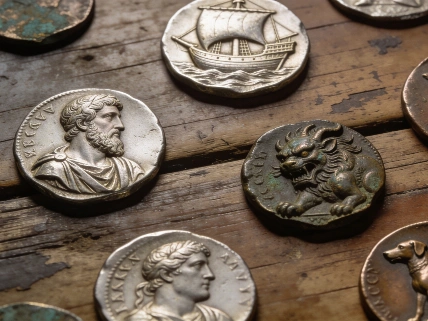

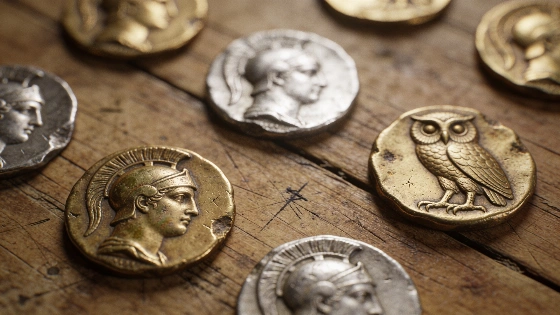
Athena's portrait became a defining feature of ancient coinage, spreading from Athens to distant regions and influencing monetary design from the Greek world to Rome and beyond. This article traces her numismatic journey and cultural impact
For centuries, the goddess Athena stood at the center of Greek religious and civic life. Her influence, however, extended far beyond mythology and temples-Athena's image became one of the most recognizable motifs on ancient coins, shaping monetary design from Athens to the edges of the ancient world. As Greek coinage spread through trade, conquest, and cultural exchange, Athena's portrait and symbols traveled with it, leaving a lasting mark on the currencies of multiple civilizations.
In Greek tradition, Athena was associated with wisdom, strategic warfare, crafts, and the protection of cities. Her iconography-helmet, shield, owl, olive branch-became shorthand for these qualities. The city of Athens, named for the goddess after a legendary contest with Poseidon, placed her at the heart of its civic identity. This connection was not just symbolic: Athenian coins, especially the silver tetradrachms known as "Owls," featured Athena's helmeted head on one side and her sacred owl on the other. These coins, first issued in the late sixth century BCE, became a dominant trade currency across the Mediterranean, recognized for their consistent weight and purity.
Athena's Portrait Beyond Athens
While Athens was the epicenter of Athena's numismatic presence, her image quickly spread to other Greek cities and regions. In Ionia, cities like Phokaia issued coins with Athena's helmeted profile, adapting her features to local artistic styles. Corinth, a major trading power, produced silver staters with Pegasus on one side and Athena wearing a Corinthian helmet on the other-a design widely imitated by Corinthian colonies and neighboring cities.
Further west, in Magna Graecia (southern Italy), cities such as Velia struck coins with Athena's portrait, reflecting both local identity and broader Greek influence. Even in Bactria, far to the east in what is now Afghanistan and Central Asia, coins from the third century BCE show Athena's familiar helmeted head, demonstrating the reach of Greek culture following Alexander the Great's campaigns.
Some mints experimented with more ambitious designs, depicting Athena facing forward rather than in profile. These rare issues, such as those from Herakleia in Lucania or Issos in Cilicia, required advanced engraving skills and produced some of the most visually striking coins of the ancient world. In Syracuse, Sicily, a celebrated tetradrachm from around 405 BCE replaced the usual nymph Arethusa with Athena, surrounded by dolphins-a design that may have reflected the city's recent military victory over Athens itself.
Seated, Standing, and Advancing Athena
Athena's representation on coins was not limited to her portrait. Hellenistic rulers, such as Lysimachos of Thrace, placed a seated Athena holding Nike (the personification of victory) on the reverse of their silver tetradrachms. This image became a hallmark of post-Alexandrian coinage, symbolizing both divine favor and military success. In Pergamon and other cities, Athena appears seated with her shield and spear, sometimes interacting with dynastic inscriptions or local symbols.
Other coins show Athena standing, often holding a spear, shield, or the figure of Nike. The gold staters of Pergamon, for example, feature an archaistic Palladion-Athena standing ready for battle. Seleucid and Parthian rulers also adopted Athena's standing figure, sometimes depicting her crowning the king or presenting a wreath, blending Greek iconography with local royal imagery. In some cases, Athena is shown advancing, spear drawn, as on coins from the Thessalian League or the satrapal issues of Ptolemy I, capturing a sense of movement and martial readiness.
From Athena to Minerva: Roman Adaptations
As Greek influence spread into the Roman world, Athena's image was adapted into the Roman pantheon as Minerva. Roman Republican and Imperial coins frequently borrowed Greek visual conventions, depicting Minerva with helmet, spear, and shield. On some issues, Minerva appears advancing or holding a trophy, echoing earlier Greek designs. The continuity of Athena's iconography across Greek and Roman coinage illustrates how monetary imagery served as a vehicle for cultural transmission and political messaging.
By the first century BCE, Roman coins featuring Minerva circulated widely, reinforcing her association with wisdom, warfare, and civic protection. The persistence of these motifs highlights the enduring power of classical imagery in shaping perceptions of authority and legitimacy through currency.
Numismatic Evidence and Historical Reach
The widespread use of Athena's image on coins provides valuable evidence for historians and collectors tracing the movement of Greek art, religion, and political influence. Athenian "Owls" were so trusted that they became a de facto international currency, with imitations appearing as far afield as Egypt, the Near East, and Central Asia. The adoption of Athena's portrait by non-Greek rulers, including the Parthians, demonstrates the flexibility and appeal of Greek numismatic language even in regions outside direct Greek control.
According to numismatic research, Athenian tetradrachms were produced in vast quantities during the fifth century BCE, with their weight standard (around 17.2 grams) and silver content making them a preferred medium for large transactions. The "New Style" tetradrachms introduced in the second century BCE featured more elaborate designs but retained the core Athena-and-owl identity, reflecting both artistic evolution and the persistence of tradition.
For collectors and historians, the study of Athena on ancient coins offers a window into the interconnectedness of the ancient Mediterranean and Near East. The goddess's image not only marked the authority of the issuing city or ruler but also signaled participation in a shared cultural and economic system that spanned continents.
Understanding the role of Athena in ancient coinage requires attention to both artistic conventions and the practical realities of currency circulation. While the helmeted head of Athena became a standard motif, local variations and adaptations reveal how cities and rulers balanced tradition with innovation. The enduring presence of Athena-and later Minerva-on coins underscores the importance of visual symbols in establishing trust, conveying political messages, and facilitating trade across diverse societies.