
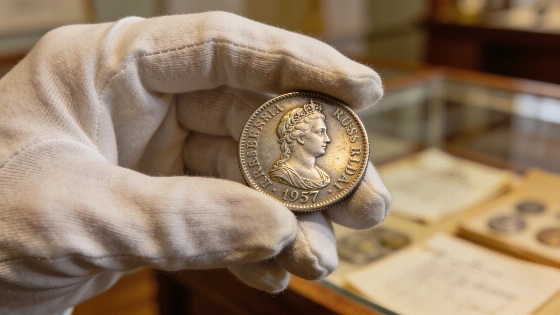
A rare 1757 Russian rouble featuring Empress Elizabeth's portrait was withdrawn after just three months, but collectors now consider it a masterpiece. The story reveals the intersection of art, technology, and imperial power in currency history.
For a brief period in 1757, the Russian Empire's silver rouble underwent a dramatic transformation. The Saint Petersburg Mint introduced a new portrait of Empress Elizabeth, designed by renowned Genevan medallist Jacques-Antoine Dassier. However, the coin's life in circulation was cut short when the empress herself ordered production to stop, making the 1757 Dassier rouble one of the most coveted rarities in Russian numismatics.
The Dassier rouble's significance extends beyond its scarcity. It marks a pivotal moment in Russian monetary art, reflecting the tensions between European neoclassical aesthetics, imperial expectations, and the technical limits of 18th-century minting. The episode also highlights the influence of foreign engravers in shaping Russia's coinage, a tradition dating back to Peter the Great's reforms in the early 1700s.
Foreign Talent and Imperial Ambition
Peter the Great's drive to modernize Russia's monetary system led to the recruitment of European specialists skilled in die making and medallic portraiture. Figures such as Jean-Georg Breuer, Solomon Gouin, and Gottfried Haupt played key roles in establishing Russia's medallic tradition and training local craftsmen. By the mid-18th century, the Saint Petersburg Mint relied on a portrait of Elizabeth by Scottish engraver Benjamin Scott, which depicted the empress in elaborate imperial regalia.
Seeking a new artistic direction, Russian officials turned to Jacques-Antoine Dassier, whose reputation was built on his work for the Royal Mint in London and a celebrated series of medals featuring British intellectuals. Dassier's contract with Russia, signed in 1756, required him to create coin and medal dies, teach Russian apprentices, and source high-quality steel for minting. His annual salary of 2,500 roubles, plus travel and assistant expenses, reflected the importance placed on his expertise.
The 1757 Rouble: Artistry and Rejection
Dassier's design for the 1757 rouble broke sharply with tradition. The obverse featured a right-facing bust of Elizabeth with flowing curls and a small crown, rendered in a lighter, classical style rather than the heavy imperial dress of earlier coins. The reverse displayed the Russian double-headed eagle, crowned and bearing the shield of St. George. The edge bore a lettered inscription identifying the Saint Petersburg Mint.
Initially, the new portrait received official approval, and the mint began striking roubles from Dassier's dies in July 1757. But within three months, Elizabeth reversed her decision, instructing the mint to halt production and requesting a new portrait more closely resembling Scott's earlier work. The reasons for her change of heart remain debated. Some later accounts suggest she disliked the depiction of her ears or the informal hairstyle, but no official records confirm these stories. Technical challenges may also have played a role, as Dassier's high-relief design proved difficult to strike sharply with the mint's equipment.
Rarity, Varieties, and Legacy
The Dassier rouble was produced for only about three months, and no separate mintage figure survives. Surviving examples are highly prized, not only for their rarity but for their artistic merit. Russian numismatists such as V.V. Uzdenikov have praised the coin as one of the finest imperial portraits ever placed on Russian currency. Modern research has identified at least six principal die varieties, reflecting differences in letter spacing, portrait positioning, date shape, and minor die defects. Some rare hybrids combine Dassier's portrait with reverses by other engravers, or vice versa.
One notable specimen, preserved by the Smithsonian Institution, features a hole near the upper obverse-likely added for official approval or archival purposes. Another mystery surrounds a second Dassier rouble, reportedly struck with a revised portrait in 1758, which has never been located in any collection or auction.
Facts and Data
The 1757 Dassier rouble was struck in silver with a fineness of .802, a standard weight of 25.85 grams, and a diameter of approximately 40-42 mm. The coin's production lasted only about three months in 1757, and no reliable mintage figure is available. In January 2014, a Mint State (MS64) example sold at Heritage Auctions for $176,250, with only two Mint State specimens traced at that time. The coin's catalog references include KM-C19c.3, Davenport 1680, Bitkin 282-284, and Diakov 433-435.
Aftermath and Historical Context
Dassier's time in Russia was brief but influential. He also created dies for a rare 1757 gold 10-rouble coin and medals commemorating the opening of Moscow University. Illness forced him to leave Russia in 1759, and he died later that year in Copenhagen. The Dassier rouble's reputation grew over time, with early Russian coin catalogs assigning it high values relative to other types. Today, it stands as a testament to the complex interplay of artistic ambition, imperial authority, and technological constraint in the history of Russian money.
The episode of the 1757 Dassier rouble illustrates how currency design can become a battleground for competing visions of national identity, artistic style, and technological capability. While Empress Elizabeth's personal preferences determined the coin's fate in her lifetime, later generations of collectors and scholars have come to see the rejected portrait as a masterpiece-an outcome that underscores the unpredictable legacy of monetary art.
In the 18th century, the process of designing and approving new coinage in Russia was shaped by both artistic and practical considerations. Foreign engravers brought new techniques and styles, but their work had to satisfy the tastes of the imperial court and the technical realities of the mint. High-relief designs, while visually striking, often proved difficult to produce consistently with available technology, leading to production challenges and, in some cases, official rejection. The story of the Dassier rouble highlights the delicate balance between innovation and acceptance in the evolution of currency.