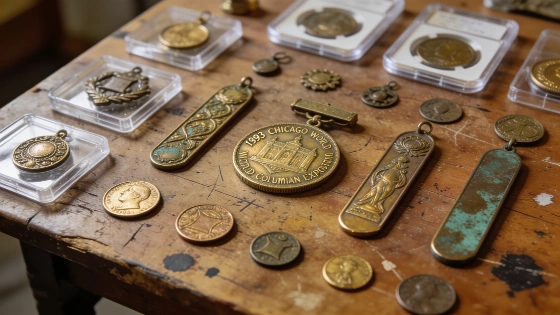
Heritage Auctions will offer 209 certified medals, tokens, and souvenirs from the 1893 Chicago World's Columbian Exposition in November 2026. Collectors face a rare shot at documented artifacts with deep provenance.
Heritage Auctions is gearing up for a November 2026 sale that will test the nerve of serious collectors. The Steve Starlust Showcase Auction of Rare 1893 Columbiana lands on November 9, bringing 209 medals, tokens, tickets, and souvenirs from the Chicago World's Columbian Exposition to the block. Online bidding opens October 9 and runs for a month, as confirmed by E-Sylum. Every piece comes from a collection built over 15 years, with each item tracked and cataloged down to the last detail.
Starlust didn't just amass memorabilia. He built a documented archive that ties back to a fair that drew over 27 million visitors between May and October 1893. The event introduced electric lighting and the Ferris Wheel, which towered 264 feet and could move up to 20,000 riders a day. Several centerpiece tokens in the auction feature the Ferris Wheel, now a symbol of American ambition. The fair's timing was no accident: it landed during a period of monetary upheaval, with the gold standard and bimetallism debates rattling the U.S. economy. The Federal Reserve wouldn't exist for another two decades, but the fair's commemorative coins and tokens hinted at the growing role of numismatics in American money culture.
Heritage's catalog spotlights medals, badges, tickets, and elongated coins. Some pieces carry the R-9 rarity tag, meaning they're among the hardest to find. The 1892 Ferris Wheel Dollar token (HK-170, Eglit-157), graded MS62 Deep Prooflike by NGC, stands out as a tribute to the fair's headline attraction. Another highlight: the 1893 Columbian Exposition View on Globe medal, graded NGC MS67, which as of September 2026 is the finest certified example of its kind. Collectors will also see historical tickets and an elongated coin pressed on an 1891-O Seated Liberty dime, a direct link to the era's currency and commemorative habits. These pieces matter for anyone tracking the evolution of U.S. coinage and the blurred line between circulating money and commemorative issues-a subject the U.S. Treasury and Federal Reserve have both examined in their reviews of currency design and public engagement.
Provenance and documentation drive value in this market. Heritage will debut a limited-edition NGC certification label, designed with Starlust, featuring the Ferris Wheel and the "Steve Starlust Collection" inscription. The catalog uses attribution numbers from Starlust's own reference, Referencing Columbiana, which builds on Nathan N. Eglit's work and documents overlooked varieties. The Numismatic Literary Guild named Starlust's book Best Reference Book of 2025 in the Tokens & Medals category, a nod to the research rigor now expected in the field. E-Sylum confirmed the award and the book's impact.
Starlust spent six years on Referencing Columbiana, which filled gaps left by earlier guides and earned recognition from the Token and Medal Society. The book's detailed attributions and descriptions have become a reference point for collectors and dealers. In the global collectibles market, provenance and third-party certification now shape price discovery and liquidity. The International Monetary Fund has flagged these factors in its analysis of alternative asset markets and their overlap with traditional finance.
Bidding for the Starlust collection opens October 9, 2026, with the main event on November 9. Each lot comes with a 22% buyer's premium and a $29 minimum. The full catalog and registration for Auction #63365 are available through Heritage's platform. Direct inquiries go to Steve Starlust at stevestarlust@gmail.com or (631) 374-4483. The auction's structure, including buyer's premiums and minimums, matches practices in major numismatic and art markets, where transparency and regulatory compliance are under the microscope from agencies like the U.S. Securities and Exchange Commission and the European Central Bank.
The 1893 World's Columbian Exposition ran for six months and left a deep mark on American currency history. While millions attended, only a small share of the fair's medals, tokens, and souvenirs survived in collectible shape. R-9 rarities in this sale are known in extremely limited numbers, making them prime targets for specialists. Elongated coins-pressed on contemporary U.S. coinage-show the direct link between circulating money and commemorative practice, a theme that surfaces in other numismatic events such as the Munich Show. Broader macroeconomic trends, including inflation expectations and real interest rates, shape demand and auction results. The Federal Reserve's recent policy statements have highlighted how inflation and monetary tightening ripple through alternative investments, including rare coins and collectibles.
The fair's official medals and tokens came in a range of metals and designs, often echoing the era's faith in technology. Surviving examples in high grades, especially with clear provenance and modern certification, fetch strong premiums. The auction's buyer's premium and minimum lot price follow the playbook for major numismatic sales, aiming for transparency and competitive bidding. As the ECB and other central banks keep tabs on how monetary policy moves asset prices, the intersection of numismatics and financial markets stays in focus for both collectors and regulators.
Bringing 209 certified artifacts from the 1893 World's Columbian Exposition to auction is a rare alignment of historical preservation and market demand. The Starlust collection's depth, paired with modern documentation and recognition from top numismatic groups, sets a new standard for cataloging and valuing currency-related objects. The Bank for International Settlements has noted the rising role of alternative assets in global portfolios, pointing to the need for robust documentation and regulatory oversight.
Elongated coins, or pressed pennies, fall under exonumia-objects tied to currency but not issued as legal tender. At the 1893 fair, visitors could use machines to press designs onto coins, creating souvenirs with a direct link to both the event and the underlying money. Their survival depends on the durability of the host coin and the care of collectors. Today, elongated coins from the fair stand as artifacts that bridge everyday money and commemorative culture.