
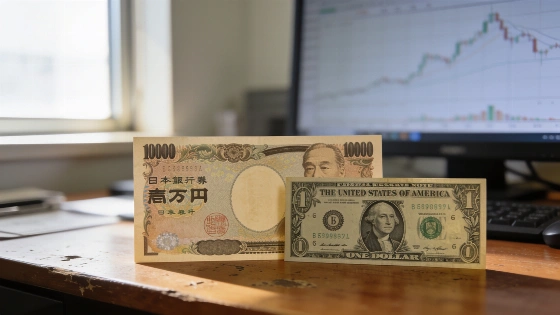
Goldman Sachs and Crédit Agricole have sharply lowered their US dollar to Japanese yen forecasts. Both banks now expect a stronger yen, pointing to policy changes in Japan and possible pension-fund moves.
Goldman Sachs and Crédit Agricole have both made a sharp U-turn on the dollar-yen outlook. Their new forecasts point to a stronger yen ahead. The shift is clear. Both banks have dropped their earlier bullish calls for the dollar. They now see Japan's currency gaining ground as policy changes and pension-fund flows reshape the market.
Goldman Sachs has cut its twelve-month USD/JPY target from 165 to 150. That is a big reversal. The bank now expects the exchange rate to hit 158 in three months, 155 in six months, and 150 in a year. This new target means a drop of about 4.7% from where the pair traded on Monday afternoon, near 157.35. Crédit Agricole has also lowered its outlook. It now sees an average USD/JPY rate of 156 in the fourth quarter of 2026, down from 163. By the last quarter of 2027, it expects 150, compared to its earlier 156 forecast.
Policy changes and pension fund moves
Why the sudden change? The answer lies in Japan's shifting policy. For years, the yen stayed weak because of easy money at home and global trends. That is changing. Both banks now point to a more positive policy stance. Goldman Sachs says faster rate hikes have helped offset the inflation from government spending. This has eased pressure on the yen. The Bank of Japan has signaled it may speed up rate increases. In its September meeting summary, several BoJ members pushed for quicker tightening to fight stubborn inflation. Bond yields have jumped. The 10-year Japanese government bond yield hit 3.12%. The 2-year yield reached 1.950% by the end of September 2026. These are levels not seen in decades. Markets expect more action from the BoJ. Japanese bond yields climb.
Crédit Agricole is watching Japan's Government Pension Investment Fund (GPIF). If the GPIF boosts its domestic bond holdings, the bank thinks about $115 billion could come back to Japan. That number could grow if other pension funds follow. This would give the yen another lift. But Crédit Agricole warns the timing and size of any shift are still unclear. The bank's best-case scenarios put short-term USD/JPY fair value in the 148-150 range. That depends on real portfolio moves. Recent data shows foreign investors sold a net ¥4.6 trillion in Japanese bonds in the week to September 26, 2026. That is the biggest weekly outflow in six months. The market is reacting to BoJ signals and rising yields. Bond market outflows.
Risks and limits
The outlook for the yen is better, but risks remain. If pension funds do not shift enough money, other factors could hold the yen back. High oil prices and a BoJ that only matches US Federal Reserve rate hikes could cap gains. Goldman Sachs also points to possible repatriation flows and the risk of intervention. But most of the expected portfolio moves are still just talk. Japanese officials have warned against letting the yen fall too far. Top currency diplomat Atsushi Mimura told markets to pay attention to "very clear" signals from Tokyo and Washington about the yen. The risk of direct intervention is real if volatility keeps up, as reported by Reuters and the BoJ.
Recent trading shows how jumpy the market is. The USD/JPY pair dropped 0.97% on Friday. It edged up 0.04% on Monday. Markets are reacting fast to new signals and shifting forecasts. These changes fit a wider trend. Big banks are rethinking currency outlooks as policy and capital flows change. Earlier reports showed similar moves for the euro and dollar.
Forecasts and market data
Goldman Sachs now sees USD/JPY at 158 in three months, 155 in six months, and 150 in twelve months. Its old targets were 162, 163, and 165. Crédit Agricole expects an average of 156 in Q4 2026 and 150 in Q4 2027. Its previous forecasts were 163 and 156. The spot rate was about 157.35 on Monday afternoon. Crédit Agricole's $115 billion repatriation estimate is based on the GPIF raising its domestic bond share to about 31% and similar moves by related funds. Both banks stress these numbers depend on real policy and portfolio decisions. Nothing is certain yet.
The GPIF is the world's biggest pension fund. Its choices shape capital flows in and out of Japan. When it buys more domestic bonds, it usually sells foreign assets and brings the money home. That can push the yen up. But the timing and size of these moves are hard to see. Traders have to watch official statements, policy hints, and real portfolio data to judge the impact on the yen. The Bank of Japan's next steps, along with signals from the Ministry of Finance and other regulators, will keep driving the yen's path in the months ahead.