
A rare 1879 Quintuple Stella gold coin, the best-preserved of only five ever made, will be auctioned by Heritage in 2026 after nearly two decades off the market, highlighting a unique episode in US monetary history
One of the rarest and most storied coins in American numismatics-the 1879 Quintuple Stella-will reappear at public auction in 2026, marking its first market appearance in 18 years. Heritage Auctions has confirmed it will offer the coin, graded PCGS PR64+ Deep Cameo, as Lot 3604 during its Platinum Session at the 2026 ANA U.S. Coins Signature Auction. Of the five known examples, four remain in private collections and one is held by the Smithsonian Institution. The auction is scheduled for September 2, 2026, with the full event running from August 31 to September 5.
The Quintuple Stella's Experimental Origins
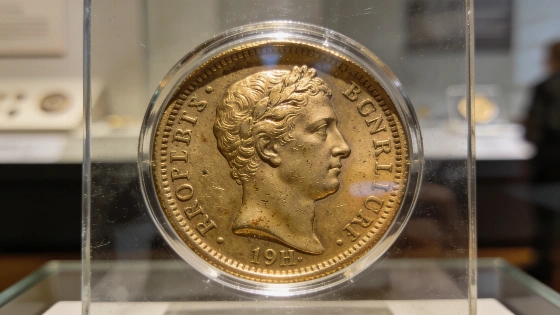
The 1879 $20 Liberty Head Quintuple Stella, catalogued as Judd-1643 and Pollock-1843, was conceived during a period when the United States considered aligning its coinage with European standards. The coin's design was based on metric weight and included a three-metal alloy, reflecting an ambition to create a gold coin that could facilitate international trade-decades before the euro would emerge as a shared European currency. Only five gold Quintuple Stellas were struck, and the dies were destroyed, ensuring their extreme rarity. The coin's obverse features James B. Longacre's Liberty Head, while the reverse replaces the familiar "IN GOD WE TRUST" with the Latin phrase "DEO EST GLORIA," meaning "To God is the glory." At approximately 35 grams, the Quintuple Stella is heavier than the standard double eagle of its era.
Pedigree and Collector Significance
This particular specimen traces its provenance through some of the most prominent collectors in American coin history, including Virgil Brand, Fred Olsen, Dr. John E. Wilkison, the Southern Collection, and Bob R. Simpson. Its status as the finest-certified Judd-1643 has made it a trophy piece for advanced collectors. The coin's mathematical inscription detailing its metallic composition and weight underscores its experimental nature and the monetary debates of the late 19th century.
Market Context and Recent Sales
In August 2025, another 1879 Quintuple Stella achieved a sale price of $2,160,000, setting a benchmark for this rare pattern. The upcoming Heritage auction is expected to draw significant attention from collectors and institutions, given the coin's rarity, condition, and historical importance. The event echoes other landmark moments in American numismatic history, such as the gathering of all 1933 Double Eagles at the 2026 World's Fair of Money, which brought together over $100 million in rare coins and currency and offered a unique perspective on the evolution of US monetary policy. For more on that historic display, see this feature on the 1933 Double Eagles exhibition.
Facts and Figures
The 1879 Quintuple Stella weighs about 35 grams and was struck in a gold alloy as part of a short-lived experiment in international coinage. Only five examples were produced, and the dies were destroyed after minting. The most recent public sale of a Quintuple Stella in August 2025 reached $2,160,000, reflecting the coin's status as one of the most valuable US pattern coins ever sold.
Understanding Pattern Coins and Their Role
Pattern coins like the Quintuple Stella were never intended for general circulation but served as prototypes to test new designs, denominations, or technical standards. In the late 19th century, the US Mint produced several such patterns as policymakers debated how best to position American currency in a global context. While most patterns remained obscure, a few-such as the Quintuple Stella-became legendary for their rarity, experimental features, and the insight they offer into the ambitions and constraints of their era. Today, these coins are prized not only for their scarcity but also for the stories they tell about the evolution of money and the challenges of international monetary cooperation.