A select group of early US quarters stamped with E or L above Liberty's head have puzzled collectors for generations. Despite multiple theories and high auction prices, the true origin of these marks remains unproven.
The appearance of a Capped Bust quarter stamped with a mysterious "L" at auction in August 1881 introduced a numismatic puzzle that remains unsolved. For more than 145 years, the meaning of the E and L marks-punched above Liberty's head on certain 1815 and 1825 US quarters-has eluded collectors, researchers, and even grading services, which now recognize these coins as distinct varieties. These coins circulated during a formative period in US monetary policy, when the nation's currency system was still developing and the dollar's value was closely linked to its silver content, a standard managed by the Treasury and influenced by international silver prices tracked by the Bank of England (BoE).
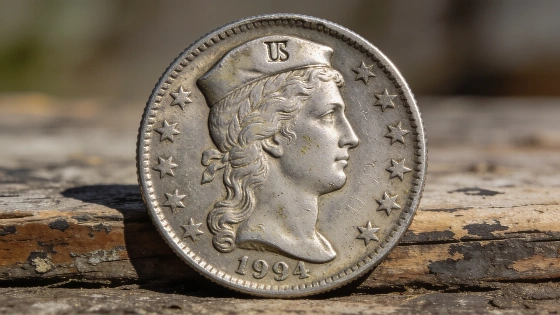
The intrigue surrounding these quarters stems not only from their rarity but also from the intentional and consistent placement of the letters. The E and L punches appear exclusively on a narrow subset of Capped Bust quarters: all 1815 examples are from the Browning-1 die marriage, while the 1825 coins are attributed to the B-2 die marriage, itself an 1825/4/2 overdate. The marks are always set above Liberty's cap, near the rim, and most surviving coins show minimal wear-many are graded Extremely Fine (XF), About Uncirculated (AU), or even Mint State. This level of preservation suggests the counterstamps were applied before the coins saw heavy circulation, and that owners may have set them aside for reasons still unknown. The high quality of these coins stands out, especially given that the US Mint's silver coin output in the early 19th century fluctuated with bullion supply and periodic suspensions of specie payments, as documented in Federal Reserve historical reviews.
Theories and evidence
Despite years of speculation, no contemporary documentation has surfaced to explain the purpose of these stamps. Theories have ranged from Mint testing and production controls to academic awards and religious disputes. One of the more detailed proposals connects the coins to the Harmony Society, a German-American communal group in Pennsylvania. According to this theory, the E and L marks may have identified rival factions-Economite and Leon-during a schism in 1832. The society's split, triggered by the arrival of Bernhard Müller (Count de Leon), resulted in a settlement where dissenters received cash and possessions. The timeline fits, and this could explain the coins' preservation, but there is no direct documentary evidence. This era also saw the US dollar's exchange rate with the British pound fluctuate, with silver flows affecting the broader monetary environment, as tracked in the Federal Reserve monetary policy archives.
Another hypothesis, put forward by Walter Breen, suggests the quarters were awarded as school prizes, with E for English and L for Latin. This could account for their high grades, as students might have kept them as keepsakes. Yet, as with the Harmony Society theory, no school records or advertisements have been found to support this idea. Other suggestions-including the marks indicating Mint screw-press settings, weight standards, or involvement in unofficial pattern sales-also remain unsubstantiated. The physical evidence complicates the picture: there is no consistent difference in weight, edge reeding, or die alignment between stamped and unstamped coins, and the effect of the counterstamp on the reverse varies from coin to coin. The absence of Mint documentation is striking, especially given the detailed record-keeping that would later define US Mint operations, as seen in annual reports to Congress and referenced by the International Monetary Fund (IMF) in its historical reviews of US currency stability.
Market appearance and grading
While some sources claim collectors were aware of these counterstamps as early as the 1870s, the first documented auction appearance was the 1881 Massamore sale. Afterward, E and L quarters began appearing more frequently in 1882 and 1883. Numismatic researcher Karl Moulton has speculated that the death of William DuBois, a former Mint assayer and curator, in July 1881 may have released a group of these coins into the market, though no evidence directly links DuBois to the counterstamped quarters.
In recent years, the numismatic community's perspective on these coins has shifted. Once dismissed as post-Mint damage, E and L quarters are now recognized by grading services such as PCGS, which began assigning numerical grades and labeling the counterstamp on holders in August 2019. This has created a specialty market for the four recognized varieties: 1815 E, 1815 L, 1825 E, and 1825 L. Auction records from 2008 to 2025 show prices ranging from $3,525 to $35,937.50, with the 1815 L considered the most elusive. The distribution of E and L marks is uneven; for example, the 1815 L is about four times rarer than the 1815 E, according to Steve Tompkins's research. Collector demand for these varieties has grown alongside a broader rise in rare coin prices, which often move independently of headline inflation indices such as the US Consumer Price Index (CPI) reported by the Bureau of Labor Statistics and monitored by the Federal Reserve for monetary policy decisions.
Physical details and surviving questions
All 1815 Capped Bust quarters were struck at the Philadelphia Mint, designed by John Reich, with a mintage of 89,235 coins. The 1825 host coins, all overdates, are attributed to three die marriages, but only the B-2 is known to carry the E and L marks. These coins are composed of 89.24% silver and 10.76% copper, weigh 6.74 grams, and measure 27 mm in diameter. Despite careful study, no pattern in weight or edge features distinguishes the counterstamped coins from their unstamped counterparts. The silver content reflected the US Mint's adherence to the bimetallic standard, a policy later debated by the US Treasury and the Bank for International Settlements (BIS) as global monetary systems evolved.
For collectors and researchers, the lack of a definitive explanation is both a frustration and a source of fascination. The Harmony Society and school-prize theories each connect several clues, but without a contemporary record-no ledger, letter, or newspaper notice-the marks remain unexplained. The earliest auction appearance in 1881 provides a fixed point for further research, but the trail remains cold. As reported earlier, the definition of what makes a coin significant can shift with new discoveries, but in this case, the evidence remains incomplete.
Unless a document emerges that clearly states why these quarters were stamped E and L, the coins will remain more than just rare collectibles. They are enduring artifacts of an unsolved American numismatic case-physical clues from a story that, for now, refuses to yield its answer. The market's recognition of these varieties has given them new status, but the real value lies in the ongoing search for the truth behind two small letters that have outlasted generations of collectors and researchers.
The Capped Bust quarter series, introduced after an eight-year break in quarter production, marks a period of transition in early US coinage. The 1815 issue was prompted by a specific request from the Planters' Bank of New Orleans, resulting in a unique mintage and a single die marriage for the year. The 1825 overdates further illustrate the complexities of early Mint operations. Whatever their origin, the E and L counterstamps have become a focal point for understanding how coins can serve as both currency and historical documents-sometimes raising more questions than they answer.