

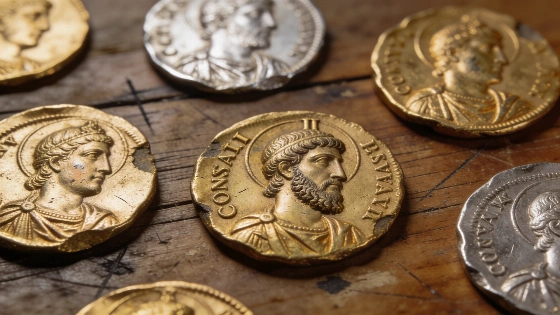
The coinage of Constans II offers a rare visual record of a ruler's aging and the Byzantine Empire's turmoil, from dynastic upheaval and religious conflict to the emperor's assassination and the collapse of key frontiers
Few rulers in history have left such a detailed visual record of their reign as Constans II, emperor of Byzantium from 641 to 668 CE. His coins not only document his physical transformation-from a clean-shaven child to a ruler with a famously long beard-but also reflect the empire's political instability, religious disputes, and economic pressures during one of its most challenging periods.
Constans II came to power at just 10 years old, following a rapid succession of deaths and coups after the passing of his grandfather Heraclius. The empire was under immediate threat: Arab armies had seized much of Egypt and were advancing through Syria. After the deaths of Heraclius Constantine and Heraclonas, and the removal of the influential empress Martina, Constans II was installed as emperor. His early coins, struck in Constantinople, show an idealized, beardless young man-an image designed to project stability and continuity to subjects across the empire.
Dynastic Upheaval and the Rise of "Big Beard"
As Constans II matured, his coin portraits changed. By the late 640s, engravers depicted him with a short beard, and by the early 650s, his beard had grown dramatically, earning him the nickname "ho Pōgōnatos" or "the Bearded." This evolving image was not just a matter of style; it marked the passage of time and the emperor's growing authority, even as the empire's fortunes declined. The coins also began to include indictional dates-Greek letters marking the 15-year tax cycle-providing rare chronological anchors for historians.
Religious conflict was a defining feature of Constans II's reign. In 648, he issued the Typos edict, attempting to silence debate over the nature of Christ's will, a move that angered both major theological factions. Coinage from this period often shows Constans with his now-iconic long beard and mustache, making these issues among the most recognizable in Byzantine numismatics.
Coinage as Political Messaging
Constans II used his coins to reinforce dynastic legitimacy. In 654, his eldest son Constantine IV was named co-emperor and appeared alongside his father on the gold solidus. By 659, his younger sons Heraclius and Tiberius were also depicted, with some coins showing all four imperial figures. These designs announced the strength and continuity of the Heraclian dynasty, even as the empire's borders continued to contract.
By the early 660s, Constans II's popularity had eroded due to heavy taxation and religious policies. In 662, he left Constantinople, traveling to Rome and then relocating his court to Syracuse in Sicily. The last coins struck in Constantinople for Constans II, around 663-668, omitted his personal name and instead featured his three sons, signaling a shift in imperial focus and perhaps an attempt to secure the dynasty's future.
Assassination and Aftermath
Constans II's reign ended violently in 668 when he was murdered in his bath in Syracuse at age 37. The circumstances remain debated, but one account claims he was killed with a heavy bronze vessel. His death triggered a brief revolt led by Mezezius, an Armenian commander, who issued extremely rare gold coins during his seven-month rule before being defeated by Constantine IV.
Coin production during Constans II's reign was not limited to Constantinople. The Carthage mint, still under Byzantine control, produced distinctive thick and crude gold coins known as "dumpy" issues, often with garbled inscriptions. These coins may have been struck using gold sourced from trans-Saharan trade routes. Meanwhile, the Syracuse mint became increasingly important as the imperial court relocated, and its coins are now highly sought after by collectors.
Silver and Bronze in a Shrinking Empire
Economic strain is evident in the coinage of Constans II. The silver hexagram, introduced by Heraclius around 615 as an emergency payment for soldiers, continued in large volumes under Constans II. These coins bore the inscription "DEUS ADIUTA ROMANIS" ("O God, help the Romans") and mirrored the changing imperial portraits seen on gold issues. Bronze coinage, however, suffered a dramatic decline in weight and quality, with the follis shrinking from nearly 24 grams under Justinian I to less than six grams. Many bronze coins from this era are poorly struck and irregular, reflecting the empire's financial difficulties.
For collectors, the coinage of Constans II offers a unique opportunity to trace the emperor's life and the empire's decline through numismatic evidence. Gold coins from Carthage and Syracuse are particularly rare and valuable, while the silver hexagram stands out for its powerful inscription. Bronze coins remain affordable but are often found in poor condition. The standard reference for these issues is the Dumbarton Oaks catalogue, with David Sear's guide also widely used. For those interested in how modern themes intersect with coin collecting, the global phenomenon of pop culture coins is explored in this feature on sci-fi-themed coinage.
During Constans II's nearly 27-year reign, the Byzantine Empire lost significant territory, faced internal religious strife, and saw its coinage reflect both the personal journey of its ruler and the broader crisis of the state. His numismatic legacy remains a vivid, tangible record of an era marked by uncertainty and transformation.
The evolution of Byzantine coinage under Constans II highlights how money served not only as a medium of exchange but also as a tool of imperial communication. Portrait changes, inscriptions, and the inclusion of dynastic heirs were deliberate choices to project legitimacy, stability, and continuity in times of crisis. The decline in coin quality and weight, especially in bronze, offers direct evidence of economic stress, while the rare issues from provincial mints like Carthage and Syracuse underscore the fragmentation of imperial authority. For historians and collectors alike, these coins provide a window into the mechanisms by which rulers sought to maintain control and shape public perception through currency.