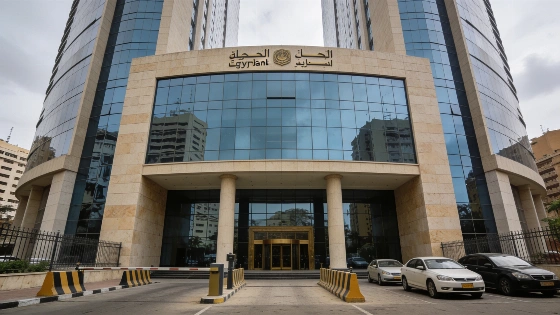
The National Bank of Egypt added 816 billion pounds in corporate deposits from 2022 to 2025, outpacing 25 rivals and capturing almost a third of all new institutional money in the country's banking sector.
Monetary tightening swept through Egypt's banking sector as the Central Bank hiked rates to fight inflation and currency swings. In the middle of this, the National Bank of Egypt quietly built a lead that left competitors scrambling to keep up. Its corporate deposit book jumped by 816.09 billion Egyptian pounds between the end of 2022 and 2025, according to published financials. No other bank came close.
Bank Misr, the next in line, managed a 253.97 billion pound increase. That left a gap of more than 560 billion pounds between first and second place. The National Bank's dominance has shifted the balance of power among Egypt's top lenders. Central Bank interventions in the foreign exchange market helped steady the pound after the 2023 devaluation and managed float, as tracked by the IMF and detailed in Monetary Policy Committee releases.
Across 26 major banks, total corporate deposits climbed from 3.16 trillion pounds at the end of 2022 to 5.91 trillion pounds by late 2025. That's an 87% jump, or about 2.76 trillion pounds in new institutional money. The National Bank's own client deposits hit 5.7 trillion pounds by December 2025, then rose to roughly 6.4 trillion by August 2026, based on sector data. The gains were not spread evenly. The largest banks took the lion's share, while smaller players posted modest increases.
After the National Bank and Bank Misr, Arab African International Bank added 244.88 billion pounds. QNB Alahli followed with 229.31 billion, and Commercial International Bank (CIB) posted a 195.73 billion pound gain. Arab International Bank and Suez Canal Bank added 186.48 billion and 118.73 billion pounds. Only eight banks managed to grow their corporate deposit portfolios by more than 100 billion pounds each during the three-year window. Abu Dhabi Islamic Bank Egypt joined this group, while Faisal Islamic Bank of Egypt brought up the rear with a 1.77 billion pound increase.
Foreign-owned banks made their presence felt. QNB Alahli, Abu Dhabi Islamic Bank Egypt, and HSBC all landed in the top ten for absolute corporate deposit growth. Among Islamic banks, Abu Dhabi Islamic Bank Egypt and Kuwait Finance House Egypt stood out, with the latter adding 60.32 billion pounds. Still, the biggest Islamic banks lagged far behind the sector's giants. The Central Bank's regulatory moves and liquidity injections helped both conventional and Islamic lenders weather market stress, a pattern noted by the Bank for International Settlements in its global reviews.
These rankings reflect absolute increases, not percentage growth. A bank with a large starting base can post a bigger gain in pounds even if its growth rate lags smaller rivals. The numbers come from independently published financial statements for each bank at the end of 2022 and 2025.
The full ranking by absolute increase: National Bank of Egypt (816.09 billion pounds), Bank Misr (253.97 billion), Arab African International Bank (244.88 billion), QNB Alahli (229.31 billion), CIB (195.73 billion), Arab International Bank (186.48 billion), Suez Canal Bank (118.73 billion), Abu Dhabi Islamic Bank Egypt (95.21 billion), Export Development Bank of Egypt (64.69 billion), and HSBC (62.13 billion). The rest posted increases from 60.32 billion down to 1.77 billion pounds.
For context, the National Bank's corporate deposits grew from 878.3 billion pounds at the end of 2022 to about 1.69 trillion by 2025. Bank Misr's corporate deposits rose from 588.58 billion to 842.54 billion pounds. Arab African International Bank expanded from 145.31 billion to 390.19 billion. Bank Misr also reported a 17% annual increase in total client deposits in 2025, rising from 2.498 trillion to 2.935 trillion pounds, with corporate lending up 17% to about 1.3 trillion pounds, according to Cairo24.
The National Bank's share-nearly 30% of all new corporate deposits-puts it at the center of Egypt's financial system. Other banks have posted record profits as digital banking and deposit growth reshape the sector, as reported earlier. The Central Bank's ongoing policy changes, including reviews of reserve requirements and open market operations, continue to shape liquidity and deposit flows, in line with the Federal Reserve and European Central Bank playbooks.
The data does not spell out why the National Bank has pulled so far ahead. Its massive deposit base gives it a built-in edge with large institutional clients. The gap between the top bank and its rivals has only widened. This may reflect longstanding corporate relationships or the ability to offer products that attract big depositors. The IMF has flagged that such concentration can boost stability in the short run but may create systemic risks if left unchecked.
Absolute growth does not always mean the fastest relative expansion. Smaller banks may have posted higher percentage jumps, but their impact on the market remains limited by their size. The available data focuses on absolute gains, not relative growth rates.
Rapid growth in corporate deposits brings both opportunity and risk for Egypt's banks. The biggest lenders have expanded their funding base, which can support more lending and investment. At the same time, the concentration of deposits in a few hands could raise questions about competition and resilience if market conditions shift. The Central Bank, working with the IMF and BIS, continues to monitor these trends to safeguard systemic stability and effective monetary policy.
Corporate deposits are a key funding source for banks, often more stable than retail money because of their size and duration. But they can be more sensitive to interest rate changes or sudden liquidity needs. Banks that depend on a handful of large depositors face bigger swings if those clients pull out. Egypt's experience during recent currency devaluations and inflation spikes highlights the need for strong risk controls and regulatory oversight, as stressed in recent Federal Reserve and ECB policy updates.