
The 1861 D Gold Dollar is the only U.S. coin struck entirely under Confederate rule. Its survival, rarity, and authentication challenges make it a unique Civil War artifact with values now reaching six figures at auction.
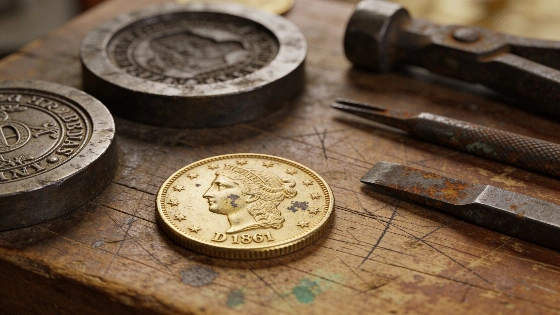
The 1861-D Gold Dollar is a contradiction in metal: it looks like a United States coin, but none were made under U.S. government authority. Every example was struck after the Dahlonega Mint in Georgia came under Confederate control, making it the only regular-issue U.S. coin produced entirely by the Confederacy. Today, collectors pay as much as $220,000 for a single coin, drawn by its tangled Civil War history and extreme rarity. Its price has climbed alongside the broader rare coin market, which often tracks global gold prices and the strength of the U.S. dollar-factors closely watched by the Federal Reserve.
Most Southern branch-mint coins from this era were struck both before and after secession, but not the 1861-D Gold Dollar. All were minted after the Confederacy took over Dahlonega. That fact alone sets it apart, turning it from a collectible into a direct artifact of a nation at war with itself. On March 9, 1861, the Confederate Congress authorized the continued operation of the Dahlonega and New Orleans mints and ordered preparations for new dies, aiming to keep coinage flowing during the conflict.
Mint Seized, Coinage Continues
The transfer of the Dahlonega Mint wasn't dramatic. The same staff who had worked for the U.S. Mint simply kept working-now for a new government. The machinery, dies, and designs stayed the same, but the authority behind the coins changed. This makes the 1861-D Gold Dollar both a product of continuity and a break with the past. The mint was formally transferred to Confederate control on April 8, 1861, and only after that date did production of the 1861-D Gold Dollar resume, as confirmed by numismatic research and historical records.
Georgia left the Union on January 19, 1861. By April, the mint was officially under Confederate control. The Confederate Congress passed a resolution to keep the Dahlonega and New Orleans mints running and to prepare new dies for future coins. For the 1861-D Gold Dollar, though, the dies had already arrived from Philadelphia before secession, and the staff used them to strike coins for a government now in rebellion. This episode highlights the complicated relationship between money and political legitimacy-a theme that still matters in central banking today, as seen in the policy frameworks of the Federal Reserve and other major institutions.
No official Federal mintage report for the 1861-D Gold Dollar survives, so production estimates vary. Most modern sources suggest between 1,000 and 1,500 coins were struck, with PCGS using 1,000 and NGC and the Guide Book of United States Coins listing 1,250. Some researchers argue for higher or lower numbers, but the true figure is unknown. Doug Winter estimates that only 65 to 75 examples survive in all grades, with perhaps 10 to 15 in Mint State. That survival rate is extremely low, even compared to other 19th-century U.S. gold coins, and helps explain why the 1861-D is so prized among collectors.
Authentication and Survival
Authenticating an 1861-D Gold Dollar is not simple. Only one die marriage-called Winter 12-Q-was used. The obverse die had already served for 1860-D Gold Dollars, paired with a new 1861 reverse die. The coins themselves are often crude by Philadelphia standards: the U and N in UNITED are usually weak, Liberty's hair and plumes lack detail, and the planchets are rough, sometimes cracked. These flaws, once seen as defects, now help experts confirm authenticity. The U.S. Secret Service and the U.S. Mint have both issued guidance on spotting counterfeits, reflecting the ongoing need for careful authentication in the rare coin market.
The most convincing fakes aren't outright forgeries but altered Philadelphia 1861 Gold Dollars with a D mintmark added. NGC has documented such cases, where the added D is malformed and surrounded by suspicious material. The real D mintmark is small, high, tilted right, and close to the right ribbon end. Authenticating the coin means matching the entire die pattern, not just checking for a mintmark.
Many surviving coins show signs of cleaning, jewelry use, or repair. Some were made into pins or pendants and later restored for collectors. These changes can affect grade and value but don't automatically mean the coin is fake. Collectors are advised to check rims and surfaces under magnification for signs of mounting or smoothing.
Market Value and Collector Demand
Prices for the 1861-D Gold Dollar have jumped in recent years, reflecting both its rarity and the strength of the rare coin market. The best-known example, once part of the Duke's Creek Collection and graded NGC MS65, sold for $138,000 in 2006 and $149,500 in 2008. After being graded PCGS MS64+, it brought $180,000 at Heritage in September 2020. Another PCGS MS63 CAC matched that price in May 2023. Even circulated coins now bring high sums: a PCGS AU58 sold for $102,000 at Stack's Bowers in November 2024, and another AU58 brought $96,000 at Heritage in August 2025. As of 2026, the 1861-D Gold Dollar is valued from $9,500 for heavily worn pieces to $220,000 for top Mint State coins, with only one or two examples typically appearing on the market each year. These prices stand out even compared to gold's performance as a commodity, which is tracked by the International Monetary Fund and referenced in central bank reserve management.
The 1861-D Gold Dollar's specifications are exact: 90% gold, 10% copper, 1.672 grams in weight, 15 mm in diameter, and a reeded edge. All were struck at Dahlonega, Georgia, using the Type 3 Gold Dollar design by James Barton Longacre. Every known example dates from the spring of 1861, with production generally placed in May, just before the mint stopped making coins for good. The mint closed in June 1861 and became an assay office, ending coin production at Dahlonega-a decision shaped by the Confederacy's changing priorities and the realities of war.
Historical Stakes and Modern Lessons
The 1861-D Gold Dollar is more than a rare Southern coin. It's a physical record of the moment the United States lost control of its own mint, even as the coins still bore the name UNITED STATES OF AMERICA. Within weeks of striking these dollars, the Confederacy shut down the Dahlonega Mint as a coining facility and turned it into an assay office. No more coins were made there. This episode shows how fragile monetary systems can be during political upheaval, a topic still studied by the Bank for International Settlements and other global financial regulators.
Collectors interested in Civil War-era coins have options, from New Orleans issues struck as Louisiana left the Union to Charlotte and Dahlonega gold, and privately made Confederate tokens. But only the 1861-D Gold Dollar was struck entirely under Confederate authority, with no doubt about its origins. Its appeal lies not just in rarity, but in its status as a product of political crisis-a coin made possible by the collapse of Federal power in the South.
In numismatics, survival often matters more than mintage. As reported earlier, coins ignored in their own time can become legends when only a few survive in top condition. The 1861-D Gold Dollar's path from a hastily struck rebel issue to a six-figure auction highlight shows that the value of money is shaped by history, conflict, and uncertainty-not just gold content or face value.
When looking at Civil War-era coins, it's important to know which were made under Federal authority and which came after a mint's allegiance changed. The 1861-D Gold Dollar stands alone here. Its authentication depends on die diagnostics, mintmark placement, and surface analysis-not just date and mintmark. Its market value reflects not only rarity but also the complexity of its origins and the risks collectors face from counterfeits and altered coins. Understanding these details is essential for anyone interested in the intersection of history and numismatics.