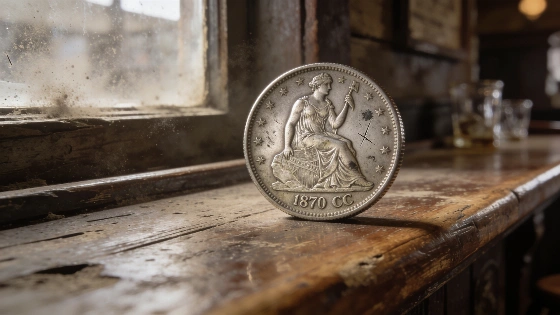
The 1870-CC Seated Liberty dollar, the first silver dollar struck at the Carson City Mint, remains a scarce and historically significant coin shaped by the realities of frontier minting and limited preservation
In 1870, the Carson City Mint struck its first silver dollars. The number was small-just 12,462 coins. This was the 1870-CC Seated Liberty dollar. It came from a mint that was more outpost than institution. The West was rough. Coin production was unpredictable. Most of these dollars ended up in daily use, not in collections. Saloons saw more of them than safes. Later, Morgan dollars from Carson City would become famous. The 1870-CC stayed in the background. But it mattered just as much.
The Morgan dollars get the spotlight. The 1870-CC Seated Liberty dollar came from a different world. The Carson City Mint sat in Nevada's mining country. It was built because the region had so much silver. But the mint was small. Its equipment was basic. Production was slow. Quality was hit or miss. Most coins went straight into circulation. People spent them fast. Few cared about saving coins by year or mintmark. The 1870-CC was 90% silver, with 0.7734 troy ounces per coin. That matched the U.S. Mint's standard for Seated Liberty dollars from 1840 to 1873. This is confirmed by historical mint records and the Federal Reserve's monetary archives.
Frontier minting and collector challenges
Carson City's coins from these years are known for being scarce. Many were not well made. The region had few collectors. Almost no one saved coins in top condition. High-grade 1870-CC dollars are extremely rare. Some say many were underweight and later melted. No one has proved it. What is clear: most 1870-CC dollars were used as money, not as keepsakes. The mint's small size and tough conditions limited how many coins it could make. Philadelphia, the main U.S. Mint, had far more resources. Carson City had to work with less. The region's economy and the era's logistics set hard limits.
In the 1960s, a bag of Carson City silver dollars turned up in government storage. This find brought new attention to the mint's coins. The sale of these coins, especially the Morgans, made headlines. Collectors chased them. Some called them "the coins Jesse James never got." The legend grew. But the Seated Liberty dollars, including the 1870-CC, stayed in the shadows. The U.S. Treasury's silver policy and coinage rules at the time were shaped by big debates over gold and silver. The bimetallic standard and the changing role of silver in the U.S. economy played a part. The IMF's historical data repository documents these shifts.
Rarity and market value
The 1870-CC Seated Liberty dollar is rare, but not the priciest U.S. coin. A worn G-4 example sells for about $3,200. An XF-40, which saw less use, goes for around $7,750. These prices show both the coin's scarcity and its lower profile compared to Morgans. The 1870-CC's mintage is tiny. Modern mints make more coins in minutes. Carson City's total output of Seated Liberty dollars was always low. Numismatic books and official mint stats confirm this.
Other first-year silver dollars have their own stories. The 1870-S dollar, for example, has no official mintage record. It was likely made for a ceremony at the San Francisco Mint. Specialists may chase the 1870-S, but the 1870-CC stands out for its low numbers, frontier roots, and survival odds. It is a true outlier among U.S. silver dollars.
Legacy and historical perspective
The 1870-CC Seated Liberty dollar is a piece of Old West history. It shows what early U.S. minting was really like. This coin's story is about more than rarity. Geography, technology, and economic need shaped its path. It started in a rough Nevada mint. Now, it sits in collections. The journey was not smooth. Central banks like the Federal Reserve still track precious metals in their reserves. Silver prices and coin demand shift with inflation and the economy. Recent CPI and PCE index releases show this in action.
Collectors and historians see the 1870-CC as proof that not all legendary coins are famous or expensive. Some, like this Seated Liberty dollar, survived because of luck and circumstance. They were not made for collectors. They were made for use. As reported earlier, the rare coin market keeps changing. But the 1870-CC's value comes from its link to a key chapter in U.S. money history.
The difference between Seated Liberty and Morgan dollars is more than just looks. The Seated Liberty series ran from 1840 to 1873. It was shaped by local silver, old technology, and changing trade. Morgan dollars started in 1878. They came from better machines and a growing collector scene. Knowing these differences explains why coins like the 1870-CC are so hard to find-and why they matter, even if their price goes up and down.