Standard Chartered projects the AUD/USD rate to reach 0.74 within three months and 0.75 in a year, citing support from the Reserve Bank of Australia, Chinese growth, commodity demand, and a stronger link to gold prices
The Australian Dollar is expected to gain further ground against the US Dollar over the coming year, with Standard Chartered forecasting the AUD/USD exchange rate to reach 0.74 in three months and 0.75 within twelve months. This outlook is underpinned by a combination of domestic monetary policy, external demand, and commodity market dynamics, with gold emerging as a notable-though secondary-factor in recent months.
As of late Monday, the AUD/USD pair was trading near 0.7114, reflecting a daily increase of approximately 0.42%. Over the course of 2026, the Australian Dollar has appreciated by 6.66% against the US Dollar, according to Standard Chartered's analysis. The bank's projections are based on the expectation that several supportive forces will remain in place, even as global conditions evolve.
RBA Policy and External Drivers
The Reserve Bank of Australia (RBA) continues to play a central role in shaping the currency's trajectory. The RBA's decision to maintain its official cash rate at 4.35% was accompanied by a policy stance that remains firmly restrictive. Governor Michele Bullock has reiterated that further rate increases are possible if inflationary pressures persist, signaling to markets that Australian interest rates may stay elevated for longer than previously anticipated. This stance contrasts with a softer US Dollar environment and is reinforced by signs of improving economic momentum in China, a key trading partner for Australia.
Commodity prices, particularly for resources such as iron ore and coal, have also provided a tailwind for the Australian Dollar. As China's growth outlook stabilizes and demand for raw materials remains robust, Australia's terms of trade have benefited, supporting the currency's value. These factors combine to create a constructive backdrop for the AUD/USD pair, though the path to the forecasted levels still requires further gains of roughly 4% to reach 0.74 and just over 5% to reach 0.75 from current levels.
Gold's Strengthening Correlation
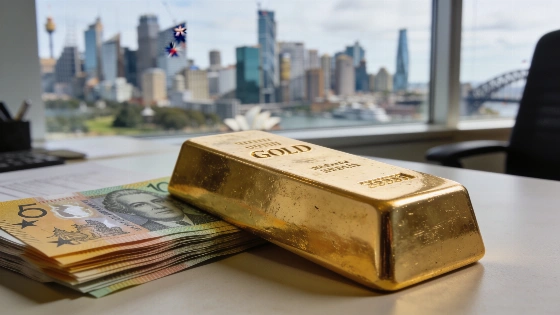
While gold is not the primary driver of the Australian Dollar, its influence has grown more pronounced in recent months. Standard Chartered notes that the three-month correlation between gold prices (XAU/USD) and the AUD/USD exchange rate has climbed to +0.82, compared to a three-year average of +0.59. This suggests that movements in gold and the Australian Dollar have become more closely aligned, likely reflecting shared sensitivities to global risk appetite, US Dollar trends, and commodity demand.
However, the bank cautions that gold should be viewed as a supporting indicator rather than the main determinant of the currency's direction. If the short-term correlation between gold and the Australian Dollar reverts to its longer-term average, this would weaken-but not invalidate-the supporting signal from gold. The broader forecast remains anchored in Australia's domestic policy and global macroeconomic conditions.
Forecasts, Risks, and Market Context
Standard Chartered's one-year forecast allows for the possibility that shifts in Chinese growth or commodity demand could offset any temporary changes in the US Dollar or gold correlation. The first key milestone is the three-month target of 0.74, which will require continued support from the RBA and resilient external demand. Should these conditions persist, the Australian Dollar's upward trajectory remains plausible, though not guaranteed.
For context, similar dynamics have influenced other major currency pairs in recent months. For example, the British Pound's performance against the US Dollar has also been shaped by interest-rate differentials and shifting demand for downside protection, as discussed in our recent coverage of how UK-US yield spreads have supported Sterling's gains. These examples highlight the importance of both domestic policy and global market sentiment in determining currency outcomes.
According to Standard Chartered, the current environment supports a constructive bias for the Australian Dollar, but the distance to the forecasted targets remains meaningful. Market participants should remain attentive to shifts in policy, commodity prices, and external demand, as these factors will determine whether the AUD/USD pair can sustain its recent momentum.
When analyzing currency movements, it is important to distinguish between correlation and causation. The recent rise in the correlation between gold and the Australian Dollar does not mean that gold prices directly cause the currency to appreciate. Instead, both assets often respond to similar global forces, such as changes in risk appetite, US Dollar strength, and commodity demand. Understanding these relationships helps clarify why certain indicators may appear more influential during specific periods, but also why their predictive power can fluctuate over time.