
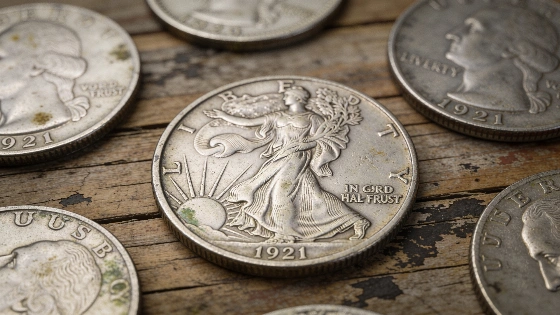
The 1921-D Walking Liberty half dollar stands out for its low mintage and heavy circulation, making it one of the most sought-after US coins of the 20th century and a benchmark for collectors tracking rare American silver coinage
Among the many notable coins produced in the United States during the 20th century, the 1921-D Walking Liberty half dollar occupies a unique position. While collectors often focus on smaller denominations such as the 1909-S Indian cent or the 1916-D Mercury dime, the 1921-D half dollar has become a central reference point for those interested in rare American silver coins. Its combination of low mintage and extensive circulation has contributed to its enduring appeal and scarcity in higher grades.
Production Constraints and Circulation Patterns
The year 1921 was marked by unusual production priorities at the US Mint. With the transition from Morgan dollars to the new Peace dollar design, minting resources were heavily allocated to silver dollar production, leaving other denominations with sharply reduced outputs. The Denver Mint produced just 208,000 Walking Liberty half dollars in 1921, a figure that remains the lowest mintage for any circulating half dollar of the 20th century. For comparison, the Philadelphia Mint struck only 246,000 halves, and San Francisco produced 548,000, both also exceptionally low numbers for the series.
Unlike proof coins, which are struck for collectors, the 1921-D was intended for general circulation. Its low mintage did not immediately translate into collector demand, as half dollars were not a primary focus for most numismatists at the time. Many 1921-D halves entered everyday use and remained in circulation for years, making well-preserved examples especially difficult to find today.
Market Value and Collector Demand
The 1921-D Walking Liberty half dollar has established itself as the key date for circulated coins in its series. According to recent market data, a specimen graded G-4 (Good) is valued at approximately $285, a significant increase from $145 just a few years prior. The price rises steeply in higher circulated grades: VG-8 (Very Good) examples command around $470, while VF-20 (Very Fine) pieces reach $1,600. In XF-40 (Extremely Fine), the coin can fetch as much as $3,875. Notably, only the 1921-S half dollar, with a higher mintage, surpasses the 1921-D in price at the highest circulated grades.
These figures reflect both the rarity of the 1921-D in better condition and the strong collector interest in the Walking Liberty series. The coin's status is reinforced by its consistent performance in the numismatic market, where demand for classic US silver coins remains robust. For context, the 1933 Double Eagle gold coins, another iconic rarity, are set to be displayed together at a major event, highlighting the ongoing fascination with rare American coinage (see coverage of the $100 million coin exhibition).
Historical Context and Competing Rarities
In the early 1920s, collectors had several options for acquiring scarce US coins. Barber half dollars from 1913, 1914, and 1915 were available with even lower mintages than the 1921-D, and the 1916 Standing Liberty quarter had already attracted attention for its rarity. As a result, the 1921-D half dollar did not immediately stand out, and many pieces continued to circulate, further reducing the number of high-grade survivors.
Over time, however, the 1921-D's combination of low mintage and heavy use has made it a benchmark for collectors. Its price trajectory and scarcity in upper grades have cemented its reputation as a cornerstone of 20th-century US coin collecting. The coin's appeal is also tied to the enduring popularity of the Walking Liberty design and the broader interest in large silver denominations among collectors.
For those tracking the evolution of US coinage, the 1921-D Walking Liberty half dollar offers a clear example of how production decisions, collector preferences, and circulation patterns can combine to create lasting numismatic value.
The Walking Liberty half dollar series, issued from 1916 to 1947, is widely regarded for its artistic design and historical significance. The 1921-D stands out not only for its rarity but also for illustrating the impact of minting priorities and economic conditions on coin availability. Unlike commemorative or proof issues, the 1921-D was a workhorse of everyday commerce, and its survival in collectible condition is a testament to both chance and changing collector attitudes. Understanding the dynamics behind such coins helps explain why certain dates become key references in the world of currency history and collecting.