
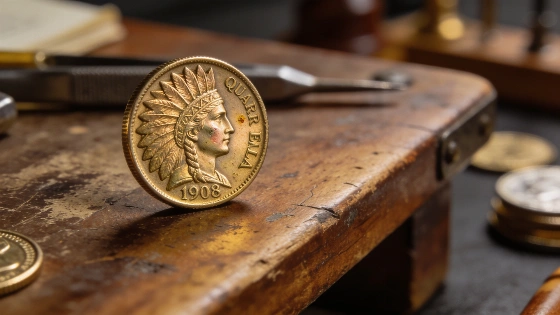
A 1908 Indian Quarter Eagle graded MS-67 by PCGS will headline Stack's Bowers Galleries' Summer 2026 auction, offering collectors a chance at one of the finest surviving examples of this iconic U.S. gold coin in exceptional condition
One of the rarest condition examples of the 1908 Indian Quarter Eagle will be offered at Stack's Bowers Galleries' Summer 2026 Global Showcase Auction, drawing attention from collectors worldwide. The coin, graded MS-67 by PCGS, will appear as Lot 2237 during the September 1 Rarities Night session at the firm's Griffin Studios in Costa Mesa, California. While the 1908 issue is not the rarest by date, its survival in such pristine state is highly unusual, making this offering a significant event for those interested in early 20th-century U.S. gold coinage.
The 1908 Indian Quarter Eagle, struck at the Philadelphia Mint, marked a turning point in American coin design. Sculptor Bela Lyon Pratt, a student of Augustus Saint-Gaudens, introduced an incuse design-where the main features are sunken below the coin's surface-setting it apart from all other U.S. coins intended for regular circulation. This innovation was met with skepticism at the time, as some critics feared the recessed areas could harbor dirt or facilitate counterfeiting. Despite these concerns, the design was approved and entered circulation, and today it is celebrated for its distinctiveness and historical significance.
Condition Rarity and Population Data
Although the Philadelphia Mint produced 564,821 Indian Quarter Eagles in 1908, and many were saved as souvenirs of the new design, very few have survived in top grades. According to the PCGS Population Report as of August 18, 2026, only six grading events for the 1908 issue have reached MS-67, with none finer. Across the entire Indian Quarter Eagle series, PCGS has recorded just eight MS-67 grading events: six from 1908, one from 1914, and one from 1929. No circulation-strike Indian Quarter Eagle has been certified at MS-68 or higher. This places the Stack's Bowers coin at the absolute peak of the PCGS census for the series.
The coin's technical preservation is matched by its visual appeal. It displays deep honey-orange gold tones, softly mottled with powder-blue and pinkish-apricot highlights, and features strong frosted luster and sharp strike definition. The broad, flat fields of the incuse design make any contact marks especially visible, which is why so few examples survive in such high grades. PCGS estimates that more than 41,000 1908 Indian Quarter Eagles remain across all grades, with over 26,000 in Mint State, but only about 1,016 are MS-65 or better. The population drops sharply above that level, underscoring the rarity of MS-67 coins.
Historical Context and Collector Interest
The Indian Quarter Eagle series is notable not only for its design but also for its place in the broader narrative of U.S. coinage. Pratt's incuse approach was unique among American coins, and the series' first-year issue benefited from collector interest and public curiosity. Many 1908 coins were set aside at the time, but the vast majority have acquired marks or wear over the decades, making high-grade survivors exceptional. The coin's composition-90% gold and 10% copper-gives it a weight of 4.18 grams and a diameter of 18 mm, with a reeded edge. The obverse features a Native American portrait facing left, while the reverse shows a standing eagle perched on arrows and an olive branch.
Stack's Bowers Galleries has a history of bringing rare U.S. coins to market, including other standout pieces such as the only Mint State 1796 Draped Bust quarter with a gold CAC sticker, which was also featured in a recent landmark auction of early American coinage. These events highlight the ongoing demand for coins that combine historical importance with exceptional preservation.
Key Figures and Market Implications
For collectors and numismatists, the 1908 Indian Quarter Eagle in MS-67 represents a true condition rarity. With only six grading events at this level and none higher, the coin stands at the summit of what is available to the market. Its status is reinforced by the absence of any MS-68 examples in the PCGS census, making it a target for those seeking the finest possible representatives of the series. The coin's technical and visual qualities, combined with its historical context, are likely to drive strong interest and competitive bidding when it crosses the auction block.
While the 1908 Indian Quarter Eagle is often chosen as a type coin due to its relative availability in lower grades, the situation changes dramatically at the highest levels of preservation. The sharp drop in population above MS-65 means that coins like the Stack's Bowers example are seldom seen and command significant premiums. For reference, the PCGS Population Report as of August 18, 2026, confirms only six MS-67 grading events for the 1908 issue, with none finer, and just eight MS-67s for the entire series.
The Indian Quarter Eagle's incuse design remains a subject of study and debate among numismatists. Unlike traditional relief coins, incuse coins have their main features pressed below the surface, which affects both their appearance and their vulnerability to wear. This design choice, unique among U.S. circulating coins, was controversial at the time and continues to influence how collectors assess condition and rarity. The combination of technical challenges and historical context ensures that high-grade examples remain among the most sought-after pieces in American numismatics.