
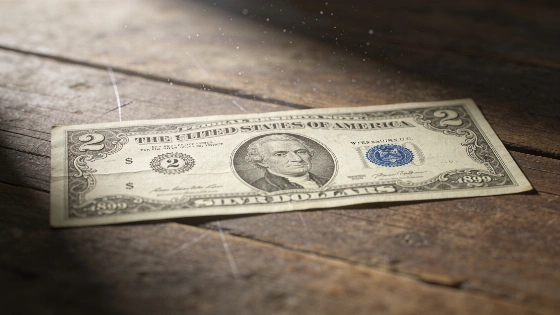
The 1899 $2 Silver Certificate, known as the Mini-Porthole, stands out for its unique design and the rare combination of Napier and McClung signatures, linking the note to a pivotal era in American monetary and social history
The Series 1899 $2 Silver Certificate, often called the "Mini-Porthole" by collectors, is more than a visually distinctive piece of American currency. Its compact central portrait of George Washington, framed by ornate engraving, has made it a favorite among numismatists. Yet, a particular example set to appear as Lot 22032 in Stack's Bowers Galleries' Summer 2026 Global Showcase Auction carries a deeper historical resonance. This note features the engraved signatures of James C. Napier and Lee McClung-a pairing that not only identifies it as Friedberg 253 but also connects it to two Americans whose careers briefly intersected at the U.S. Treasury.
Origins of the Mini-Porthole Note
The roots of the 1899 $2 Silver Certificate trace back to the monetary debates of the 1870s, when the U.S. Congress eliminated the standard silver dollar with the Coinage Act of 1873. This move, later dubbed the "Crime of '73," sparked controversy among silver miners and farmers who favored a more expansive money supply. The Bland-Allison Act of 1878 partially reversed course, requiring the Treasury to purchase silver and issue Silver Certificates-paper notes backed by silver dollars held by the government. Initially, these certificates were available only in higher denominations, but by 1886, $1, $2, and $5 notes were authorized, making them more practical for daily transactions.
The $2 denomination reached an artistic peak with the 1896 Educational Series, celebrated for its allegorical designs. The 1899 series, however, shifted to a more traditional format: a strong central portrait of Washington, flanked by allegorical figures representing Mechanics and Agriculture. The note's blue serial numbers and Treasury seal, along with a large blue "2," provide striking contrast to the green-inked reverse. The Bureau of Engraving and Printing credits G.F.C. Smillie with the Washington portrait and vignettes, though the overall designer remains unknown-a detail that has led to some confusion in modern descriptions.
Historical Context and Signature Rarity
The 1899 $2 Silver Certificate belongs to the era of large-size U.S. currency, measuring about 44% larger than today's notes. Production of $2 Silver Certificates spanned from 1886 to 1926, with the 1899 series marking the final issue. Over this period, changes in Treasury officials resulted in a sequence of signature combinations, each catalogued by Friedberg numbers. The Napier-McClung pairing, found on Fr. 253, is especially notable for its brief overlap during the Taft administration.
James Carroll Napier, whose signature appears at the lower left, was a pioneering Black lawyer, businessman, and civic leader. Born in Nashville in 1845 to parents who had been enslaved, Napier rose to prominence through education and public service, eventually becoming Register of the Treasury in 1911 under President William Howard Taft. His signature is one of only five from African Americans to appear on U.S. paper currency, making notes like Fr. 253 historically significant beyond their monetary value.
Lee McClung, the Treasurer of the United States whose signature appears alongside Napier's, was a former Yale football star who later built a career in finance. Appointed by Taft, McClung served from November 1909 to November 1912. The overlap of Napier and McClung's terms lasted only about 20 months, making notes bearing both signatures relatively scarce. According to Stack's Bowers, plates with McClung's signature continued in use briefly after his resignation, so Fr. 253 notes likely entered circulation between 1911 and early 1913, despite the "1899" series date.
Condition, Value, and Collector Appeal
Most large-size notes were heavily circulated, making high-grade survivors rare. The Stack's Bowers Fr. 253 example has been graded Gem Uncirculated 65 PPQ by PCGS Banknote, a designation requiring strong margins, original paper quality, and no significant flaws. Only two Fr. 253 notes are known at this grade, with five finer, according to the auction house. The note is estimated to fetch between $2,500 and $3,500 at auction, reflecting both its condition rarity and the historical importance of its signatures. The broader U.S. Currency portion of the sale is scheduled for September 2-4, 2026.
The story of the Mini-Porthole note is part of a wider tradition of American numismatics, where design, history, and social context intersect. For example, the upcoming 2026 World's Fair of Money in Pittsburgh will showcase rare pieces such as the 1933 Double Eagles, offering collectors a unique perspective on the evolution of U.S. currency. For more on how numismatic events highlight American monetary history, see this feature on the 1933 Double Eagles exhibition.
Silver Certificates and Their Legacy
Silver Certificates were once redeemable for silver dollars, but this practice ended in 1968 as silver prices rose and Treasury reserves declined. While these notes remain legal tender at face value, their collector value far exceeds their nominal worth-no one would trade a Mini-Porthole for two modern dollars. Collectors approach the 1899 $2 Silver Certificate from multiple angles: as a design icon, a relic of the silver standard, a condition rarity, and a document of social progress through its signatures.
The 1899 $2 Silver Certificate encapsulates a period when American currency was not just a medium of exchange but also a canvas for national identity and social change. Its design, production history, and the stories of those whose names it bears offer a window into the complexities of U.S. monetary and political life at the turn of the 20th century.
Large-size U.S. banknotes, such as the Mini-Porthole, illustrate how physical currency once provided ample space for artistic expression and symbolism. The transition to smaller notes in 1929 reduced this visual impact but increased practicality for everyday use. Today, collectors value these historical notes not only for their rarity and condition but also for the narratives they preserve-stories of economic debate, technological change, and the individuals who shaped the nation's financial system.