
A rare 1894-S Barber dime sold for over $1.25 million at Stack's Bowers Galleries' Rarities Night, which saw more than $26 million in sales and set new price records for US coins and collectibles.
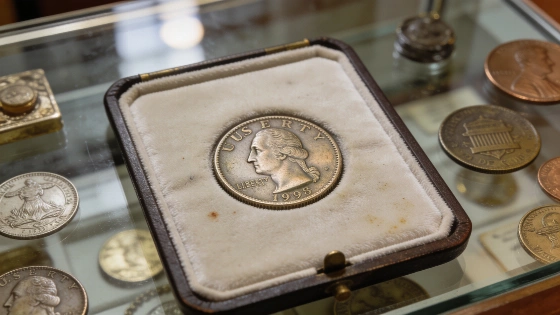
The Norweb 1894-S Barber dime was the star of Stack's Bowers Galleries' Rarities Night, selling for $1,250,500 after a round of determined bidding. Graded Proof-63 by PCGS and carrying both CAC and CMQ endorsements, the coin led an auction that saw collectors and investors drive prices for rare US coins to new heights. The sale was widely reported, including by Smithsonian Magazine, which confirmed the public result.
Stack's Bowers, based in Costa Mesa, California, reported total sales of $26,305,945 for the 631-lot session, with all figures including the buyer's premium. The auction opened with a locket containing an "Inverted Jenny" stamp once owned by Col. Edward H.R. Green, which sold for $439,200-more than double its previous auction price from 2015. But it was the competition for key US coin rarities that set the tone, as buyers responded to ongoing changes in global monetary policy and US dollar exchange rates, tracked by the Federal Reserve.
Record prices for US coinage
Several coins reached new highs. A 1793 Liberty Cap Half Cent, certified AU-58 by PCGS and endorsed by CAC and CMQ, brought $73,200-a record for its grade. The 1796 Draped Bust Quarter, graded MS-62 by NGC with a Gold CAC sticker, sold for $292,800, beating out even higher-graded examples from past years. A 1796 Draped Bust Half Dollar with Small Eagle reverse, previously owned by Col. Green and Eric Newman, reached $671,000, topping its prior record by over $200,000.
Other notable results included a two-piece set of 1912 Pattern Buffalo Nickels at $122,000, a Space Flown 22 Karat Gold 2000-W Pattern Sacagawea Dollar at $390,400, and an 1861-O Liberty Seated Half Dollar (State of Louisiana Issue) at $170,800. The 1851 Augustus Humbert $50 gold piece, graded AU-58+ by PCGS, sold for $317,200. An 1876 Liberty Head Double Eagle in Proof-64 (PCGS, CAC) reached $439,200, a record for that issue.
Market dynamics and collector demand
Stack's Bowers president Brian Kendrella called the results "extraordinary," noting that total prices far exceeded presale estimates and that the rare coin market has picked up speed in recent years. The auction covered a wide range-from early federal copper to Civil War-era silver and gold, and even space-flown modern patterns-showing that demand spans many eras and denominations. Buyers focused on coins with strong provenance, high grades, and third-party endorsements, often paying premiums for pieces with both CAC and CMQ approval. This demand comes as the US Consumer Price Index (CPI) continues to show persistent inflation, prompting some investors to look for alternative assets, a trend also tracked by the European Central Bank (ECB).
For example, the 1795 Flowing Hair Silver Dollar (AU-50+ PCGS, CAC, CMQ) sold for $67,100, a strong price for its grade. The 1875 Gold Dollar in MS-65 (PCGS, CAC, CMQ-X) brought $85,400, well above published price guides. Even coins with condition issues, like a 1930-S Saint-Gaudens Double Eagle with "Unc Details-Cleaned" (PCGS), sold for $158,600, beating comparable results from the Bernard Richards Collection in 2024. A complete 1869 Proof Set of minor and silver coinage (NGC, CAC) reached $82,350, above expectations.
Comparisons and broader trends
The jump in collector interest and auction prices for US coins reflects a broader trend in the numismatic market, where rarity, condition, and provenance drive value. As recent analysis notes, the move toward digital authentication and the decline of physical cash have not reduced demand for historic coins. Instead, third-party grading and certification have become central to building trust and value in high-end transactions.
Stack's Bowers' results also show how auctions set new price benchmarks. When a coin sets a record at a major event, it often changes expectations for similar pieces in private sales and future auctions. The $1.25 million result for the 1894-S dime will likely affect insurance valuations and encourage collectors to consign similar rarities in the future. Only 24 examples of the 1894-S Barber dime were struck, with just 9 known to survive, making it one of the most sought-after rarities in American numismatics. Of the original mintage, three coins were set aside for assay testing, leaving 21 for circulation, according to recent independent reports.
Data and market context
At the Summer 2026 Global Showcase Auction, Stack's Bowers sold 631 lots for a total of $26,305,945. The top lot, the Norweb 1894-S Barber dime, brought $1,250,500. Other major sales included the 1796 Draped Bust Half Dollar at $671,000 and the 1876 Liberty Head Double Eagle at $439,200. These prices set new highs for their grades and types, with several coins beating previous auction records by $50,000 to $200,000 or more. Before this sale, only five examples of the 1894-S Barber dime had appeared at auction since 2005, with prices ranging from $1.3 million to $2.16 million, underscoring its reputation as a "classic rarity in all of numismatics," as described by Stack's Bowers and confirmed in recent coverage.
While rare coins are often seen as a niche collectible, the sums involved and the international participation at events like Rarities Night show their importance. Auction houses such as Stack's Bowers play a key role in price discovery, with their results closely watched by dealers, collectors, and insurers. The mix of historical significance, third-party certification, and competitive bidding continues to drive both liquidity and volatility in this specialized market. These trends are increasingly relevant as global central banks, including the Federal Reserve and the ECB, monitor alternative asset flows and their possible impact on financial stability.
In numismatics, the difference between face value and collector value is central. While a coin's legal tender status determines its use in daily transactions, its collector value depends on rarity, condition, provenance, and market demand. Third-party grading agencies such as PCGS and NGC, along with endorsement services like CAC and CMQ, are now essential for establishing a coin's credibility and marketability. Their certifications help buyers and sellers navigate a market where small differences in grade or provenance can mean six- or seven-figure swings in price. As digital authentication tools become more common, the balance between physical rarity and technological trust will continue to shape the future of coin collecting and the wider market for historic currency.