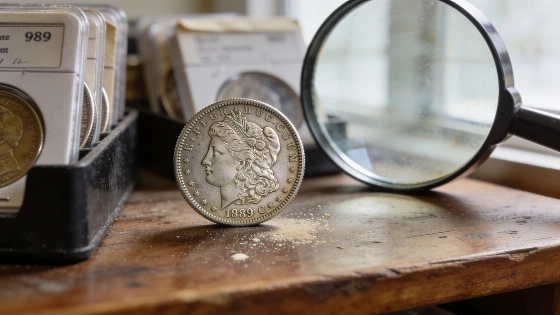
A CAC-approved 1889-CC Morgan Dollar graded MS-63 is set for auction, spotlighting the coin's scarcity, historical context, and collector demand after decades of limited survival and a dramatic minting backstory
The 1889-CC Morgan Dollar stands as one of the most coveted coins in American numismatic history, combining a low mintage, a turbulent political backdrop, and a survival rate that has kept collectors searching for decades. This year, Stack's Bowers Galleries will present a CAC-approved, PCGS MS-63 graded example from the KBella Collection in its Summer 2026 Global Showcase Auction, offering collectors a rare opportunity to acquire a coin that rarely appears in such condition.
Minted at the Carson City facility, the 1889-CC Morgan Dollar's story is inseparable from the economic and political debates of late 19th-century America. After the Carson City Mint ceased operations in 1885 due to political disputes over silver policy, it remained dormant until late 1889. The reopening followed the election of President Benjamin Harrison, whose administration reversed the previous stance against large-scale silver coinage. However, the mint's late-year restart left little time for production, resulting in a mintage of just 350,000 coins-one of the lowest for the Morgan series.
Condition Rarity and Collector Appeal
While the 1889-CC does not have the absolute lowest mintage among Carson City Morgan Dollars, its survival in high grades is exceptionally limited. PCGS estimates fewer than 30,000 examples remain across all grades, with only about 5,000 surviving in Mint State (MS-60 or better). The coin offered by Stack's Bowers, graded MS-63 and approved by CAC, is notable for its strong strike, semi-reflective fields, and attractive peripheral toning-features that set it apart from most surviving examples, which often show average strikes and more surface marks.
Stack's Bowers reports that only 18 coins at the MS-63 level have received CAC approval, with just nine finer. This combination of grade, eye appeal, and third-party verification makes the upcoming auction lot a significant event for advanced collectors. The coin's provenance from the KBella Collection, assembled in the 1960s, adds further historical interest and authenticity.
Historical Context: The Silver Debate and Carson City's Role
The 1889-CC Morgan Dollar was minted during a period of intense debate over the United States' monetary standard. The closure of the Carson City Mint in 1885 reflected President Grover Cleveland's opposition to the free-silver movement, which sought to expand silver coinage and increase the money supply. Carson City, located near the Comstock Lode, was at the heart of the silver-mining boom and the political struggle over the nation's currency policy. The Bland-Allison Act of 1878 had already mandated large-scale silver dollar production, but the mint's shutdown interrupted this process in Nevada.
When coinage resumed in October 1889, the Carson City Mint had to overcome years of inactivity and equipment deterioration. The resulting 1889-CC Morgan Dollars were produced in a compressed timeframe, further limiting their numbers. Unlike other Carson City issues, the 1889-CC was almost entirely absent from the General Services Administration (GSA) sales of the 1970s, which released millions of "CC" dollars from government vaults. According to PCGS, only a single 1889-CC appeared in those sales, underscoring its scarcity in the modern collector market.
Market Impact and Auction Significance
The 1889-CC Morgan Dollar is widely regarded as the rarest Carson City Morgan in Mint State, often compared to the 1893-S as a key business-strike rarity in the series. Auction records reflect this status: in July 2013, a PCGS MS-68 example sold for $881,250, setting a benchmark for the issue. While the MS-63 coin in the upcoming Stack's Bowers auction is more accessible, its CAC approval and visual quality sharply narrow the field of comparable pieces. For collectors seeking to complete a high-grade Carson City set, opportunities to acquire such a coin are exceptionally rare.
For those interested in the broader context of rare U.S. coinage and the debates that shaped their creation, the story of the 1889-CC Morgan Dollar echoes themes found in other numismatic controversies, such as the ongoing discussion over the origins of the 1866 nickel quarter eagle, which is explored in detail in this analysis of pattern coins and mint errors.
Key specifications for the 1889-CC Morgan Dollar include a denomination of one dollar, a composition of 90% silver and 10% copper, a weight of 26.73 grams, and a diameter of 38.10 mm. The coin features a reeded edge and was designed by George T. Morgan. Its PCGS number is 7190, and the NGC ID is 2559.
Understanding Condition Rarity in Numismatics
In coin collecting, "condition rarity" refers to the scarcity of a coin in high grades, regardless of its original mintage. The 1889-CC Morgan Dollar exemplifies this concept: although more than 350,000 were struck, only a small fraction survive in Mint State, and even fewer combine strong eye appeal with third-party approval. This distinction is crucial for collectors, as market value is often driven not just by how many coins exist, but by how many remain in top condition. The absence of the 1889-CC from major government releases further amplifies its desirability, making each high-grade example a centerpiece for advanced collections.