A rare 1866 Liberty Head Quarter Eagle struck in nickel, not gold, is set for auction, reigniting debate over whether it was an intentional pattern or a minting mistake. Its origins remain unclear, challenging collectors and historians alike
When a coin appears to break the rules of its own era, it often leaves more questions than answers. The 1866 Liberty Head Quarter Eagle, struck not in gold but in nickel, is one such enigma. Scheduled for auction by Heritage Auctions in September 2026, this coin-catalogued as Judd-542, Pollock-607, and graded PCGS Proof-64 with CAC approval-has become a focal point for numismatic debate about intention, error, and the boundaries of official coinage.
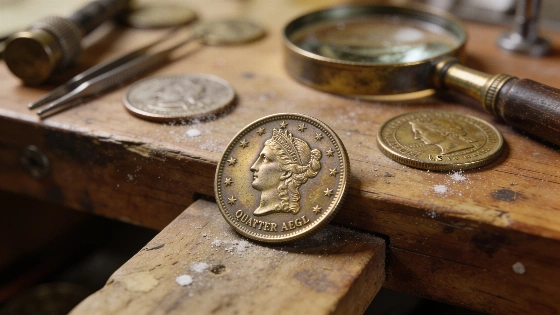
At first glance, the coin mirrors the familiar Liberty Head Quarter Eagle design by Christian Gobrecht, a motif used on U.S. $2.50 gold coins from 1840 to 1907. Yet, unlike the standard 1866 issue, which was 90% gold and 10% copper, this piece is composed of nickel. The Philadelphia Mint produced only 3,080 business-strike quarter eagles in 1866, all in gold-making the existence of a nickel version especially puzzling.
Experimental Coin or Striking Error?
Numismatists have long debated whether the Judd-542 is an intentional pattern coin or the result of a striking error. Pattern coins are typically produced to test new designs, metals, or technologies, and often never intended for circulation. However, the Judd-542 uses regular quarter eagle dies, not experimental ones, and its dimensions closely match those of the Three-Cent Nickel coin introduced in 1865. The Three-Cent Nickel, authorized by Congress and produced from 1865 to 1889, was made of 75% copper and 25% nickel, weighed about 1.9 grams, and measured roughly 17.9 millimeters in diameter-just a tenth of a millimeter less than the quarter eagle.
This similarity has led some experts to suggest that a Three-Cent Nickel blank may have been mistakenly fed into the quarter eagle press, producing a coin with the correct design but the wrong metal. While a single such error is plausible, the existence of several Judd-542 specimens complicates the theory. Multiple identical errors are rare, especially in a tightly controlled minting environment.
Rarity and Grading Controversy
As of June 2026, only six examples of the Judd-542 are tracked by the Saul Teichman roster, with two of those possibly being duplicates due to lack of certification. Heritage Auctions rates the coin as High R.7, indicating extreme rarity. The coin heading to auction is listed as No. 4 on the Teichman roster and remains in a PCGS Generation 1.2 "Rattler" holder, a type used only from 1986 to 1989, adding another layer of collector interest.
The debate over the coin's status is further complicated by its grading history. One known Judd-542 was initially certified by NGC as a mint error struck on a Three-Cent Nickel planchet, weighing 2.04 grams-within the Mint's tolerance for that denomination. It sold for $25,850 in April 2015. Later, PCGS certified the same coin as a Proof-66 pattern, and it was sold by Stack's Bowers for $23,500 in May 2016. This shift in classification highlights the blurred line between pattern coins and mint errors, a topic explored in depth in resources such as a recent guide to rare mint errors and die trials.
Technical Details and Collector Appeal
The Judd-542 offered in the upcoming auction is described as having luminous silver-nickel surfaces and a strong strike, despite nickel being much harder than the gold alloy typically used for quarter eagles. The coin features a reeded edge and displays fine planchet striations, with a small lint mark near Liberty's neck and a few microscopic contact marks. Its presence in an early PCGS holder, combined with CAC approval, makes it especially attractive to collectors who value both rarity and provenance.
For comparison, a standard 1866 Liberty Head Quarter Eagle measures 18 millimeters in diameter and weighs 4.18 grams, while the Three-Cent Nickel is just 0.1 millimeter smaller and less than half the weight. The close match in size between the two coins supports the wrong-planchet theory, but the lack of definitive Mint documentation leaves the question open.
Enduring Mystery at the Philadelphia Mint
The 1866 nickel quarter eagle stands at the intersection of pattern coinage and mint error, with its true origin still uncertain after 160 years. Whether it was a deliberate experiment with new metals, a collectible produced for insiders, or the result of a rare sequence of striking errors, the Judd-542 continues to challenge assumptions about U.S. coin production in the post-Civil War era. Its crossover appeal draws in pattern specialists, Liberty Head gold collectors, and error enthusiasts alike, ensuring that debate over its status will persist as long as examples remain in private hands.
Understanding the distinction between pattern coins and mint errors is crucial for collectors and historians. Pattern coins are typically authorized by the Mint to test new designs or compositions, often with official records or documentation. Mint errors, by contrast, result from unintended mistakes during production-such as using the wrong planchet or die. The Judd-542 blurs these lines, as its existence is supported by both plausible error mechanisms and the historical context of 19th-century Mint experimentation. Without surviving documentation, the debate remains unresolved, highlighting the complexities of numismatic classification and the ongoing need for careful research in the field.