A rare 1848 Gothic Florin Pattern, central to Britain's early decimalization and the "Godless Florin" controversy, will be auctioned in 2026. Its story reveals how a single coin design ignited debate over tradition, religion, and monetary reform.
In 2026, a remarkable piece of British currency history will re-emerge as Stack's Bowers Galleries auctions an 1848 Gothic Florin Pattern, graded NGC Proof-66 and estimated at $20,000-$30,000. This coin, originating from the Charles "Cheech" Litman Collection, is more than a numismatic rarity-it marks a pivotal moment in Britain's journey toward decimal currency and stands at the heart of the "Godless Florin" scandal that challenged Victorian conventions.
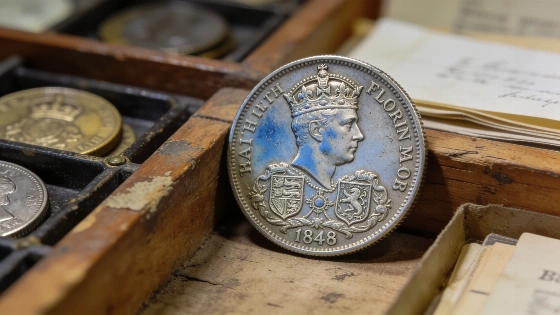
At first glance, the 1848 Gothic Florin Pattern is a showcase of Victorian artistry. Queen Victoria appears in a medieval-inspired crown and dress, surrounded by heraldic shields and floral emblems representing England, Scotland, and Ireland. Yet its significance lies in its role as Britain's first serious attempt to introduce decimal coinage, a move that would eventually reshape the nation's monetary system.
Decimal Ambitions and a Divided Public
For centuries, Britain's currency operated on the pounds-shillings-pence system: one pound equaled 20 shillings, and one shilling equaled 12 pence, making a pound worth 240 pence. While familiar to most Britons, reformers saw this as unnecessarily complex. Proposals for decimalization had circulated in Parliament since the early 19th century, with figures like Sir John Wrottesley and John Bowring advocating for coins valued at one-tenth and one-hundredth of a pound. The florin, worth two shillings, was designed as a bridge-compatible with both the old and proposed decimal systems.
The Royal Mint's experiments in 1848 included not only the florin but also denominations such as Centum, Decade, and Dime. Ultimately, "florin" was chosen, partly due to Prince Albert's familiarity with continental florins. The coin's design, led by William Wyon for the obverse and William Dyce for the reverse, featured the inscription "ONE FLORIN - ONE TENTH OF A POUND," making its decimal intent explicit.
The "Godless Florin" Controversy
What set the 1848 Gothic Florin Pattern apart was not just its decimal value, but the omission of two traditional phrases: "DEI GRATIA" (By the Grace of God) and "FIDEI DEFENSOR" (Defender of the Faith). Instead, the coin simply read "VICTORIA REGINA 1848." When this abbreviated legend was carried over to the 1849 circulating florin, public backlash was swift. Critics dubbed it the "Godless Florin," and suspicions grew, especially as the Master of the Royal Mint at the time, Richard Lalor Sheil, was Roman Catholic. The controversy was so intense that production was halted, and the Royal Mint was forced to redesign the coin, restoring the religious titles and further embracing the Gothic style in subsequent issues.
According to Stack's Bowers, the 1848 Gothic Florin Pattern being offered is a plain-edge specimen, catalogued as S-3890; KM-745; ESC-2917 (old 799). It weighs approximately 11.3 grams, measures 28 mm in diameter, and is struck in sterling silver. The coin's preservation is exceptional, with gunmetal-gray toning and cobalt blue highlights, reflecting its long history in private collections.
Industrial Innovation Meets Medieval Imagery
The 1848 florin was produced at the Royal Mint's Tower Hill facility in London, which had adopted steam-powered presses capable of striking up to 60 coins per minute. This blend of advanced industrial technology and medieval-inspired design is a hallmark of Victorian Britain, where tradition and modernization often collided.
The Gothic Florin's legacy is not just artistic. It foreshadowed Britain's eventual move to decimal currency, which would not be completed until Decimal Day on February 15, 1971. The florin, as a two-shilling coin equal to one-tenth of a pound, remained a practical link between the old and new systems for over a century.
Collectors and historians see the 1848 Gothic Florin Pattern as a tangible record of a society negotiating the boundaries between monarchy, religion, and modernity. Its story echoes other moments when rare coins have captured public attention, such as the gathering of all 11 government-owned 1933 Double Eagles at a major U.S. coin event, as covered in this feature on historic American coin reunions.
Specifications and Auction Details
The 1848 Gothic Florin Pattern offered by Stack's Bowers is a silver coin struck to the florin standard (.925 fine), with a plain edge and a diameter of 28 mm. It is graded NGC Proof-66 and comes from the Charles "Cheech" Litman Collection, known for its rare U.S. and world coins. The coin will be auctioned as Lot 41511 in Session B-Ancient Coins & World Coins Part 2: Great Britain, Ireland & Scotland-on September 2, 2026, at Griffin Studios in Costa Mesa, California.
For reference, the coin's catalog numbers are S-3890; KM-745; ESC-2917 (old 799). Stack's Bowers has set a pre-sale estimate of $20,000-$30,000, reflecting both its rarity and its historical importance.
The Gothic Florin's journey from experimental pattern to controversial circulation coin and, finally, to a prized collector's item illustrates how currency design can become a flashpoint for broader debates about national identity, religious tradition, and the pace of change. Its survival in such high grade offers a rare opportunity to examine the intersection of art, technology, and monetary policy in Victorian Britain.
The "Godless Florin" episode highlights the power of symbolism in currency. While the omission of religious titles was intended to create a visually balanced design, it instead provoked a public reaction that forced the Royal Mint to reconsider how coins communicate authority and values. This case demonstrates that even small changes in coin inscriptions can have outsized effects on public trust and acceptance, especially when they touch on questions of tradition and national identity.