

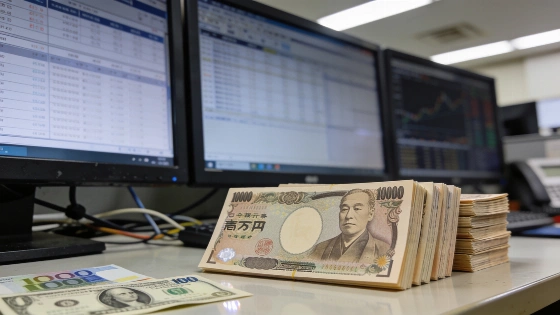
The Japanese yen climbed against the US dollar and euro after coordinated intervention by Japan and the United States, with authorities signaling readiness for further action if needed
The Japanese yen strengthened sharply against both the US dollar and the euro at the start of the week, following a rare coordinated intervention by Japanese and US authorities aimed at supporting the yen. The move, confirmed by Japan's Ministry of Finance, marked the second major yen-buying operation this year and signaled Tokyo's determination to counter persistent downward pressure on its currency.
On Monday, the yen traded as high as 156.80 per US dollar, its strongest level since early February 2026. Against the euro, the yen reached 179.435, a level last seen in mid-November 2025, before settling at 180.31. These gains followed direct market intervention late last week, when Japanese and US officials acted together to purchase yen and sell foreign currency reserves, seeking to stabilize the exchange rate after months of depreciation.
According to data released by the Bank of Japan, the latest intervention may have involved as much as $36.58 billion in foreign exchange reserves. This brings Japan's total intervention spending for 2026 to over $100 billion, reflecting the scale of official efforts to influence the yen's value. The Ministry of Finance stated that it would not hesitate to take further action if market conditions warranted, underscoring the government's concern about the impact of a weaker yen on import costs and domestic inflation.
Market participants have closely watched the yen's trajectory in recent months, as the currency has faced sustained selling pressure due to wide interest rate differentials between Japan and other major economies. While the Bank of Japan has begun to adjust its ultra-loose monetary policy, Japanese rates remain well below those in the United States and Europe, making the yen less attractive to investors seeking higher yields. This has contributed to a cycle of depreciation, prompting authorities to intervene directly in the foreign exchange market.
Japan's interventions are notable not only for their size but also for the rare involvement of the United States, which typically refrains from direct currency market operations except in exceptional circumstances. The coordinated action suggests a shared concern about excessive volatility and the risk of disorderly market moves, particularly as the yen's weakness has implications for global trade balances and financial stability.
Central bank data shows that the yen appreciated by 0.51% against the US dollar on Monday, and by 0.62% against the euro. These moves followed the coordinated intervention, which was confirmed by Japan's Ministry of Finance and supported by the US Treasury. The yen's gains also extended to other major currencies, including the British pound, fueling speculation that Japanese authorities may intervene again if the currency resumes its decline.
While intervention can provide temporary relief, its long-term effectiveness depends on broader monetary and economic conditions. Analysts note that unless Japan's interest rate policy shifts more decisively, the yen may remain vulnerable to renewed selling pressure. For now, the coordinated action has demonstrated the authorities' willingness to act, but the underlying drivers of yen weakness-such as global rate differentials and capital flows-remain in place.
Currency intervention is a direct tool used by governments or central banks to influence the value of their currency in the foreign exchange market. In Japan's case, the Ministry of Finance instructs the Bank of Japan to buy or sell yen using the country's foreign exchange reserves. Such interventions are typically reserved for periods of extreme volatility or when authorities judge that market moves are out of line with economic fundamentals. Coordinated interventions, involving more than one country, are even less common and are generally seen as a signal of heightened concern about market stability. However, interventions alone rarely alter long-term currency trends unless supported by changes in underlying economic or policy conditions.