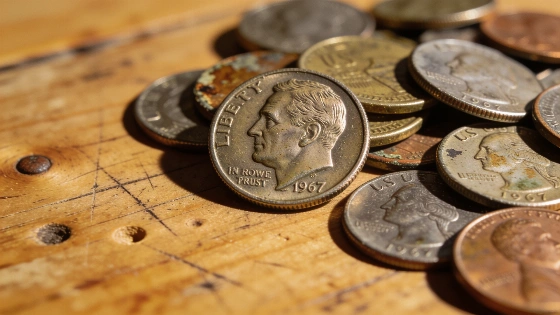
The 1967 Roosevelt dime saw the highest production in U.S. history, yet truly high-grade examples are rare. Discover how policy changes and collector sentiment shaped the fate of this common but elusive coin.
In 1967, the United States Mint produced more Roosevelt dimes than in any other year, with over 2.24 billion coins struck. Despite this record output, collectors today find that locating a truly pristine, gem-quality 1967 Roosevelt dime is unexpectedly difficult. The reasons for this scarcity are rooted in the monetary and collector climate of the mid-1960s, when the U.S. coin market was undergoing rapid change.
Coin collecting had surged in popularity during the late 1950s and early 1960s, but by the middle of the decade, the landscape shifted dramatically. The introduction of the Kennedy half dollar in 1964, combined with rising silver prices, led to widespread hoarding of silver coins and a resulting shortage in everyday circulation. In response, U.S. officials implemented emergency measures: mintmarks were removed from coins, silver was eliminated from dimes and quarters, and annual proof sets were replaced by Special Mint Sets. These changes were intended to discourage hoarding and stabilize coin supply, but they also dampened collector enthusiasm for new issues.
Record Mintage, Low Collector Interest
The 1967 Roosevelt dime, produced without a mintmark, became a symbol of this era. With a mintage of 2,244,007,320 pieces, it dwarfed previous production figures-Philadelphia's 1962 output, for example, was just over 75 million dimes. The sheer volume led many collectors to ignore the coin, assuming that such a common issue would never become valuable or interesting. As a result, few rolls or individual coins were set aside in uncirculated condition, and most entered circulation immediately.
According to Numismatic News, even when collectors search original rolls of 1967 dimes today, they rarely find coins that meet the highest grading standards. The mass-production process prioritized quantity over quality, and the absence of mintmarks made it difficult to distinguish coins from different facilities. While Special Mint Sets offered a higher finish, these were not equivalent to traditional proof coins and did not guarantee flawless examples.
Quality Scarcity Amid Abundance
Despite its abundance, the 1967 Roosevelt dime is now recognized as a challenge for those seeking top-grade specimens. In Mint State-60 (MS-60), the coin typically trades for around 50 cents-barely above face value. However, coins graded at the highest levels, such as MS-67 or above, are notably scarce and command significant premiums among specialists. This paradox-an extremely common coin that is genuinely rare in superb condition-reflects the unique circumstances of its production and the collector apathy of the time.
For context, the 1967 dime was the last year U.S. dimes were issued without a mintmark, a policy that ended in 1968. The removal of mintmarks was part of a broader effort to reduce speculation and stabilize coin circulation, but it also erased a key point of interest for collectors. As a result, the 1967 issue stands as a reminder of how policy decisions can have lasting effects on the availability and desirability of specific coins.
In the broader world of U.S. coin collecting, the challenge of finding high-grade examples of otherwise common coins is not unique to the Roosevelt dime. For instance, the pursuit of top-condition Walking Liberty half dollars has also set records in recent years, as seen when a 1939 Proof Walking Liberty Half Dollar achieved a record grade at auction-a story detailed in this analysis of rare U.S. half dollars.
Understanding the Numbers
The 1967 Roosevelt dime's mintage of over 2.24 billion coins remains the highest for any U.S. dime. By comparison, the 1965 issue saw more than 1.65 billion dimes produced, while earlier years rarely exceeded 100 million. Despite these massive figures, the number of coins surviving in truly gem condition is a fraction of the total. Most 1967 dimes in circulation today show signs of wear, and original rolls are seldom encountered. The coin's price in MS-60 has remained low for decades, but the scarcity of top-grade examples may eventually be reflected in higher market values as collectors recognize the difficulty of the search.
The story of the 1967 Roosevelt dime illustrates how changes in minting policy, collector behavior, and economic conditions can combine to shape the fate of a coin. While billions were produced, the lack of collector interest at the time and the focus on quantity over quality have made high-grade survivors a genuine rarity. For those interested in the intersection of monetary policy and numismatics, the 1967 dime offers a case study in how abundance does not always translate to availability-at least, not for those seeking the very best examples.
Mintmarks serve as small letters on U.S. coins that identify the minting facility-such as "D" for Denver or "S" for San Francisco. Their removal from circulating coins between 1965 and 1967 was a direct response to the coin shortage and the belief that collectors were driving coins out of circulation. While this policy succeeded in increasing coin supply, it also removed a key feature that had long attracted collectors. The restoration of mintmarks in 1968 helped revive interest, but the years without them remain a distinctive chapter in U.S. coinage history.