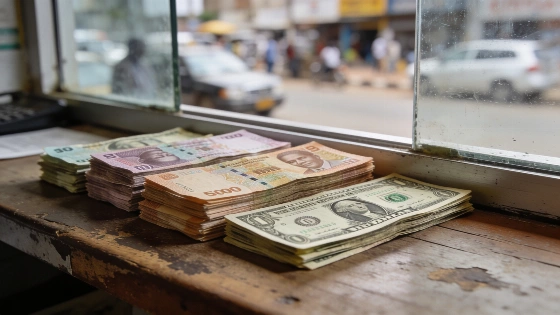
Uganda's shilling is under renewed strain as commercial banks quote weaker rates and businesses rush to secure dollars, putting the currency at risk of hitting its lowest level ever against the US dollar amid ongoing uncertainty in Iran.
Uganda's shilling is close to reaching its lowest point ever against the US dollar, with traders warning it could soon cross the 4,000-per-dollar threshold. The pressure comes as demand for dollars picks up, especially from manufacturers and energy companies looking to secure rates before further swings in the market.
Dollar demand climbs as global tensions rise
On September 17, 2026, the Ugandan shilling traded around 3,925 per US dollar, its weakest since February 2024. Later that day, it recovered slightly to the 3,910-3,930 range, but the currency remained under strain as commercial banks continued to quote weaker rates (Bloomberg; CNBC Africa). The conflict in Iran has added volatility to global currency markets, prompting some businesses to make forward purchases to lock in exchange rates before the shilling drops further.
Adam Mugume, executive director for research and policy at the Bank of Uganda, pointed to manufacturers and energy-sector firms as the main sources of increased dollar demand. These companies need foreign currency for imports and operating costs, and uncertainty over the Iran conflict's duration has made them more eager to secure dollars. The Bank of Uganda's own analysis links the shilling's weakness to this rising demand from importers, especially as global oil prices climb and external risks grow (Bank of Uganda).
Regional currencies feel the strain
Uganda is not alone in facing currency pressure. In mid-September 2026, the Ugandan shilling was among the most vulnerable East African currencies, while the Kenyan shilling and Nigerian naira held steadier (CNBC Africa; Reuters). According to traders cited by Reuters, the Ghanaian cedi and Zambian kwacha are also expected to remain under pressure, while the Nigerian naira and Kenyan shilling are forecast to stay relatively stable. This uneven impact shows how global events affect African currencies differently, depending on each country's exposure to external shocks.
Recent trends in the region echo this pattern, with currencies reacting in their own ways to global risks. For example, the South Korean won's recent gains, as covered in a previous analysis, show how local factors and sector trends can shape currency movements even when markets are unsettled.
Key numbers
On September 17, 2026, commercial banks in Uganda quoted the shilling at 3,925/3,935 to the US dollar, up from 3,860/3,870 at the previous week's close. The Bank of Uganda reported interbank and forex market rates of 3,740-3,780 per dollar as of August 31, but by September 15, the shilling had weakened to about 3,920-3,930-a drop of roughly 4-6% in less than three weeks (Daily Monitor; New Vision). More market participants are making forward purchases to hedge against further depreciation, reflecting the uncertainty around the Iran conflict's effect on global currency flows.
In response to the shilling's rapid decline, the Bank of Uganda announced on September 15, 2026, that it would raise the reserve requirement ratio for commercial banks to 13.5% from 11.0%, effective September 24. The central bank said this move was meant to support macroeconomic and financial stability, not to directly intervene in the currency market (CNBC Africa; Daily Monitor). Such policy steps are in line with what other central banks, like the Federal Reserve and the European Central Bank, have done during periods of market stress.
Why is the shilling so exposed?
Uganda's reliance on imports for manufacturing and energy makes the shilling more sensitive to external shocks. When global events disrupt markets, local firms often speed up their dollar purchases to avoid higher costs later. This can create a cycle that puts even more pressure on the currency and makes it harder for the central bank to stabilize rates with standard policy tools. The Bank of Uganda's recent tightening follows a broader trend among emerging market central banks, including recommendations from the Bank for International Settlements on managing liquidity and exchange rate swings.
While some regional currencies have stayed relatively stable, Uganda's dependence on global supply chains and imported goods leaves the shilling more vulnerable to sudden changes in sentiment. The current situation shows how quickly outside events can lead to real costs for businesses and consumers in economies that rely on imports.
For both businesses and households, a weaker shilling means higher prices for goods and services priced in dollars. This can push up consumer prices, reduce purchasing power, and make financial planning harder for companies with dollar-denominated debts. For central banks in emerging markets, managing these pressures often means balancing support for the currency with the need to keep the economy growing, especially when the shocks come from abroad.