
Two massive steel hubs used to create a Sidney Poitier presentation medal for a 2001 scholarship event have reappeared after 25 years. Their survival exposes gaps in private mint documentation and raises new questions for collectors.
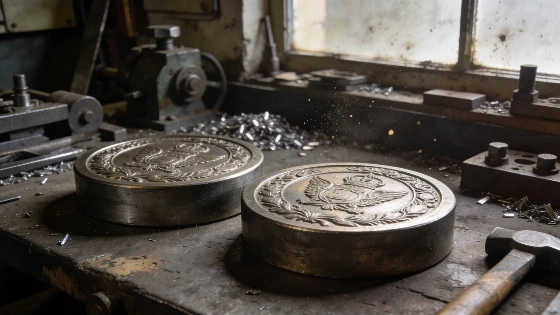
Two steel hubs, each weighing about eleven pounds, have turned up after spending 25 years out of sight. These tools were used to strike a commemorative medal honoring Sidney Poitier, and their survival offers a rare look at the behind-the-scenes work of private American mints. It also shows how easily even notable artifacts can disappear from view. The hubs were made during a turbulent time: just days after the September 11 attacks, as the Federal Reserve cut rates and tried to steady the U.S. dollar. Currency markets swung sharply as investors looked for safe ground.
Unlike the finished medals that collectors seek out, these hubs were never meant to be seen by the public. They carry the positive image of Poitier's portrait and signature, along with a "Great American" reverse design, for a three-inch medal produced by Roger Williams Mint in Massachusetts. Each hub's obverse face measures 76.27 mm. The date on the tooling-September 20, 2001-places their creation just nine days after 9/11, tying them to a moment of national upheaval. In those days, the Federal Reserve pumped billions into the financial system, and the Bank of England worked with other central banks to keep global payments moving. (FOMC policy statement).
Private minting and the Poitier connection
The story starts with the Costco Scholarship Fund, launched in 2000 to help students at the University of Washington and Seattle University. The second annual fundraising breakfast, held in Bellevue, Washington, brought Sidney Poitier as keynote speaker. By 2001, Poitier was not only a Hollywood legend and the first Black actor to win the Academy Award for Best Actor, but also a diplomat for The Bahamas. The event raised money for 70 new scholarships, adding to the 91 from the year before. Since then, the Costco Foundation has funded thousands of scholarships, part of a larger pattern of corporate support for higher education and local economies.
Roger Williams Mint, a private mint in Attleboro, Massachusetts, was hired to make a presentation medal for the event. The obverse hub shows Poitier's likeness and signature; the reverse has a torch of knowledge above a map of North America, surrounded by a laurel wreath. These hubs were the first step: hub to die, die to medal. But while the tools survived, the medals themselves have mostly vanished. Private mints like Roger Williams have long produced commemorative and corporate medals, often outside the oversight of the U.S. Mint or Bureau of Engraving and Printing, which answer to the Treasury and Federal Reserve.
Missing medals and unanswered questions
Numismatist Ken Potter, known for his work with error coins, acquired the Poitier hubs after Roger Williams Mint closed in 2006. Potter says a medal was given to Poitier at the 2001 event, but no other examples-no trial strikes, samples, or proofs-have shown up in the collector market. The actual mintage is unknown, and there may be more medals in private or institutional hands, unrecognized by collectors. This kind of scarcity is familiar in the coin world, where limited runs and spotty records can drive up prices, as seen with some commemorative gold and silver coins tracked by the International Monetary Fund and Bank for International Settlements.
The fate of Roger Williams Mint is a warning. Once a major producer of medals, tokens, and New York City transit tokens, the company was bought by Osborne Coinage in Cincinnati after closing in 2006. That move saved some production tools, including the Poitier hubs, from being scrapped. Potter's collection of Roger Williams Mint hubs, discussed publicly as early as 2013, shows the range of the mint's work for outside groups.
For collectors, the survival of these hubs is both lucky and frustrating. Without the finished medals, details like metal composition, weight, finish, and edge treatment are unknown. The hubs themselves are now the best evidence of the medal's existence and design. Their value sits at the crossroads of several interests: medallic art, private mint history, Hollywood memorabilia, and African American history.
Industrial relics and market realities
Industrial tools like these hubs are rarely kept once a contract ends. Most are scrapped or separated from the objects they made. The Poitier hubs survived only because a specialist recognized their historical value. Their reappearance echoes other rare mint artifacts that have surfaced, such as the reported earlier escape of twelve American Platinum Eagle trial coins, which became high-value rarities after leaving official control. The rarity and provenance of such items can be shaped by economic factors, including inflation and investor demand for tangible assets, as tracked by the Consumer Price Index and reported by the U.S. Bureau of Labor Statistics.
Records from the College Success Foundation confirm the September 20, 2001, event in Bellevue as the occasion for Poitier's keynote and the medal's presentation. But with no other medals appearing in the market, the hubs are now the main evidence of this meeting point between private minting, celebrity, and educational philanthropy.
Potter plans to auction the pair, leaving collectors to decide their value. Whether they are seen as industrial leftovers or unique artifacts connecting minting, Hollywood, and African American achievement, the fact remains: two heavy pieces of steel have outlasted the medals they were made to create. It's a reminder of how easily the physical history of private mints can disappear unless someone steps in. For those watching the collectibles market, auction results for such items can be influenced by interest rates and liquidity, as outlined in the ECB monetary policy overview.
Understanding hubs and dies in medal production
In medal and coin production, a hub is a steel tool that carries the design in positive relief. The hub is used to make a die, which holds the design in negative (recessed) form. The die then strikes a blank metal planchet, transferring the image to the finished medal or coin. While finished medals are often saved as collectibles, the hubs and dies are usually destroyed or recycled after production ends. When they survive, they offer a rare look at the manufacturing process and the industrial history behind commemorative and circulating money.