
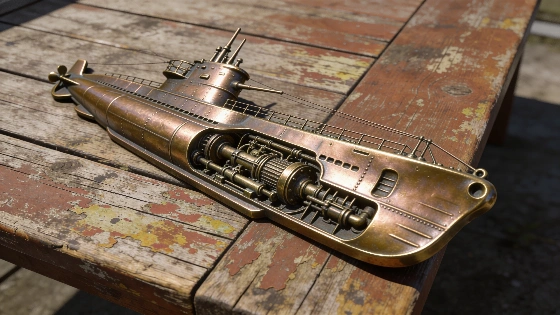
A new art medal commemorates the Turtle, the first submarine used in combat during the American Revolution, highlighting its technical breakthroughs and the risks of early underwater warfare
On a September night in 1776, a hand-built wooden submarine slipped beneath the surface of New York Harbor, aiming to break the British blockade. The Turtle, piloted by American Sergeant Ezra Lee, attempted to attach an explosive to the hull of HMS Eagle. The mission failed, but the event marked the first use of a submarine in combat and set a precedent for underwater military technology.
Engineering a New Kind of Warfare
Designed by David Bushnell in 1775, the Turtle was a technical outlier for its era. Its oak shell, iron hoops, and tar sealant gave it a distinctive turtle-like shape, but its real innovation lay inside. The vessel featured a treadle-driven propeller for horizontal movement, a manual crank for vertical adjustment, and a primitive ventilation system to supply air while submerged. Water ballast was managed by intake valves and a pump, allowing the operator to dive or surface as needed. The plan was to drill a mine into an enemy ship's hull, set a time-delay fuse, and escape before detonation-a concept that proved too ambitious for the technology of the time.
Despite Lee's efforts, the Turtle's hand-powered drill could not penetrate the Eagle's metal-reinforced hull. Strong currents and limited visibility forced an early retreat. The submarine was later lost at sea, but its legacy as the world's first combat submarine endures. The Turtle's innovations foreshadowed the development of modern underwater vessels, even if its initial mission ended in failure.
Commemorating the Turtle's Legacy
To mark the 250th anniversary of this milestone, Jim Licaretz-winner of the American Medallic Sculpture Association MEDALS250 competition-has created a limited edition art medal. Unlike typical commemorative pieces that focus on famous figures or battles, this medal highlights the technical ingenuity of the Turtle. The reverse side of the medal reveals the submarine's internal mechanisms, from the propeller to the ballast system, capturing the complexity of Bushnell's design.
Only 76 of these 3½-inch cold-cast bronze medals will be produced, each priced at $117.76 plus shipping. Orders are handled by distributor Mel Wacks, with details available for collectors interested in owning a piece of early American naval history. The medal's design stands out for its focus on engineering rather than heroics, offering a rare tribute to the machinery that shaped the course of military technology.
Historical Context and Collector Demand
The Turtle's story is not just a footnote in naval history-it represents a turning point in the use of technology for military advantage. While the submarine's mission failed, its existence forced both American and British forces to reconsider the possibilities of underwater warfare. The medal's release coincides with a broader interest in numismatic innovation, as seen in other recent commemorative issues such as the Chinese Dragon coin, which was reported earlier for its own design breakthroughs.
For collectors, the Turtle medal offers more than historical nostalgia. Its limited mintage and detailed depiction of 18th-century engineering make it a tangible link to a period when the boundaries of technology and warfare were being redrawn. The price and scarcity are likely to drive demand among both numismatists and those interested in military history.
According to available figures, the Turtle medal's production run is capped at 76 pieces, reflecting the year 1776 and reinforcing its commemorative purpose. Each medal measures 3½ inches in diameter and is cast in bronze, a material chosen for its durability and historical resonance. The $117.76 price point is a deliberate nod to the year of the Turtle's mission, further anchoring the piece in its Revolutionary War context.
The Turtle's place in currency and military history is defined by its ambition and its failures. While it never succeeded in its intended attack, the vessel's design and the risks taken by its operator set a new standard for innovation under pressure. The decision to honor the Turtle with a medal that foregrounds its mechanical complexity, rather than its combat outcome, signals a shift in how numismatic art can capture the spirit of invention. In a field often dominated by portraits and battle scenes, this medal stands as a reminder that the machinery of history is as worthy of recognition as the people who operated it.
The Turtle's technical features-such as its early propeller, ballast system, and ventilation device-were unprecedented in the 18th century. Submarines would not become a practical part of naval arsenals until well into the 19th and 20th centuries, but Bushnell's design laid the groundwork for future developments. The medal's detailed rendering of these mechanisms provides a rare educational resource for those interested in the evolution of underwater technology, bridging the gap between numismatics and engineering history.