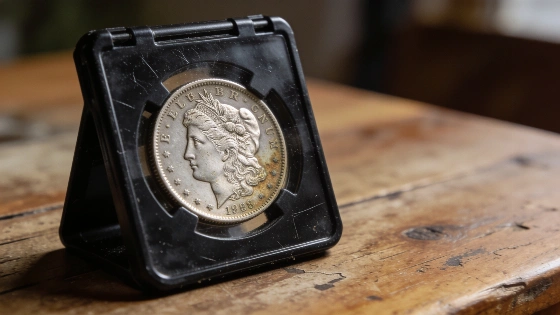
A 1936 Norfolk, Virginia, Bicentennial Half Dollar graded NGC MS-65 with a Gold CAC sticker and housed in a vintage black NGC holder sold for $11,937.38, highlighting the intersection of numismatic rarity, historical complexity, and grading provenance
When a single coin brings together historical significance, technical quality, and collector rarity, it stands out in the world of U.S. commemorative currency. The 1936 Norfolk, Virginia, Bicentennial Half Dollar, recently auctioned for $11,937.38, is one such example-graded NGC MS-65, approved with a Gold CAC sticker, and preserved in a seldom-seen original black NGC holder. This convergence of attributes has drawn attention from advanced collectors and historians alike.
Three Centuries in Silver
The Norfolk half dollar is unique among classic U.S. commemoratives for marking not just one, but three milestones in the city's civic history. Authorized by Congress, the coin commemorates the 300th anniversary of the original Norfolk land grant (1636), the 200th anniversary of its royal borough status (1736), and the 100th anniversary of its incorporation as a city (1845). Despite its 1936 date, the Philadelphia Mint struck the coins in 1937, a practice not uncommon for commemoratives of the era. The design features five dates-1636, 1682, 1736, 1845, and 1936-none of which matches the actual year of minting, making the coin a compact historical record in silver.
Artist William Marks Simpson, with Marjory Emory Simpson, created a design dense with symbolism. The obverse displays Norfolk's city seal, including a sailing ship, plow, and sheaves of grain, reflecting the city's maritime and agricultural roots. The reverse features the British Royal Mace, a rare colonial artifact presented to Norfolk in 1753, underscoring the city's status as a royal borough and its colonial heritage.
Rarity, Grading, and Market Value
Of the 25,000 Norfolk half dollars originally struck, 8,077 were melted due to weak collector demand, leaving a net mintage of just 16,936. This places the coin in the middle tier of rarity among classic U.S. commemoratives. Composed of 90% silver and 10% copper, each coin contains 0.36169 troy ounces of silver. Lower-grade Mint State examples typically trade in the hundreds of dollars, but coins with exceptional grades, originality, and provenance-such as this MS-65 example-command much higher prices.
The Numismatic Guaranty Corporation (NGC) assigned this coin a grade of MS-65, indicating strong luster, sharp detail, and minimal marks. The Gold CAC sticker, awarded by the Certified Acceptance Corporation, signals that the coin meets or exceeds the standards for the next higher grade, effectively placing it in a select group of top-quality survivors. The presence of a Gold CAC sticker can significantly increase a coin's desirability and market value, as it assures collectors of exceptional quality within the assigned grade.
The Black NGC Holder and Numismatic Provenance
Adding to its appeal, this Norfolk half dollar is housed in an original black NGC holder, the first production slab used by NGC in the late 1980s. These holders, featuring a black insert and no hologram, were quickly replaced by the now-standard white insert. Estimates suggest that only 25 to 200 of these original black holders survive, as many were discarded before their historical significance was recognized. Today, coins in these holders are valued not only for their contents but also as artifacts from the early days of third-party grading.
For collectors, the combination of a rare coin, elite grade, Gold CAC approval, and vintage holder represents a convergence of numismatic history and modern collecting standards. The sale of this Norfolk half dollar at GreatCollections on February 8, 2026, offered a rare opportunity to acquire a piece that bridges both the colonial era and the evolution of coin grading.
For context, the 1936 Norfolk half dollar's market performance can be compared to other high-profile U.S. commemoratives. For example, a 1939 Proof Walking Liberty Half Dollar graded Proof-68+ by PCGS and approved by CAC recently set a grading record at auction, as detailed in this analysis of the 1939 Proof Walking Liberty Half Dollar. Such results highlight how rarity, condition, and provenance continue to drive collector interest and market value in the numismatic world.
Understanding Commemorative Coin Value
Commemorative coins like the Norfolk half dollar are not intended for everyday circulation. Their value depends on a combination of historical context, mintage, condition, and collector demand. While the face value remains fixed, the collector market assigns prices based on these factors, with grading and third-party certification playing a growing role in recent decades. The presence of a Gold CAC sticker and a vintage holder can further distinguish a coin, signaling both quality and provenance to potential buyers.
Collectors and historians view such coins as tangible links to the past, encapsulating not only monetary value but also the evolution of currency, civic identity, and the standards by which coins are judged. As the numismatic market continues to evolve, coins that combine historical depth with exceptional preservation are likely to remain in demand among those seeking more than just silver content or face value.
The layered history of the 1936 Norfolk half dollar illustrates how commemorative coins can serve as both historical documents and evolving collectibles. The interplay between original mintage, survival rates, grading standards, and market recognition shapes their place in the broader story of U.S. currency and collecting.