

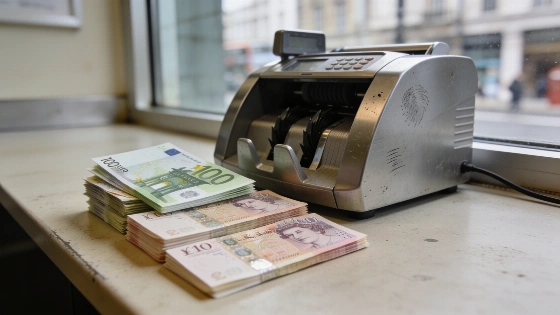
The British pound has regained ground against the euro, with the GBP/EUR rate climbing back above key levels. Market calm and higher energy prices are supporting Sterling, but September's political calendar could bring renewed volatility.
The British pound has resumed its upward trajectory against the euro, reversing losses from late July and pushing the GBP/EUR exchange rate to its highest level since the start of the summer correction. This renewed strength comes as the market enters a period of relative calm, with few domestic political events scheduled in the United Kingdom until Parliament reconvenes in September. The current environment has allowed Sterling to recover, with the exchange rate clearing initial resistance and moving above its 50-day moving average, a technical indicator often watched by analysts for signs of sustained trends.
Buying interest in the pound has been evident since the start of the week, and the pair now trades above 1.1700, a level that previously capped rebound attempts. The next technical barrier is seen at 1.1750, with the late July high of 1.1810 representing a further target if momentum continues. Support for the pair has also shifted higher, with the 50-day moving average now at 1.16587 and additional support at 1.16331 and 1.16000. The rising trendline from November's low continues to underpin the uptrend, suggesting that the recent correction may have run its course rather than signaling a broader reversal.
Market Drivers Behind Sterling's Strength
Several factors are contributing to the pound's resilience against the euro. One key driver is the recent rise in global energy prices, particularly oil and gas. Since early August, Brent crude has climbed from just above $82 to around $92 per barrel, reversing much of the decline seen after a brief period of geopolitical de-escalation in the Gulf. Historically, higher energy prices have tended to support the pound against the euro, as they influence relative interest rate expectations between the United Kingdom and the euro area.
When energy prices rise, bond yields-reflecting interest rate expectations-often increase. Because the UK's natural interest rate is typically higher than that of the eurozone, global increases in yields tend to be reflected more quickly in UK rates. This dynamic can make Sterling more attractive to investors when interest rates are a key driver of currency movements. However, the usual relationship between UK and German bond yields has not moved significantly this week, with the spread between two-year gilts and Bunds remaining near its lowest point of the year. Despite this, the pound has continued to strengthen, suggesting that other factors are also at play.
Risk Appetite and Market Calm
Another important influence is the tone of global financial markets. The S&P 500 index has reached new record highs this week, and implied volatility has dropped, reversing the risk-off sentiment that contributed to Sterling's early August weakness. The pound is considered a pro-cyclical, higher-yielding currency, meaning it tends to benefit when investors are willing to take on more risk. In contrast, the euro often acts as a funding currency, strengthening when investors reduce risk and repatriate funds. As a result, calm and optimistic market conditions have provided a tailwind for the pound against the euro, independent of domestic economic data.
For context, the GBP/EUR spot rate stood at 1.17087 at the time of writing, having moved further above the 50-day moving average since last Friday. This technical setup supports the view that the uptrend remains intact, with the correction phase likely complete. The next immediate test for Sterling will be Thursday's release of UK second-quarter GDP data, where consensus expects growth of 0.4%, slightly above the Bank of England's previous assumption. A stronger-than-expected reading could reinforce the case for higher UK rates and further support the pound.
Looking Ahead: Political Risks and Forecasts
While the current environment favors Sterling, risks remain on the horizon. August is typically a period of thin market liquidity, and the absence of major UK political events has removed two sources of volatility: domestic political uncertainty and sudden market shocks. However, this window may close quickly when Parliament returns in September. Attention will then shift to the UK Budget and fiscal policy, areas that have repeatedly weighed on Sterling in recent years. Some institutional forecasts, such as those from Rabobank, anticipate a multi-quarter decline in the pound-to-euro rate as domestic politics reassert themselves as a negative factor for Sterling.
For those needing to buy euros, the current period may represent a limited opportunity. Institutional consensus continues to expect the GBP/EUR rate to move lower over the coming year, so any approach toward the late July high could be seen as a chance to act rather than wait for further gains. This perspective is echoed in recent coverage of Sterling's performance, such as the analysis of key support levels and upcoming UK GDP data in this related article.
According to recent market data, the GBP/EUR spot rate recovered from a low near 1.1600 in early August to trade above 1.1700 by mid-month. The 50-day moving average, a commonly referenced technical indicator, has risen to 1.16587, while the spread between two-year UK gilts and German Bunds remains near its lowest point of the year. Brent crude oil prices have increased by roughly $10 per barrel since the start of August, contributing to the broader market context supporting Sterling.
Understanding the relationship between energy prices, interest rates, and currency movements is crucial for interpreting the pound's recent performance. When global energy prices rise, they can push up inflation expectations and bond yields, especially in countries with higher natural interest rates like the UK. This can attract capital flows into Sterling, strengthening the currency against lower-yielding counterparts such as the euro. However, this mechanism is not automatic, and other factors-such as risk appetite, political developments, and central bank policy-can override or complicate the expected outcome. As the UK approaches a busier political calendar in September, the balance of these forces will determine whether Sterling's summer rally can be sustained.