
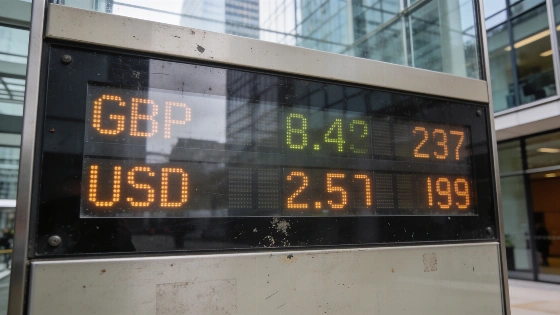
A surprise jump in US job creation has pushed the pound lower against the dollar and reignited debate over a possible Federal Reserve rate hike in September, leaving inflation data as the next critical test for currency markets
The pound sterling's recent stability against the United States dollar was abruptly interrupted when new US employment figures shattered market forecasts, sending the GBP/USD rate to its lowest point in two weeks within minutes. The catalyst: a US jobs report that not only exceeded every economist's estimate but also erased the main argument against a Federal Reserve rate increase this September.
Within twenty minutes of the Bureau of Labor Statistics' announcement that the US economy added 162,000 jobs in August, the pound fell from 1.3535 to 1.3487 against the dollar before partially recovering. This move was sharper than most analysts had anticipated, given that consensus expectations had pointed to a much smaller gain of 56,000 jobs, with some forecasts even predicting a net loss.
Labour Market Surprises and Market Reaction
The August jobs data did more than just beat expectations-it rewrote the narrative for US monetary policy. The previous month's figure, initially reported as a decline of 23,000 jobs, was revised to a gain of 21,000, eliminating the notion of a summer slowdown. Over the past year, the average monthly increase had been just 31,000, making August's result more than five times the recent trend.
Market pricing for a Federal Reserve rate hike on 16 September shifted rapidly. Before the jobs release, futures implied a 54% probability of a hike; after the data, that probability jumped to 61%. The unemployment rate held steady at 4.1%, and wage growth remained subdued, with average hourly earnings up 0.3% for the month and 3.1% year-on-year-well below the 3.7% annual increase in the US personal consumption expenditures (PCE) price index through July.
Despite the strong jobs print, the dollar's gains were not unchallenged. Earlier in the week, Federal Reserve Governor Christopher Waller had suggested that the employment report would likely mirror recent trends, which had led to a brief dollar sell-off and a dip in rate hike expectations. The actual data, however, forced a rapid market reassessment.
Inflation Now Takes Center Stage
With the labour market no longer providing a reason to delay tightening, attention has shifted to the upcoming US inflation report due on 11 September. The Federal Reserve's next move now hinges on whether inflation data confirms persistent price pressures. If inflation surprises to the upside, the dollar could strengthen further, especially as US Treasury yields have already climbed to their highest levels since January 2025.
For the pound, the timing is especially sensitive. Speculative positioning is already net short, and the Bank of England faces its own policy decision on 17 September, including a vote on the pace of balance sheet reduction. The GBP/USD pair's failure to break below 1.3485, even after such a strong US payrolls number, suggests that traders are waiting for inflation data before making further moves against sterling.
Recent coverage of the pound's vulnerability to external data, such as Australian inflation, highlights how quickly sentiment can shift when new figures emerge, as seen in our earlier breakdown.
Key Figures and Policy Implications
According to the Bureau of Labor Statistics, the US economy added 162,000 jobs in August 2026, compared to an average monthly gain of 31,000 over the previous twelve months. The unemployment rate remained at 4.1%. Average hourly earnings rose 0.3% month-on-month and 3.1% year-on-year. The GBP/USD rate dropped from 1.3535 to 1.3487 within twenty minutes of the data release, before stabilizing near 1.3510. Market-implied odds of a September Federal Reserve rate hike increased from 54% to 61% following the report.
What Drives Currency Moves after Data Surprises?
When major economic data diverges sharply from expectations, currency markets can react within seconds. For currency pairs like GBP/USD, the direction and scale of the move depend not only on the headline number but also on revisions, wage growth, and how the data changes central-bank policy probabilities. In this case, the removal of a negative jobs print and the outsized August gain forced traders to reassess the likelihood of a US rate hike, directly impacting the dollar's value against the pound. However, when wage growth lags behind inflation, as it did here, the case for aggressive tightening becomes less clear-cut, and markets may pause until the next key data point-such as inflation-arrives.