
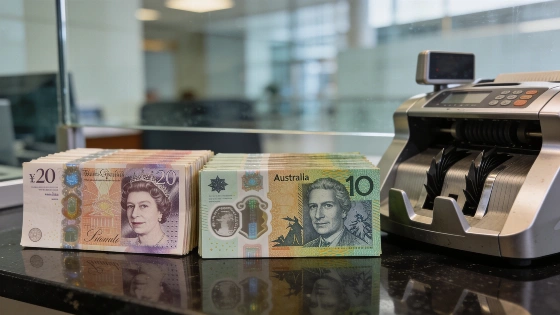
The Pound to Australian Dollar rate inched higher as global risk aversion weighed on the Australian Dollar, while hawkish Reserve Bank of Australia signals may cap Sterling's gains above AU$1.91
The Pound to Australian Dollar (GBP/AUD) exchange rate saw a modest rise on Thursday, reflecting a cautious global mood that left risk-sensitive currencies under pressure. As investors responded to ongoing geopolitical tensions and shifting central bank signals, the Australian Dollar weakened, allowing Sterling to gain ground despite a lack of strong domestic drivers.
Risk Aversion Supports Sterling
Market sentiment remained fragile as concerns over Middle East stability persisted. Reports of Iran demanding control over shipping through the Strait of Hormuz and the threat of prolonged regional conflict contributed to investor caution. In this environment, the Australian Dollar-often favored when risk appetite is strong-lost some of its appeal. The Pound, meanwhile, benefited from its status as a relatively stable alternative, even as UK economic data offered little surprise.
According to the Office for National Statistics, the UK economy expanded by 0.4% in the second quarter, down from 0.6% in the first quarter. While this growth matched expectations, much of the momentum was attributed to temporary factors such as the World Cup and favorable summer weather. Economists have warned that persistent inflation pressures, driven by high energy prices and geopolitical risks, could slow growth in the second half of the year.
Australian Dollar Faces Headwinds
The Australian Dollar's weakness was amplified by the global risk-off mood. With hopes for a ceasefire in the Middle East fading and shipping disruptions unresolved, investors remained wary of holding higher-risk assets. This dynamic left the 'Aussie' under pressure, even as the Reserve Bank of Australia (RBA) maintained a relatively hawkish stance by keeping interest rates on hold earlier in the week.
At the time of writing, the GBP/AUD exchange rate was trading near AU$1.9123, slightly higher on the day. For context, the Pound to Australian Dollar rate stood at 1.910309, down 0.03% on the session, while the Australian Dollar to US Dollar rate was 0.705926, down 0.07%. These figures reflect a broader pattern of risk-sensitive currencies losing ground as global uncertainty persists.
Central Bank Signals and Near-Term Outlook
Looking ahead, attention turns to a scheduled speech by Reserve Bank of Australia Governor Michele Bullock. After the RBA's recent decision to leave rates unchanged, Bullock's hawkish tone has suggested that further tightening remains possible if inflation risks persist. Should she reinforce this message, the Australian Dollar could find support, potentially limiting further gains for Sterling above the AU$1.91 level. However, with little new UK data expected in the near term, broader risk sentiment is likely to remain the main driver of the GBP/AUD exchange rate.
Recent coverage of major currency pairs has highlighted how geopolitical risks and economic data continue to shape market direction. For example, a recent analysis of the Dollar, Euro, and Australian Dollar underscored the impact of global events on currency stability and investor positioning.
Understanding Risk-Sensitive Currencies
Risk-sensitive currencies like the Australian Dollar tend to perform well when investors are optimistic about global growth and stability. In contrast, periods of heightened uncertainty or geopolitical tension often prompt a shift toward currencies perceived as safer, such as the Pound, US Dollar, or Japanese Yen. Central bank policy signals can reinforce or counteract these trends, but market sentiment often dominates short-term moves. For those making international payments or managing currency exposure, understanding these dynamics is essential for anticipating potential rate fluctuations and associated costs.