
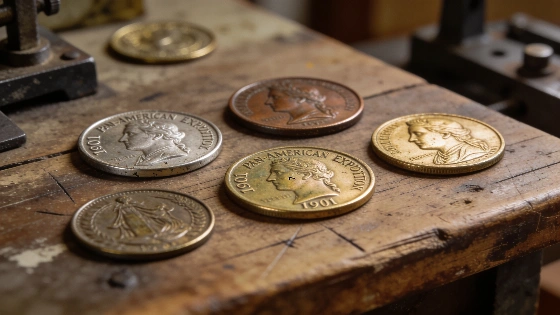
Buffalo's 1901 Pan-American Exposition left behind rare US Mint medals and tokens. The fair is forever tied to President McKinley's assassination and a turning point in American coinage and leadership.
On September 6, 1901, President William McKinley was shot inside the Temple of Music at the Pan-American Exposition in Buffalo. The attack stunned the country. Nine days later, McKinley died. Theodore Roosevelt took office. The Secret Service's role changed for good. The agency's protective mission became permanent, as shown in U.S. Secret Service records. The fair's medals and tokens, made on site by the US Mint, became lasting reminders of a world's fair that mixed hope for the future with sudden tragedy.
Between May and November 1901, more than eight million people came to the exposition. At least 5.3 million paid the 50-cent entry fee. Investors put in $5 million through stock and bonds. State and federal grants added another $800,000. Buffalo beat Niagara for the fair thanks to its strong rail links. The grounds lit up with electric lights, still new for most Americans. The fair's size and money flows showed off the era's economic boom. The US dollar ran on the gold standard, which kept exchange rates steady and inflation low. Later, the Federal Reserve would look back on this period in its own reviews.
Medals struck in a time of change
Inside the US government building, the Treasury Department set up a working Mint press. It made official exposition medals in silver, copper, and brass. G. T. Brewster designed them. The front showed a Native American riding an eagle. The back had a relief map of the Western Hemisphere and the fair's logo. Collectors now know these as PCGS #642671 (HK-287) in silver, #642672 (HK-288) in copper, and #642675 (HK-289) in brass. They are rare. Rarity ratings run from R-5 to R-8. The Mint's live demonstration was both a technical feat and a way to build public trust. The Treasury wanted people to see how coins were made. Later, the Federal Reserve would echo this idea in its own outreach about currency and trust.
The fair also produced other so-called dollars. These include the President McKinley Assassination Dollar and the Buffalo Dollar, made in brass and aluminum. The McKinley medals (PCGS #642676, HK-290 and #642677, HK-290a) and the Buffalo Dollar (PCGS #642678, HK-291) captured both the fair's optimism and the shock of McKinley's death. Roosevelt's rise to the presidency brought a new era for US coin design. At the same time, the US dollar stayed tied to gold. Foreign exchange markets stayed calm. The IMF's historical tables document this period of stability.
Souvenir presses and what survived
The Mint's medals were not the only coins made at the fair. Another exhibit showed off the "First Coin Machine Used By the U.S. Mint." This steam press came from the Philadelphia Mint and had worked from 1836 to 1874. It had already appeared at the Centennial and Columbian expositions. At Buffalo, it struck two souvenir designs: a Pan-American memento and a medal with the Lord's Prayer. These came in gold-plated, sterling silver, and 14K gold. Prices ranged from 25 cents to $2.50. Each token came with a card about the press and the Historic Coin Press Co. of Buffalo, NY. These souvenirs fit the era's push for public engagement in money matters. The Treasury and, later, the Federal Reserve stressed the need for public education about currency. This idea still shapes Federal Reserve outreach today.
Most fair buildings vanished after the exposition. The New York State Building still stands. The Pan-Am Coin Concession Hut survived by luck. William Simon, from the Simon Brewing family, bought it and moved it to Gardenville, New York. In 1999, it was found again and restored. Now it sits at the Forest Avenue Resource Center of the Buffalo Museum. The old fairgrounds are now a neighborhood. Buffalo's place in coin history lives on in city and museum records. The fair's link to Buffalo's growth and transport network is clear.
McKinley's last speech and a new coin era
President McKinley came to the fair on September 5, 1901. He wanted to celebrate American progress. His speech, later printed for the Louisiana Purchase Exposition, called world's fairs "timekeepers of progress." The next day, he was shot while meeting the public. He died nine days later. His death ended an era of 19th-century conservatism. Roosevelt's energetic, progressive style took over. Roosevelt later pushed for new coin designs. Numismatists trace this shift back to Buffalo. The US dollar's reputation stayed strong thanks to gold convertibility. The Federal Reserve, created in 1913, took on the job of keeping money stable and managing exchange rates.
During the fair's six months, the Mint's on-site coin making let visitors see the process up close. The official medals are rare: R-6 for silver, R-7 for copper, R-8 for brass. The Lord's Prayer and Pan-American souvenirs, made in precious metals, added to the fair's coin legacy. For collectors, these pieces are more than artifacts. They show a moment when money, politics, and technology met in Buffalo. The timing mattered. The early 1900s brought low inflation and steady bond yields, as shown in BIS historical data. It was a calm before big changes.
For another look at historic US coin collections, the Adams Family auction shows how rare coins can reappear after years in storage.
Legacy and what makes these medals different
The Pan-American Exposition's medals and tokens show how world's fairs shaped both culture and money. The US Mint's choice to strike medals on site let people watch coins being made. The old steam press tied the event to earlier fairs and the story of American minting. The restored Pan-Am Coin Concession Hut is a real link to this history. It stands as proof of the fair's impact on commemorative coinage.
Commemorative medals and so-called dollars are not the same as regular coins. Circulating coins are made for daily use. They must meet strict rules for value, weight, and metal. Commemorative medals mark special events, anniversaries, or fairs. They are not meant for spending. Their designs are unique. Mintages are often low. Many use precious metals. Collectors value them for rarity, condition, and history-not face value. Knowing these differences matters for anyone interested in coins, history, or collecting. The story of Buffalo's fair medals is proof.