
A new limited-edition bronze medal from the Medal Collectors of America commemorates the 250th anniversary of the United States by depicting the dramatic fall of King George III's statue in 1776 and the forging of American unity
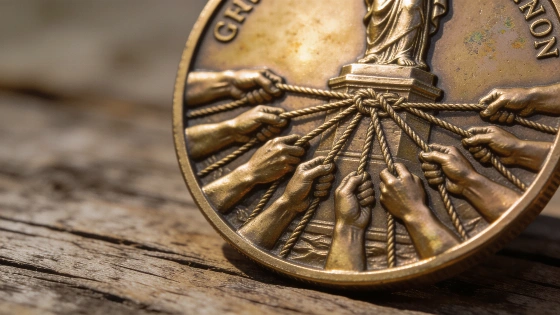
Thirteen hands, each gripping a rope, pull in unison to bring down a monarch. This is not a scene from a revolution, but the reverse of the Medal Collectors of America's (MCA) 2026 bronze medal-an object that transforms a pivotal act of defiance into tangible currency history. The medal, released for the United States' semiquincentennial, does not simply mark a date. It crystallizes the moment when the colonies, united against royal authority, toppled the statue of King George III in Manhattan's Bowling Green Park on July 9, 1776.
For collectors, the MCA's decision to mint only 76 pieces at $250 each is a calculated nod to the year of independence, but also a reminder of scarcity and exclusivity in the world of commemorative currency. MCA members have priority access, while nonmembers must contact the organization directly-a structure that echoes the closed circles of early American society, where access to power and symbols was tightly controlled.
From Royal Tribute to Revolutionary Symbol
The original statue, commissioned by the General Assembly of the Colony of New York in 1770 and crafted by British sculptor Joseph Wilton, was intended as a gesture of gratitude to King George III for repealing the Stamp Act. Yet, within six years, the same monument became a target for colonial anger. After George Washington read the Declaration of Independence to a crowd near Bowling Green, the statue was torn down by a mob. Its lead was melted and recast as musket balls-turning royal iconography into ammunition for the revolution.
Heidi Wastweet, the medal's designer, channels this transformation on the reverse: the 13 hands represent the original colonies, and the inscription UNITED AGAINST TYRANNY • 1776 • 2026 draws a direct line from the act of rebellion to the present. The obverse features Liberty herself, hair unbound and windblown, with a Phrygian cap-an ancient symbol of freedom-behind her shoulder. The Latin phrase LIBERTAS AMERICANA crowns the design, while the organization's name is discreetly placed in the lower corner.
Commemorative Medals and the Politics of Memory
Commemorative medals have long served as more than collectibles; they are instruments of political memory and identity. The MCA's 2026 issue arrives as the United States prepares for its 250th anniversary, a moment when questions of national unity and historical narrative are again in sharp focus. The choice to immortalize the destruction of a royal statue-rather than a more sanitized symbol-signals a willingness to confront the country's origins in conflict and dissent.
In the context of recent commemorative releases, such as the U.S. Mint's Freedom 250 Race Medal reported earlier, the MCA's approach stands out for its historical specificity and refusal to gloss over the violence and urgency of 1776. Where other medals may celebrate unity through sport or spectacle, this piece foregrounds the act of collective resistance that defined the American Revolution.
Scarcity, Value, and Collector Demand
With only 76 medals available to MCA members and a separate channel for nonmembers, the 2026 issue is positioned as both a historical artifact and a high-demand collectible. The price point and limited mintage are likely to drive secondary market interest, especially as the semiquincentennial approaches and public attention turns to symbols of American independence. For context, previous high-profile commemorative issues have seen rapid sellouts and significant aftermarket premiums, particularly when tied to major anniversaries or events.
According to data from the MCA and comparable organizations, limited-edition medals marking major historical milestones often appreciate in value, with resale prices sometimes doubling or tripling within a year of release. However, actual returns depend on factors such as design quality, historical resonance, and the credibility of the issuing body. The 2026 medal's explicit link to a foundational act of rebellion may give it an edge among collectors seeking pieces with both artistic and narrative weight.
Commemorative medals occupy a unique space in the world of currency and numismatics. Unlike circulating coins, they are not legal tender, but their value is shaped by scarcity, craftsmanship, and the stories they embody. The destruction of the King George III statue in 1776 was not just an act of vandalism-it was a calculated political gesture that transformed a symbol of monarchy into a tool of revolution. By choosing this moment as the centerpiece of its 2026 medal, the MCA challenges collectors to engage with the complexities of American history, rather than settle for comfortable myths. In a market saturated with generic commemoratives, this medal's unapologetic focus on unity through resistance sets a new standard for what currency artifacts can represent.
Commemorative medals differ fundamentally from circulating coins in both purpose and legal status. While coins are issued by governments for everyday transactions and carry a face value, medals are typically produced by private organizations or mints to mark specific events, anniversaries, or achievements. They are not intended for use as money, but rather as objects of art, memory, or investment. The value of a medal is determined by factors such as mintage, design, historical significance, and demand among collectors. In the United States, the tradition of issuing medals to commemorate major historical events dates back to the 18th century, with each new release offering a lens through which to view the evolving narrative of national identity.