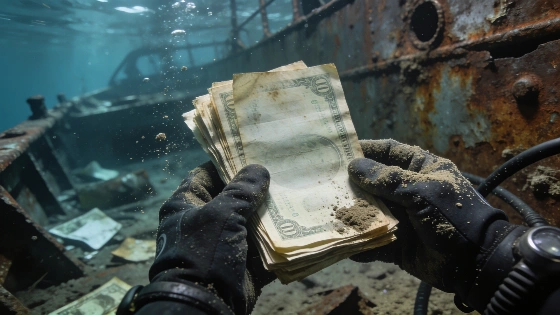
Long-lost Indian rupee banknotes and currency paper have been recovered from four twentieth-century British shipwrecks, revealing how fragile monetary cargoes survived war, sabotage, and decades underwater
When divers pried open a long-sealed cargo hold of the SS Breda in 1992, they did not find gold bars or silver coins. Instead, they surfaced with stacks of blank, watermarked paper-destined to become Indian rupee banknotes, preserved against all odds after half a century on the seabed. This was not an isolated discovery. Over the last century, four British ships lost en route to India have yielded a different kind of treasure: currency paper and banknotes, some unsigned, some already bearing the image of King George V, all testifying to the global reach and vulnerability of monetary logistics in wartime.
Unlike the well-publicized gold and silver hauls from shipwrecks, these finds reveal the hidden risks and operational details of moving currency across oceans. Each shipwreck tells a story of interrupted supply chains, emergency procedures, and the surprising resilience of paper money under extreme conditions.
Currency Lost and Found
The SS Camberwell, sunk by a German mine in the English Channel in May 1917, was carrying 10-rupee notes manufactured by Portals Ltd. for British India. These notes, unsigned for security reasons, were meant to be completed in India before entering circulation. Only fragments survived the sinking, but even these partial notes have become prized numismatic artifacts.
One year later, the SS Shirala was torpedoed off Sussex while transporting a mixed cargo that included both unsigned 5- and 10-rupee notes and a rare shipment of pre-signed 1-rupee notes. Some of these notes floated ashore and were destroyed by authorities, but a handful escaped official destruction and remain in private collections. The 1-rupee notes, already signed and dated 1917, are unique among shipwreck recoveries for having completed the full authorization process before disaster struck.
The SS Egypt, lost in 1922 after colliding with the French ship Seine, was carrying not only precious metals but also Hyderabad rupee notes printed in London by Waterlow and Sons. These notes, in denominations of 5, 10, and 100 rupees, were unsigned and intended for overprinting in Hyderabad before circulation. Some were recovered by specialized salvage expeditions a decade later, adding another layer to the complex history of Indian currency production and distribution.
Paper Survives Where Metal Fails
The SS Breda's story stands out for the sheer improbability of its cargo's survival. Damaged by a Nazi air raid in December 1940 and sunk off the Scottish coast, the Breda was carrying at least 30 boxes of uncut, watermarked paper sheets for 5- and 10-rupee notes. Manufactured by Portals Ltd. for the Bank of England, these sheets were intended for printing at the Nashik press in India. When divers finally accessed the cargo room in 1992, they found the wooden boxes long decayed but the paper itself remarkably intact, with only minor edge damage and creasing. The sheets bore the watermark of King George III and the legend "RESERVE BANK OF INDIA," a testament to both the durability of specialized currency paper and the logistical complexity of wartime supply routes.
These discoveries are not just curiosities for collectors. They highlight the operational risks faced by colonial monetary authorities and the lengths to which they went to secure the integrity of currency shipments. The fact that unsigned notes and blank paper were routinely shipped separately from signatures and overprints reflects a deliberate strategy to minimize losses from piracy, sabotage, or wartime interception.
Numbers and Historical Context
Between 1917 and 1940, at least four British ships carrying Indian currency or currency paper were lost at sea: the SS Camberwell (1917), SS Shirala (1918), SS Egypt (1922), and SS Breda (1940). The SS Egypt alone was transporting gold and silver valued at around one million pounds, alongside Hyderabad rupee notes. The SS Breda's cargo included at least 30 boxes of uncut sheets for 5- and 10-rupee notes, manufactured to strict specifications for watermarking and security. Surviving notes from these wrecks are now rare, with most unsigned notes destroyed by authorities and only a handful of signed 1-rupee notes from the SS Shirala known to exist in private hands.
For collectors and historians, these shipwreck recoveries offer a tangible link to the operational realities of currency production and distribution in the early twentieth century. The survival of paper currency-often considered fragile and perishable-contrasts with the fate of many metal coins, which can corrode or become unrecoverable in deep-sea environments. The technical details of watermarking, signature separation, and overprinting reveal a sophisticated approach to risk management that extended far beyond the mint or print shop.
Why Shipwreck Banknotes Matter
While the romance of lost treasure often centers on gold and silver, the recovery of Indian rupee notes and currency paper from shipwrecks exposes a different kind of value: the logistical, technological, and institutional systems that underpin modern money. These finds are not just relics-they are evidence of how currency systems adapt to crisis, how authorities balance security with practicality, and how even the most mundane objects can become historical witnesses when disaster intervenes. The story of these shipwreck banknotes stands alongside other numismatic mysteries, such as the rare 1861-O half dollar reported earlier, in showing how currency history is shaped as much by accident and contingency as by official policy.
Watermarked currency paper is engineered for both durability and security. The watermark-a faint design embedded in the paper during manufacture-serves as a key anti-counterfeiting feature and is visible when the note is held up to light. In the early twentieth century, British suppliers such as Portals Ltd. specialized in producing these sheets to the exacting standards required by the Bank of England and the Reserve Bank of India. By shipping unsigned or unprinted sheets separately from the signatures or overprints, authorities reduced the risk that intercepted cargo could be used for fraud or unauthorized circulation. This separation of production stages remains a core principle in modern banknote logistics, reflecting lessons learned from both successful and failed shipments in the past.